
In 1178 the first king of Portugal built a magnificent Gothic church in the city of Alcobaça (ahl koh BAH sah) to commemorate his victory over the Moors.
The church evolved into a monastery, now home to the tombs of King Pedro I and his murdered mistress Inês, and to a tale of young love gone gruesomely creepy.
Here’s the story: In 1340, Pedro’s father, King Afonso IV, arranged a politically strategic marriage for his son. Pedro instead fell in love with his new wife’s lady-in-waiting, Inês de Castro.
Pedro’s father did not approve of the prince’s affair and exiled Inês. A few years later, Pedro’s wife died. Upon hearing the news, Inês returned to Portugal, moved in with Pedro, and bore him four children.
Afonso thought Inês’s influence presented too much of a threat to Pedro’s legitimate son and heir to the throne. In 1355, the king had Inês murdered.
A grief-stricken Pedro sought revenge against his father and sparked a civil war within Portugal. Upon Afonso’s death in 1357, Pedro became king. Then things got weird—Pedro installed dead Inês as his queen.
Corpse bride

In 1360, Pedro had his beloved’s decaying body exhumed, crowned, and propped up on a throne.
He required visiting nobility to kiss the hem of her royal robe, as a sign of allegiance.
He tracked down her killers, cut out their hearts, and, according to legend, ate them (the hearts, that is), Hannibal Lecter-style.
At the monastery, Pedro and Inês’s ornate tombs face each other, so that on Judgment Day they will see each other first upon rising.

A few years ago when visiting Portugal, I explored Lisbon, Sintra, and the Algarve. (To read about those experiences, please see: Lisbon: Discovering the discoverers, Eccentric Sintra, and Laundry at the edge of the world.)
I wanted to see more of the country’s fishing villages, terraced vineyards, and beaches, all bound within a region the size of Indiana.
Recently I did just that. To more easily navigate the language and logistics, I joined a tour that began in Lisbon, headed north, and ended in Porto.
Severance
The region of the world that now includes Portugal and Spain was invaded in the 700s by Muslims from North Africa, known as Moors.
To reclaim the territory, Christian kingdoms conducted a war that dragged on for centuries. In Portugal, King Afonso I led the fight, retaking Lisbon in 1147 after four hundred years of Moorish rule. He became the first king of Portugal.
Afonso’s royal court included a young nobleman named Geraldo, who often caused problems for Afonso. Finally, to avoid punishment, Geraldo fled to the countryside.
While on the run, he recruited an army of commandos and began ransacking Moorish villages. (He knew Afonso would not mind.) His blitzkrieg tactics, such as attacking at night or in poor weather, were consistently successful.
On a night in 1166, Geraldo scaled the walls of the Moorish city of Évora (EH voh rah). He located the night watchman and his daughter and, presumably to keep them quiet, removed their heads with his sword. With the sentries thus silenced, he stole the keys, unlocked the gates, and allowed his army of guerrillas to overrun the city. Évora was captured.
The conquest restored Geraldo’s reputation in the eyes of the king. Afonso pardoned him for his crimes and appointed him governor of Évora.
The gruesome beheadings of the two Moors are celebrated in Portugal’s epic poem, The Lusiads, published in 1572:
Watch this one, shinning down his lance(Luís Vaz de Camões)
Back to the ambush, with the heads
Of the two watchmen, and so captures
Évora with subterfuge and daring;
That city has taken for its armorial
That warrior with the two heads
Cold in his hand (unique and chilling sight!):
Gerald the Fearless is that fearful knight.
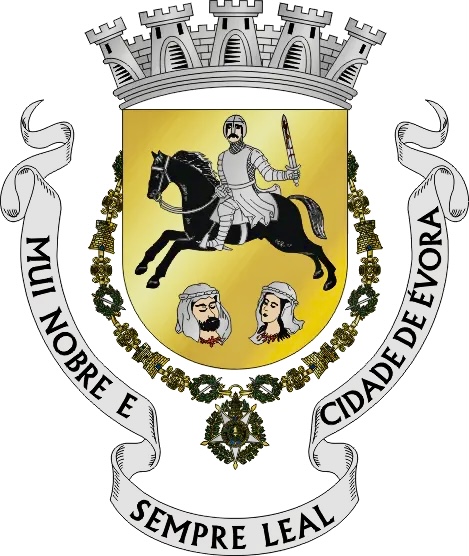
Évora’s city crest is an image of Geraldo and two bloody Moorish heads. Local monuments, statues, and lampposts feature him proudly holding the grisly trophies aloft.

Despite Reconquista, the influence of the Moors is still evident in Évora’s narrow streets, whitewashed houses, arched alleyways, wrought-iron balconies, and ceramic tiles.
The city is much older than the Moors, though. The Romans conquered it in 57 BCE. They left behind remnants of city walls, an arch, baths, and undoubtedly more, buried beneath the streets of the town. The temple dates from the first century and was likely erected in honor of Augustus Caesar.
Today, Évora is a university town and agricultural center with a population of fifty-five thousand. When I visited, workers were setting up food carts, tables, and chairs in preparation for a festival in Praça do Giraldo, the main square named after Geraldo. The sound system played “Hotel California.”

Bone yard
Évora’s crest is not the only place in town to see severed heads. There’s also the Chapel of Bones—not a Halloween haunted house, but a monument to the dead.
The chapel was built by Franciscan friars in the 1500s to free up space in the town’s overcrowded cemeteries.
The exhumed remains were moved to the chapel, where they were artfully arranged to cover the walls and ceiling. The skulls and bones are from an estimated five thousand corpses.
At the entrance to the chapel is a sign: “We bones that are here await yours.”
Corkers
Imagine planting a crop that cannot be harvested for twenty-five years. And, thereafter, every nine.
Cork farmers must exercise such patience.
We traveled through the rolling hills and plains of the Alentajo (ah len TAY zhoo) region, a landscape used for agriculture and forestry. Villages crouch on distance hills. White stucco farmhouses are trimmed in blue. Supposedly, the color blue discourages insects.
We turned off the highway onto a dirt road. At the edge of a forest, we climbed into a canopied wagon pulled by a tractor, belonging to the Rovisco Garcia farm.
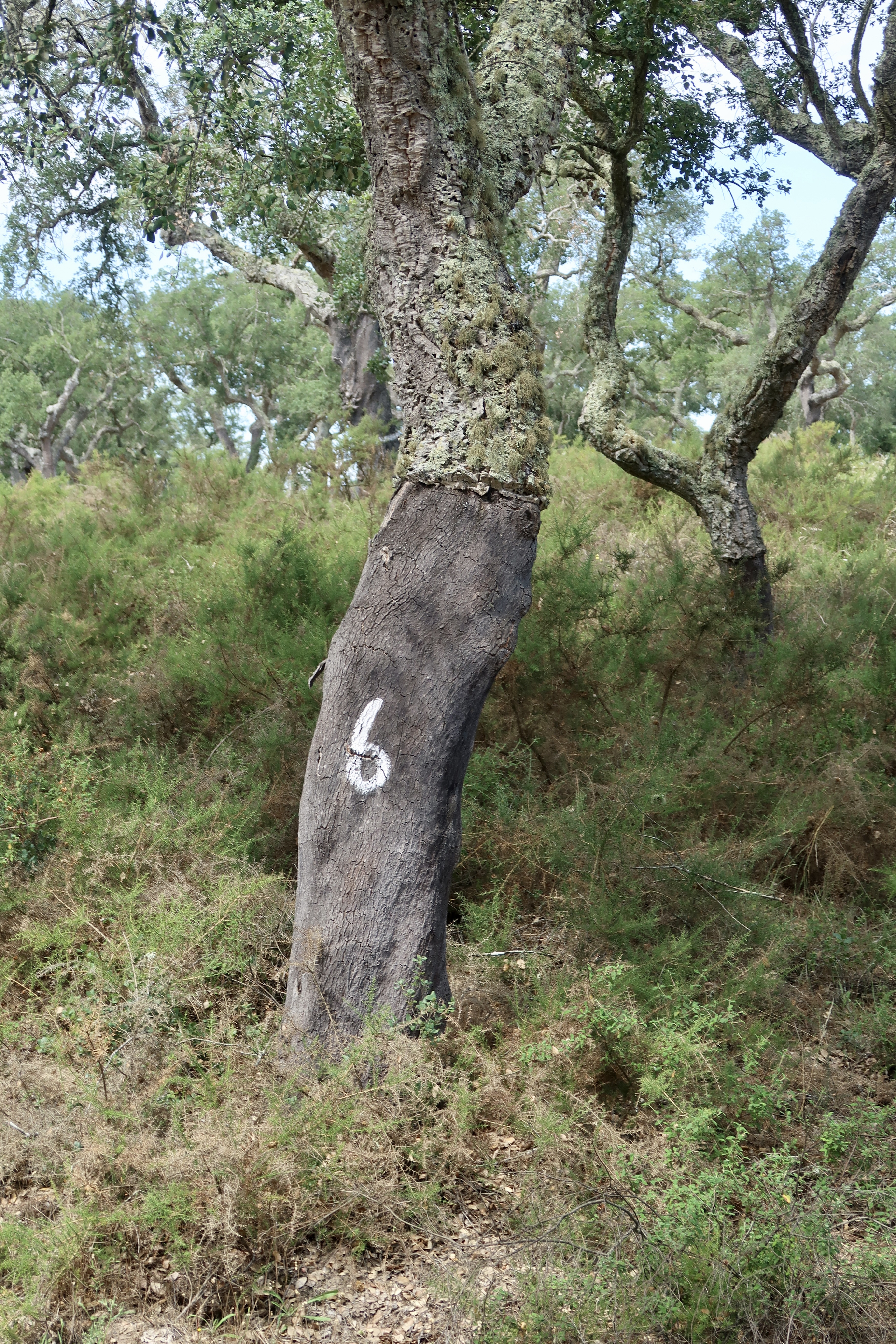
While chugging through the forest, we saw numerous cork-oak trunks stripped of their bark, naked up to their branches. Large single numbers were painted on the wounded boles.
Margarida, one of the farm’s owners, explained that each number represents the year a tree can be harvested again. A tree painted with a 6, for example, can be harvested in 2026.

The bark of the cork oak has been harvested by humans for over five thousand years. Portugal is the leading producer, supplying up to fifty percent of the world’s cork. The versatile material is water-resistant, buoyant, and pliable, and used mostly to make stoppers for wine bottles.
Shops in Portugal sell many other products made of cork, including coasters, mats, post cards, bulletin boards, hats, purses, wallets, shoes—even bikinis. Cork is also used for gaskets and flooring.
Margarida explained that a cork oak is first harvested at the age of twenty-five. Waiting for that moment must be the agricultural equivalent of watching paint dry. Eventually, experienced cork strippers use specialized hand tools to slit the bark and peel it away from the trunk.

The quality of the first harvest is poor. Nine years later the stripped cork is slightly better. Finally, at the age of forty-three, the tree generates soft, smooth cork bark that is useful commercially.
The tree can be harvested a dozen more times over the next one-hundred years. Cork farming is multi-generational. “We have a saying,” Margarida shared. “Vineyards of mine, olive groves of my parents, cork-oak groves of my ancestors.”
Eleven generations of Margarida‘s family have grown and harvested cork. Her 103-year-old and 98-year-old grandparents still live on the farm.
A cork oak from Águas de Moura is one of Portugal’s national monuments. The Whistler Tree is over fifty feet tall and fourteen feet in circumference. The tree is 240 years old and has been harvested over twenty times. In 1991, it produced over one hundred thousand bottle stoppers.
Margarida‘s family farm also grows grapes, olives, pine nuts, and acorns. Beef cows graze beneath the trees. Deer, game birds, and wild boars roam free.
At the house, the farm dog trotted out to meet us on three legs. It had lost the fourth to a wild boar.
Surf city
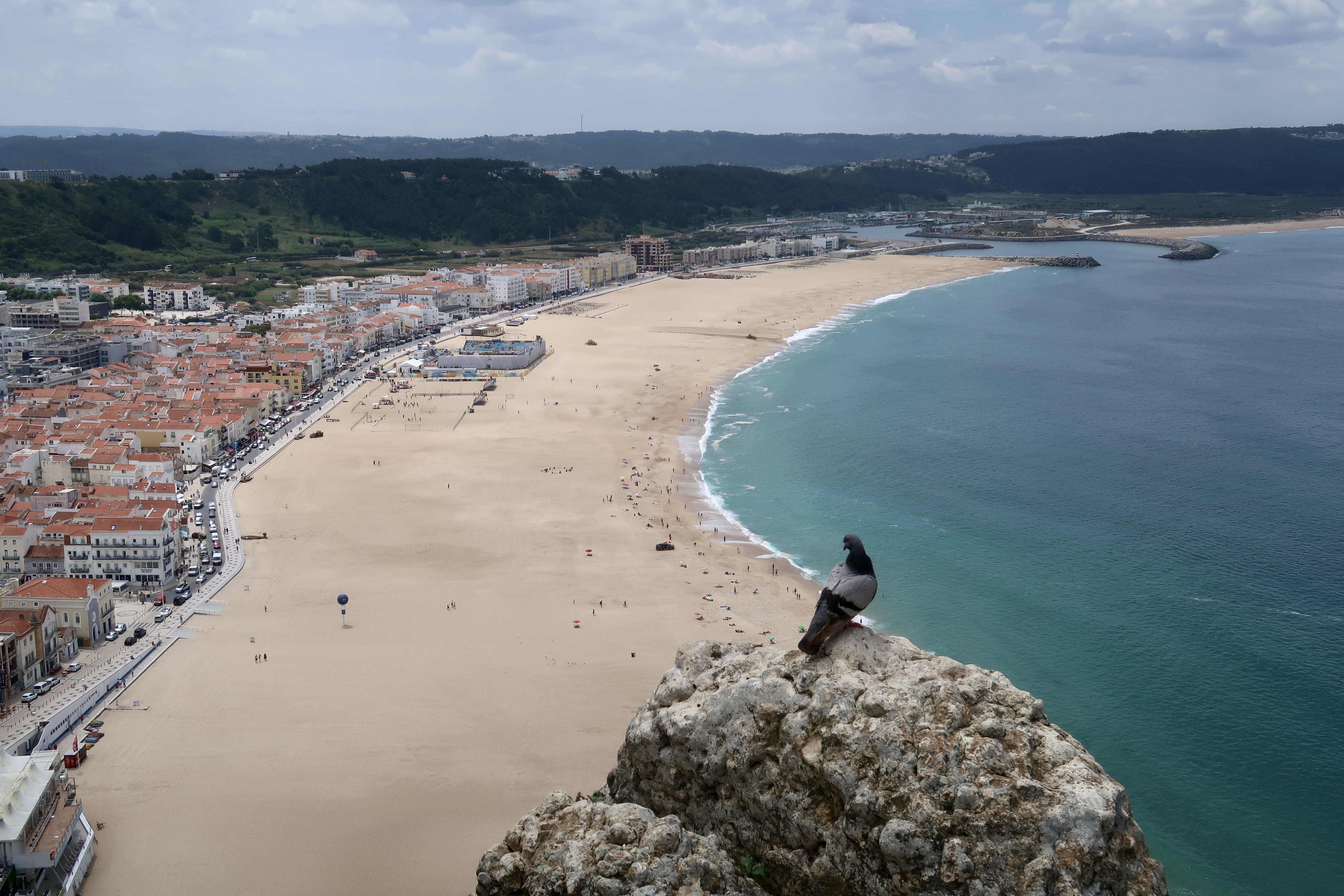
From the cliffs of the tiny village of Sítio (SEE tee oo), the view is expansive. Below is the sleepy town of Nazaré (nah zah RAY) and its broad curving beach. Atlantic Ocean waves pound the shore, while families picnic in the sand.
The visibility was near zero, however, on a morning in 1182, when Dom Fuas Roupinho went hunting. The dom plays a part in one of a couple of interwoven legends, centuries apart.

The first story is about a small wooden statue supposedly sculpted by the carpenter, Joseph of Nazareth, of his wife, Mary, with Jesus.
In the 400s, the statue was rescued from those who destroyed religious icons. A monk removed the statue from Palestine to Spain. After the invasion of the Muslims in the 700s, the statue was smuggled again, this time to the coast of Portugal. There, it was hidden in a grotto in the cliffs overlooking the sea.
Enter Dom Fuas, mayor of a nearby town, on horseback, four hundred years later. Early in the morning, the dom was stalking a white deer on the cliffs near the grotto. Heavy fog from the sea enveloped the crags. In its flight from the hunter, the deer lost its footing and fell over the three-hundred-foot cliff.
Dom Fuas and his horse were inches from going over the edge, when he called to the nearby icon, “Our Lady, help me.” His prayer was answered. He attributed his survival to Mary’s intervention.
In thanks for the seeming miracle, Dom Fuas ordered a small stone chapel built over the grotto. The statue, Our Lady of Nazaré, was placed on the altar and became the namesake of the town below the cliffs.
Due to the high number of pilgrims visiting the site in the 1300s, King Fernando I had a church built nearby. The statue was transferred to the Sanctuary of Our Lady of Nazaré in Sítio.

On the day I visited Nazaré, the monsters were sleeping. Some days, they wake and rage, unleashing the most massive surf on the planet. With waves reaching up to ninety feet in height, sleepy Nazaré is home to several surfing records in Guinness World Records.
The swells reach their peak when waves from different directions converge over a steep canyon beneath the surface. Some call Nazaré’s wave set a “surfboard-breaking machine.”
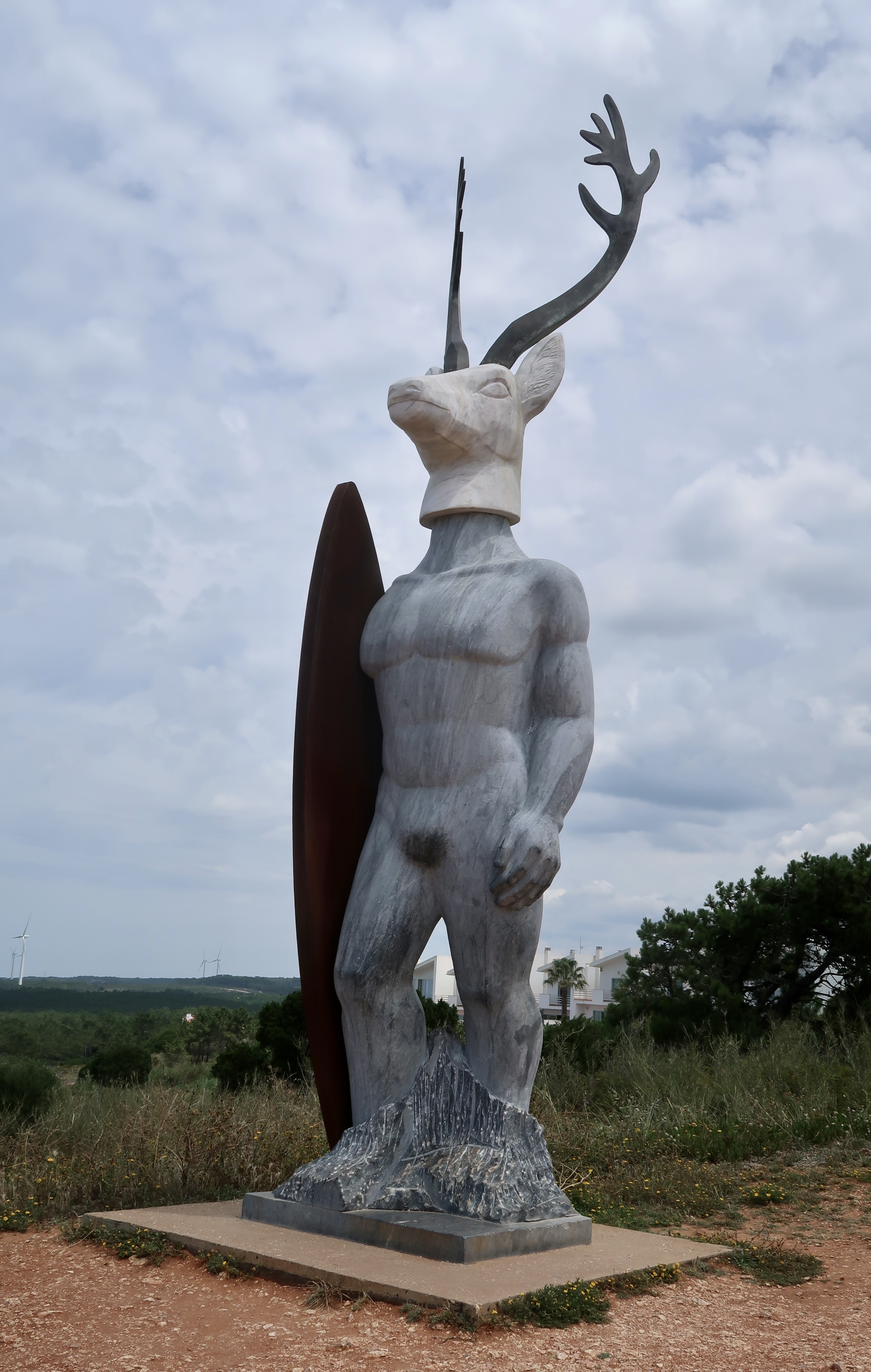
The best spot to watch the action is the lighthouse. Along the path is a surreal art installation—a giant sculpture of a surfer with the antlered head of a white deer, thus merging the legends of the migrating statue, the clumsy deer, and the monstrous surf.

Science and religion
In 1917, three children who were tending sheep near Fátima (FAH tee mah) claimed to have seen Mary, the mother of Jesus. On five different occasions, she spoke to them from a tree and shared predictions of the future.
As news of their story spread, some questioned it, but tens of thousands flocked to the site to see for themselves. Finally, the Vatican gave its stamp of approval to the miracle.
The site of Mary’s appearance has been developed into a huge modern complex. Arranged around the tree are an assembly ground, a church, a basilica, hotels, restaurants, and parking lots for the hundreds of thousands of pilgrims.

A mall of stalls sells religious trinkets, such as candles in the shapes of various ailing body parts, toys, jewelry, and images of Mary.
Some visitors crawl through the grounds to the basilica on their knees.
We continued our tour through rolling hills bristling with wind turbines and arrived at the tiny, colorful hilltop village of Óbidos (OH bee doosh). Celts, Romans, Visigoths, Moors, and now shopkeepers have taken turns living inside its forty-five-foot castle walls.
Two members of our tour worked for NASA during the Apollo missions. One wrote the how-to instructions for reentry. The other wrote the parameters for Apollo 8 to orbit the moon, the first mission to do so. They are rocket scientists. One of them, Paul, wears a t-shirt that says so.

We rolled our bags up a steep cobblestone street to a hotel, dating to the 1300s. It conceded its decor to the Middle Ages. Suits of armor stand in the hallways and the staff wear medieval costumes.
The doors to the rooms are secured by antique locks requiring loose-fitting skeleton keys to be turned twice and a couple of levers to be thrown just so. I struggled to get into my room.
To my right, the rocket scientists were struggling with their lock as well, which gave me solace.
Ruby and tawny
The Alto Douro region is the third oldest protected wine region in the world. The area is mountainous, sculpted by the Douro (DOH roo) River and its tributaries. A hundred square miles of the surrounding hillsides have been terraced, which must have taken as much work as building the Great Wall of China.
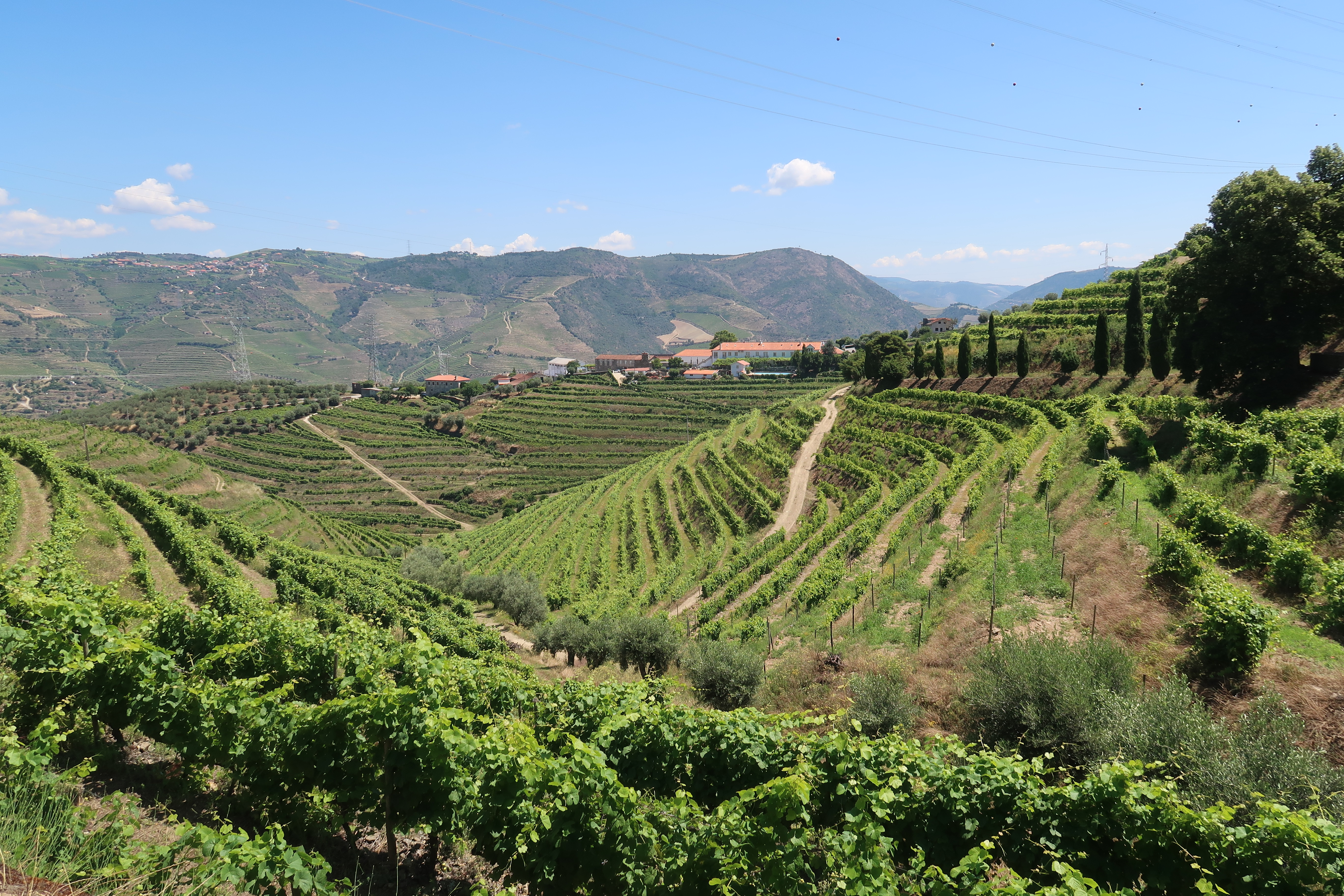
Our bus climbed twisting single-lane roads high into the mountains overlooking the Douro. We passed several quintas—wine estates clinging to the vertical slopes. Olive trees outline fields and dirt roads. Old stone buildings and small white chapels dot the hillsides. The terraces are thick with grapevines.
Port is wine to which additional alcohol, usually brandy distilled from the same grapes, is added. Thus, the wine is fortified. According to the European Union, only wines from the Alto Douro region are allowed to be labeled port. The wine received its name from the seaport city of Porto (POR-too) at the mouth of the Douro, from where much of the product was shipped.

Ruby port ages in concrete, stainless steel, or oak for up to three years. The tawny variety is aged in wooden barrels for much longer. All port wines are blends.
Halfway up a mountain we visited the Quinta de Santa Eufêmia. The current estate was founded by Bernardo Rodrigues de Carvalho. Bernardo bought the property in 1964 from his mother-in-law and then expanded it. He took advantage of the phylloxera plague of the late 1800s, a time when many of the surrounding farmers sold their vineyards.
The quinta is now owned by the fourth generation of Bernardo’s family. One of the owners, Teresa, walked us through a sunny vineyard, as she shared the growing and harvesting processes with us. Back at the winery, we saw huge granite vats where grapes are still trodden by bare feet, so as not to crush the seeds and affect the flavor.
However, the first winemakers in the valley were the Romans, two thousand years ago. Bernardo’s family has found Roman dolia, large earthenware vessels for fermenting wine, and numerous other ancient artifacts on the property.
Sad songs
Twice during the tour, we were treated to fado, a genre of music characterized by melancholy melodies and lyrics. Typically, two classical guitarists accompany a singer. In Lisbon, the singers are usually female; in Coimbra (KWEEM brah), male. In both cities, their voices soared plaintively, yet stoically, as they conveyed their sad fates.
Fado performers were traditionally from the urban working class—sailors, dock workers, and fishwives. The genre appeared during the early 1800s in Lisbon, likely in the Alfama district. Some trace its history to the influence of Moors or Brazilians.
The songs are often about the life of the poor, perhaps a fishwife longing for her husband at sea or a sailor pining for home.
Farewell mother, farewell Maria,(“Fado Português,” José Régio and Alain Oulman)
Keep this well in mind,
That I make this vow:
Either I will take you to the altar,
Or it was God who was served instead.
Give me my rest at sea.
During a love song traditionally sung by a young man to a young woman in a window, we were advised to clear our throats rather than applaud, so as not to wake up the girl’s father.
The performers treat the music with passion and respect. Following the Coimbra performance, we adjourned to an outside courtyard, where the musicians poured port wine for us and touted their CDs.
Bookworms and bats
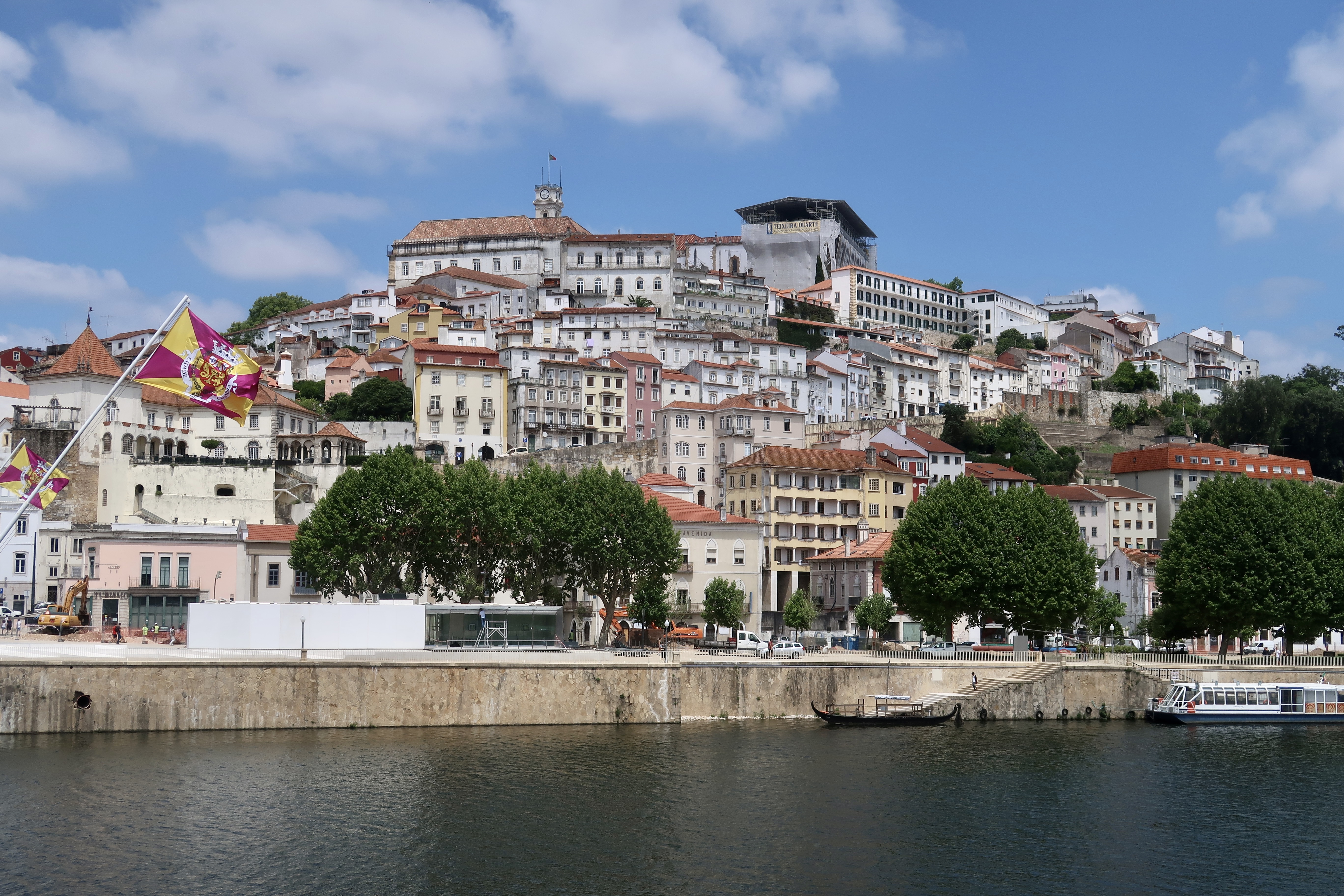
On a hilltop by the Mondego River, the Romans founded the city of Coimbra. The Moors built a fortress on the site in the 900s. In 1131, it became the residence of the first king of Portugal, Afonso I. Now his former home houses the Palace of Schools of the University of Coimbra.
With a population of 150,000, Coimbra’s cultural life revolves around its medieval university. Over the years, the school has attracted many of the brightest of Portugal’s writers, artists, academics, presidents, and prime ministers.
Originally, the university was founded in Lisbon in 1290. After a few relocations, it finally settled in Coimbra in 1537. (The campus bookstore sells ball caps emblazoned with 1290.) Coimbra is among the oldest universities in continuous operation in the world.

Today, the University of Coimbra has twenty-five thousand students. Its core historical buildings, the Palace of Schools, are classified as a UNESCO World Heritage Site.
With local guide Cristina, we toured the former palace. In the courtyard, students in ankle-length black capes posed like superheroes, or maybe vampires, for graduation photos.
In years past, students wore the capes throughout the school year. Now they are reserved for special occasions.
The royal palace has three large spaces: the armory (now used for academic ceremonies), the king’s quarters (now used for taking exams), and the throne room (now used for defending doctoral theses). Its walls are lined with the portraits of most of Portugal’s kings.
Built in the 1700s, the ornate Joanine Library is another highlight of the university. The main floor consists of three halls filled floor to ceiling with venerable books and manuscripts, shelved within richly carved and gilded oak cases.

The Joanine served as a model for the Beast’s library in the 2017 Disney film, Beauty and the Beast.
The library contains nearly sixty thousand books—much of the best of what was printed in Europe between the 1400s and 1700s.
One of our tour members asked Jorge, the librarian on duty, how the books are cataloged. The system is not Dewey’s. It’s simpler—room, case, shelf, and position.
Jorge demonstrated with an example. Book 1294, he said, is in the first room, second case, ninth shelf, and fourth position from the left.
To retrieve it, he ascended a hidden staircase built into the walls and then climbed a rickety wooden ladder. The book he brought down to us, number 1294, was the first printed edition of Dante Alighieri’s Divine Comedy, one of only fourteen known copies in the world.

Most of the books in the Joanine are priceless. That’s where the bats come in.
In addition to humidity, heat, and direct light, insects are an enemy of paper. At the Joanine, bats are the guardians. The library houses a colony of bats as a natural method of pest control.
At the end of the day, librarians cover the tables and chairs with leather tarps and open the windows. At dusk, the bats emerge from their roosts and hunt book-eating insects inside the library before swooping out of the windows. In the morning, the staff clean the floors and tarps of guano.
Outside, in the courtyard, graduating students fluttered their long black capes like wings.
 YearTripper