
Revolution. Castro. Communism. Bay of Pigs. Soviet Union. Khrushchev. Missile Crisis. Cold War. Embargo.

These incendiary buzzwords formed my earliest impressions of the country of Cuba.
They were shared with me during my teen years by civics teachers, politicians, and the media. Communism was evil, I came to understand. So was Cuba’s revolutionary leader, Fidel Castro.
He dared to disengage from the suffocating imperial embrace of the United States and form a bond with the evil Soviet Union. The Soviets were, of course, delighted to gain a foothold in the western hemisphere.
The situation came to a head when the Soviets moved nuclear missiles into Cuba and pointed them at us. Through nerve-racking diplomatic efforts, President Kennedy managed to defuse the threat. Still, the Soviets were now embedded on the island. The U.S. retaliated by imposing a crippling trade embargo.
Thirty years later the Soviet Union dissolved. Sixty years later, the U.S. embargo is still in place.
Popular perceptions notwithstanding, visiting Cuba is neither difficult nor illegal. My former college roommate and longtime friend, Craig, suggested we give it a go.
We took advantage of a license by the U.S. government allowing travel to the island. Authorized reasons range from the humanitarian to the artistic, from the religious to the athletic. The category under which we qualified is called “support for the Cuban people.”
Only later did I understand what that meant.
City of Ruins
The José Martí International Airport looks like a set for a movie taking place in Eastern Europe in the 1960s. Once, it was the Latin American hub for Aeroflot, the Soviet airline.
The interior is stark. A dark, narrow corridor led to a customs officer who closely examined my passport and visa, and then took my photo.
Outside, the heat was oppressive. Cuba was still enduring its dry season when we arrived. The rainy season was late. The weedy landscape between the airport and Havana’s Old Town was sunbaked. Trash was scattered along the berm.
We passed miles of decaying one-story stucco and concrete buildings, their windows and doors brandishing metal bars and grilles like the facades of prisons. Gates, low walls, and fences are graffitied. Kudzu overwhelms the shrubbery. Outdoor advertising signs cheerily promote the benefits of government improvement projects.
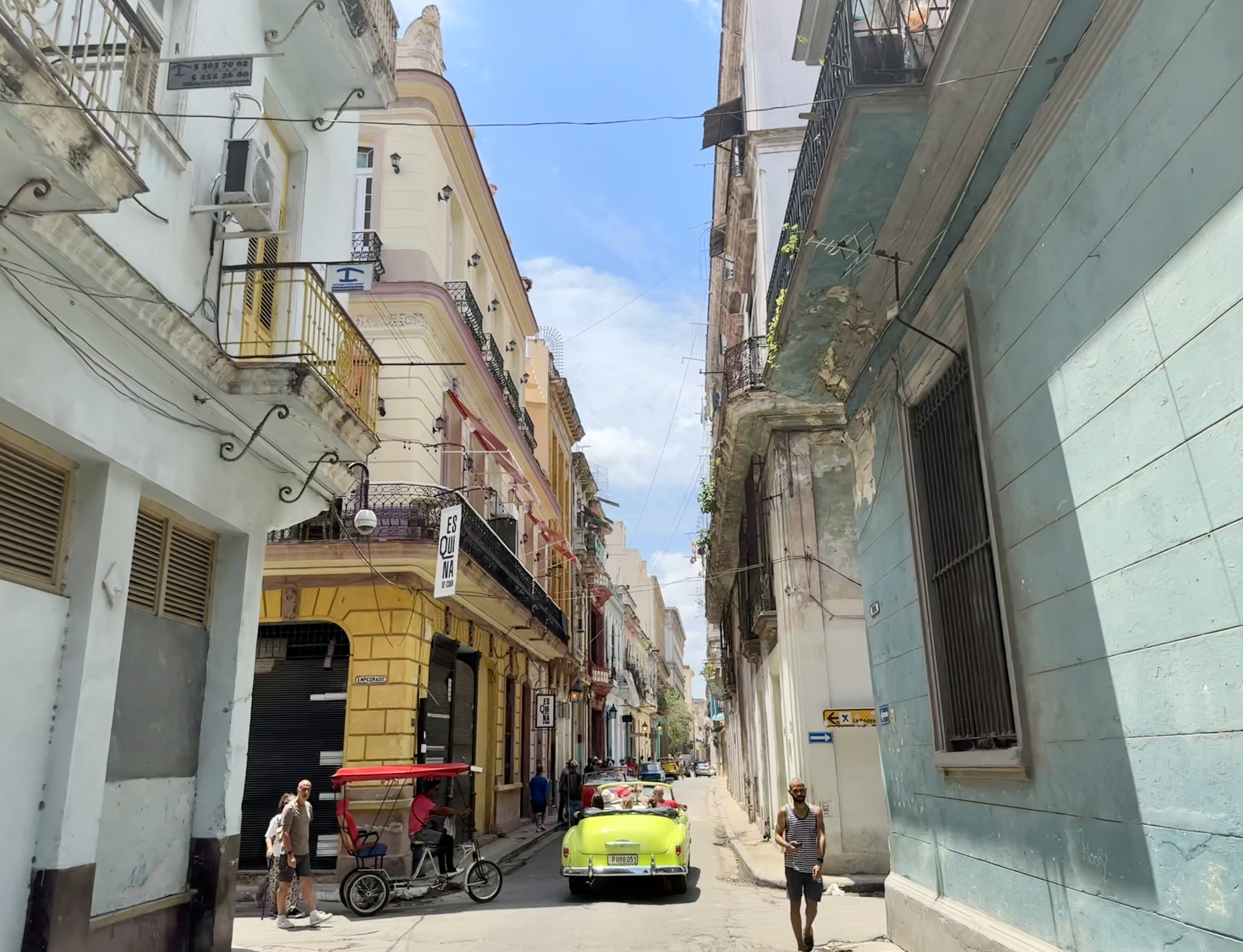
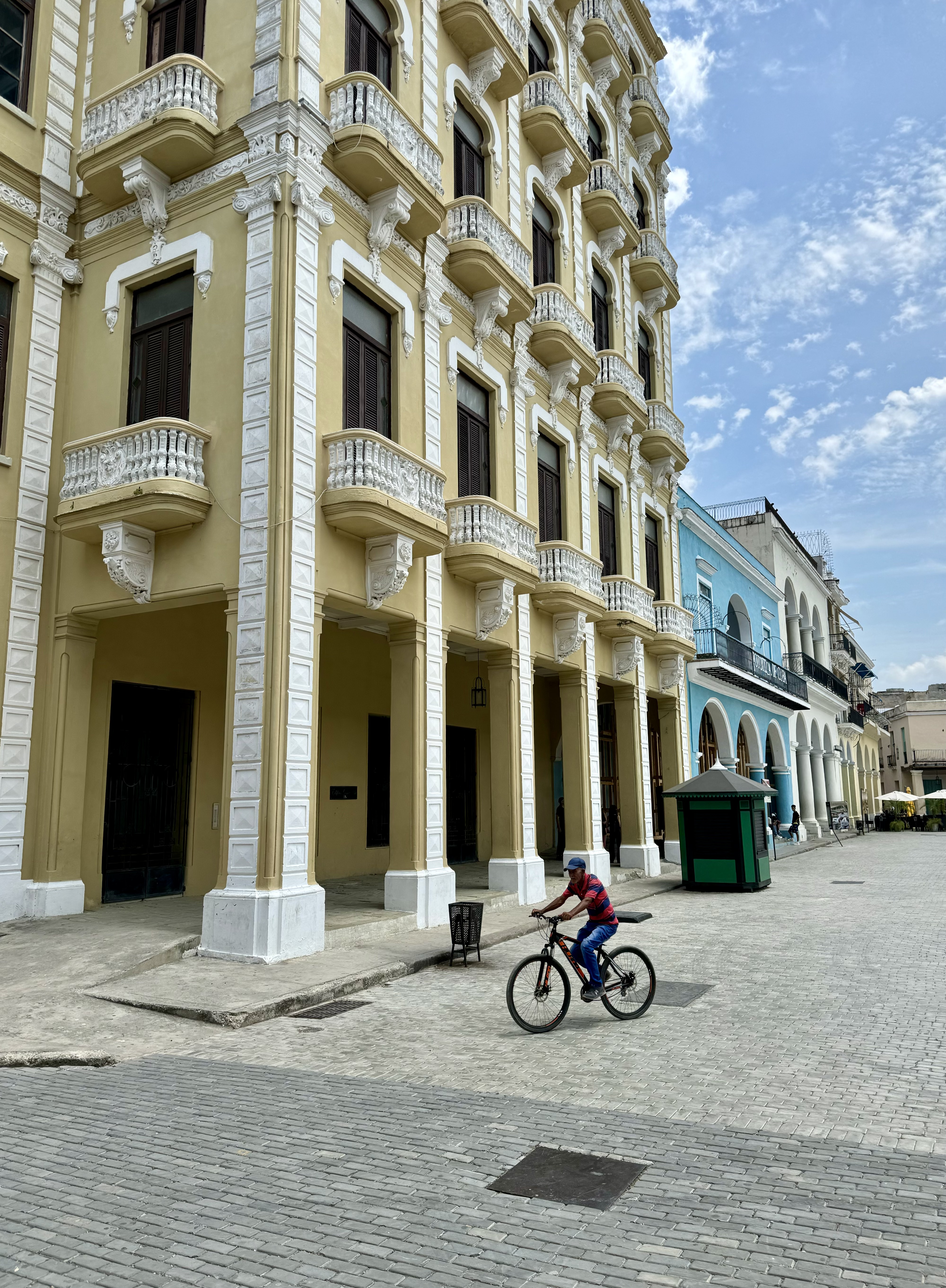
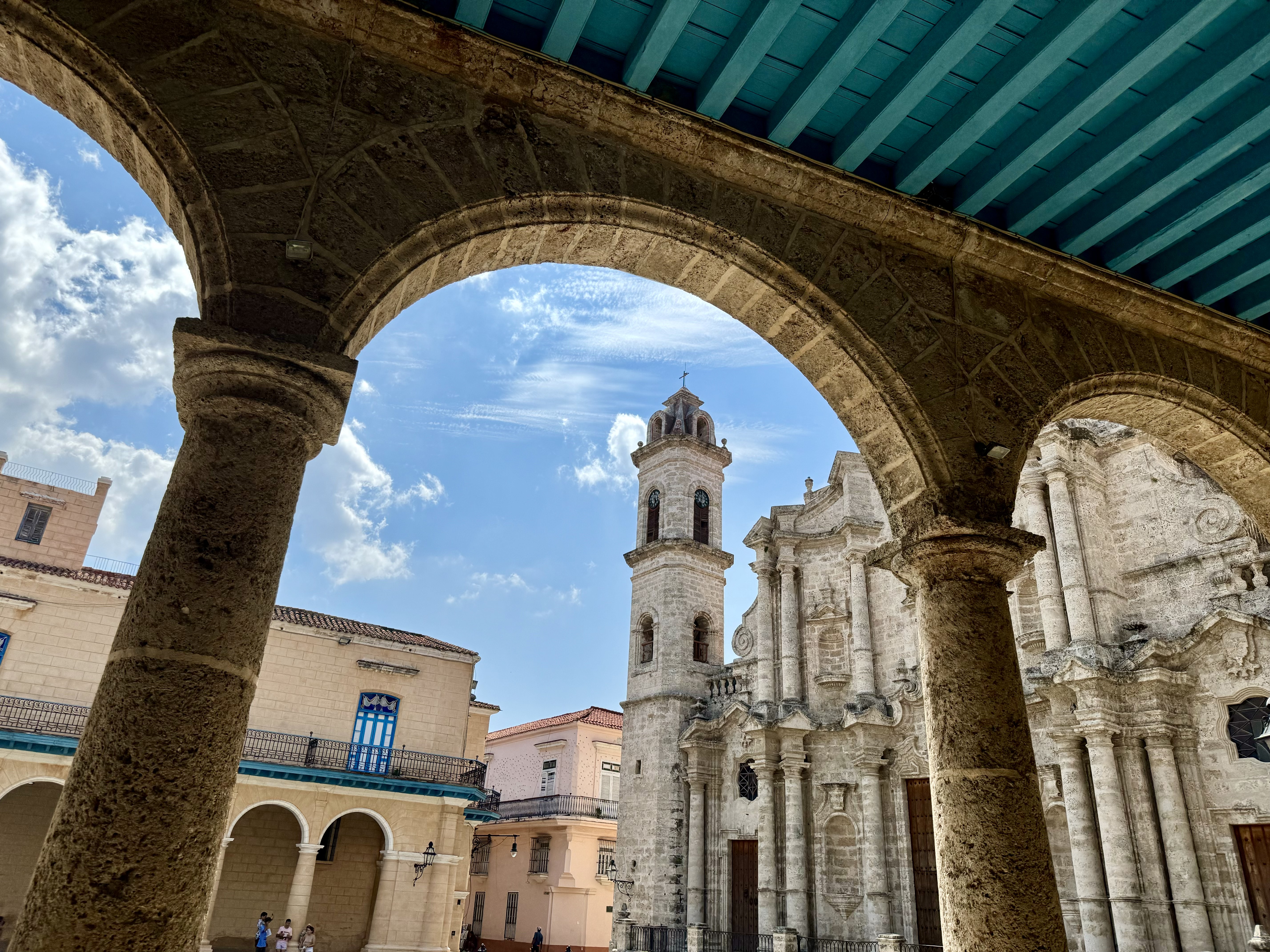
We entered the Old Town. Much of it was built in the 1600s by the Spanish in baroque and neoclassical styles. The architecture is magnificent—but crumbling. Cornices have fallen. Paint is peeling. Some buildings are shells, imploded, open to the sky. Time, neglect, pollution, and hurricanes have taken their toll.
The steamy, trashy streets are narrow, most of them one-way. For several minutes, our taxi was trapped in traffic behind a garbage truck.
Finally, we arrived at our guesthouse or casa particular. Casa particulares are spaces within private homes that locals rent to travelers, much like Airbnbs. Staying in a guesthouse supports a small, independent business, which in many cases, may be the host’s main source of income. One night’s rent at a guesthouse equals the average income of a Cuban for one month.

After checking in, Craig and I strolled down Obispo Street past El Floridita and Sloppy Joe’s to Castillo de San Salvador de la Punta. We stopped at the Malecón, Havana’s five-mile long seawall. The rocky beach is strewn with trash.
We were constantly approached by touts who wanted to reserve our dinners, take us on tours, sell us Cuban cigars, introduce us to sex workers, or change our U.S. dollars into pesos.
Another World
At 6 p.m. we met our tour group. There were ten of us, Americans all. Our leader is Rainer, a Cuban. He began, “Cuba is not another country. Cuba is another world.”
A third world actually.
Rainer outlined our limitations. Travelers to Cuba cannot safely drink the tap water. Credit and debit cards issued by U.S. banks are not accepted. Due to the high cost of roaming, mobile-phone service is prohibitive. Internet access is spotty at best. Some websites and apps are blocked by the Cuban government.
Oh, and there are rolling electrical blackouts for several hours. Every single day.
We walked to a nearby restaurant for dinner—a salad of thin-sliced white cabbage, cucumber, and tomato; root-vegetable soup; fried plantains; beans and rice; stewed pork, and flan for dessert. Rum drinks were included with the meal. We would see this menu many more times.
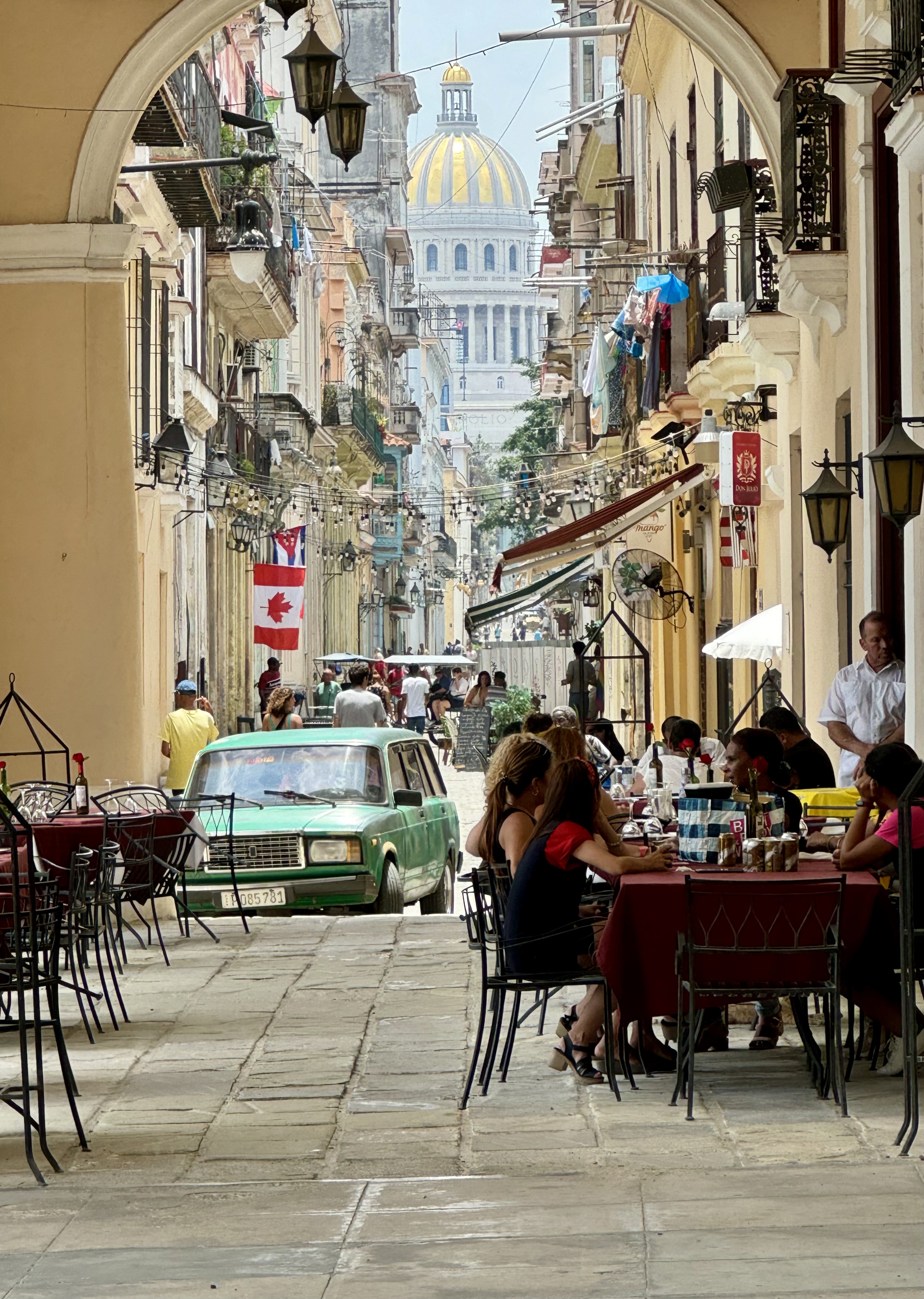
On the way back we picked our course through dark, potholed, littered streets. The blackout was in force. The residents sat behind grilles in their open doorways, fanning themselves, drinking, and chatting by candlelight. Some operated mini-convenience stores out of their windows. The men were shirtless and glistening with sweat in the heat.
Cults and classics
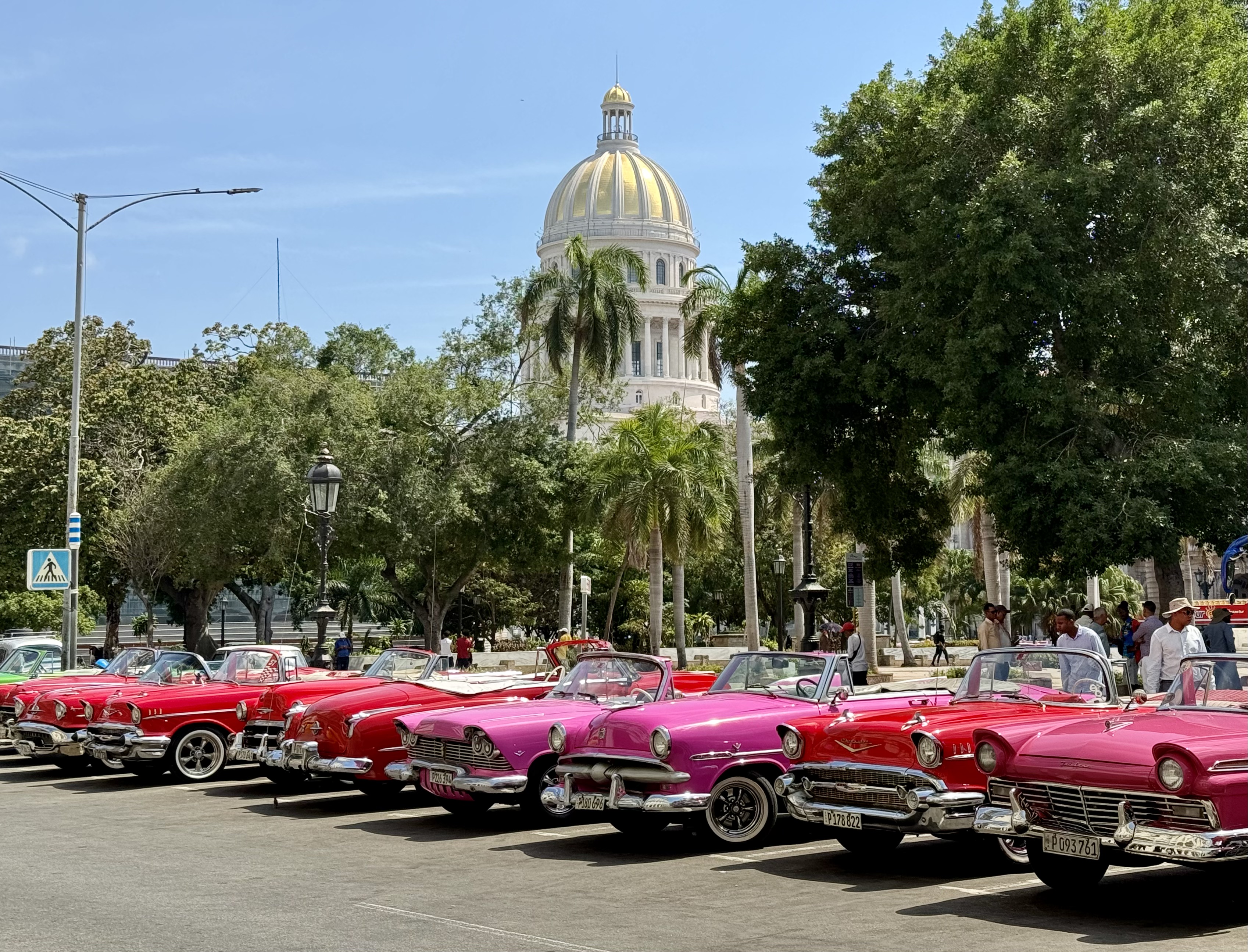
In the morning, we boarded a caravan of candy-colored classic American cars from the forties and fifties.
Fidel Castro banned the importing of American cars after the U.S. imposed its embargo in 1960.
The pre-embargo cars, approximately sixty thousand of them, compose a mobile museum. There are Chevrolets, Fords, Pontiacs, Buicks, Dodges, Plymouths, and Studebakers all over the island.
The autos are highly valued and carefully maintained. Cuban mechanics ingeniously keep them running by machining patches and substituting parts, including Russian diesel engines.
The going rate for tourists to ride in a classic car is around thirty dollars an hour—about the same as a Cuban doctor or lawyer makes in a month. (In Cuba, doctors and lawyers are government employees.)
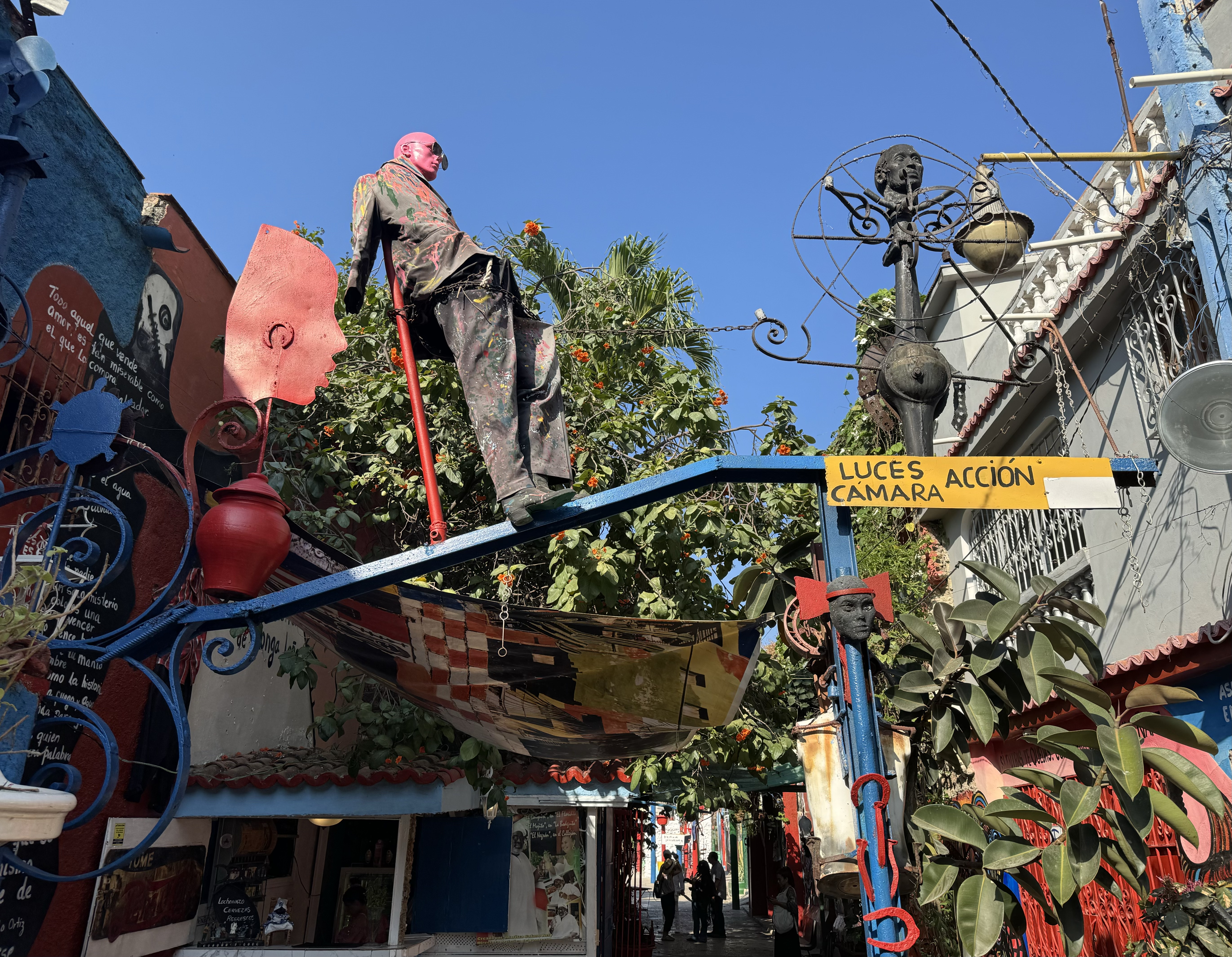
After a joy ride through the Old Town, we arrived at Callejón de Hamel.
The narrow alley is filled with colorful murals and whimsical sculptures made from discarded bathtubs and other everyday objects by folk artist Salvador Gonzáles Escalona. His work mixes surrealism and cubism.
Salvador began decorating the alley outside his apartment in 1990, eventually transforming the area from a slum to a center for Afro-Cuban culture.

The center also hosts practitioners of Santeria, a religion blending traditional West African beliefs with Roman Catholicism. Santeria was developed by slaves between the 1500s and 1800s who were trying to cling to their spiritual beliefs while being forced into Christianity. Catholic saints and rituals merged with African gods and rites.
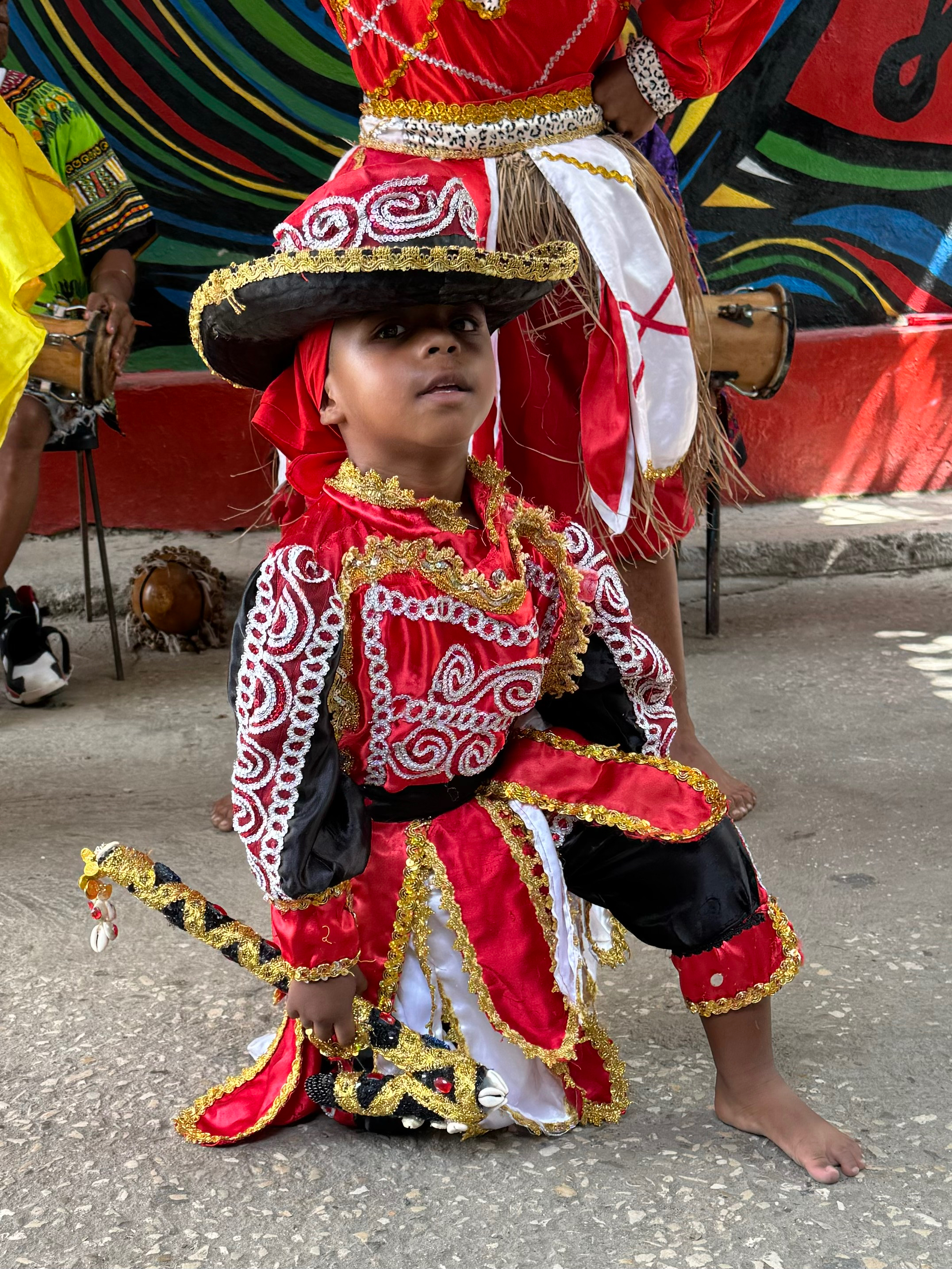
In the home of Salvador’s widow, we were served Negronis, drinks made with rum, honey, lime, and mint. In the alley we watched a rumba performance, during which flamboyantly costumed performers drummed and danced for tourists.
Our vintage caravan stopped at Revolution Plaza, where huge political and religious gatherings have been held. Castro spoke several times in the square to hundreds of thousands. Popes John Paul II in 1998 and Francis in 2015 held massive religious rallies.
Opposite the square are building facades featuring images of rebels Che Guevara and Camilo Cienfuegos. Many believe the Castro brothers were behind the untimely death of the perhaps-too-popular Cienfuegos.

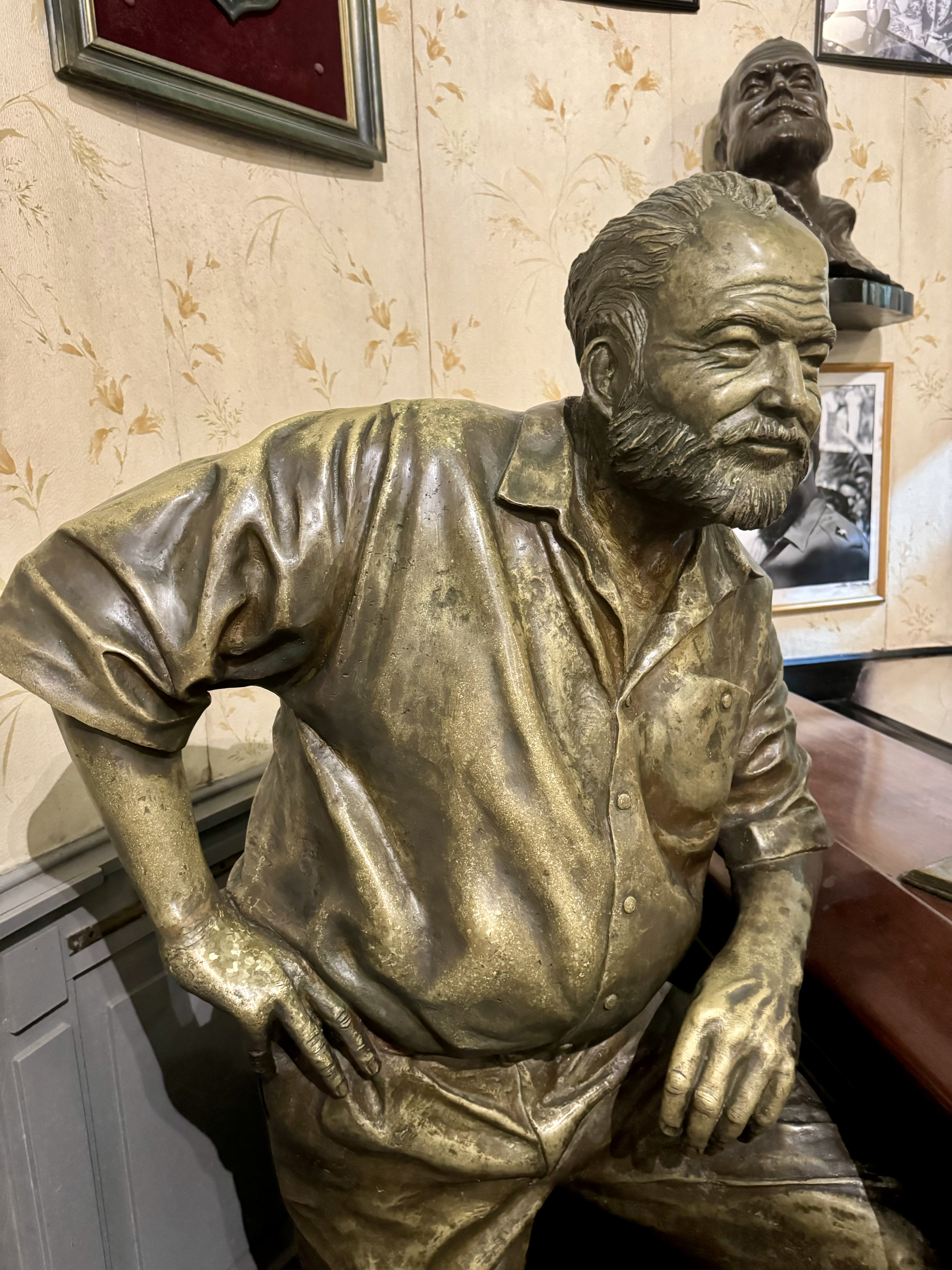
After dinner, we visited El Floridita, one of the favorite hangouts of Ernest Hemingway. The author enjoyed his lifestyle in Cuba, residing in a house outside of Havana between 1940 and 1960. He entertained celebrity guests in his home, in his favorite bars, and on his fishing boat.
In Cuba, Hemingway wrote what would become his most famous work, The Old Man and the Sea. Published in 1952, it won both Pulitzer and Nobel prizes. El Floridita is home to the author’s favorite daiquiris. A bronze statue of Papa stands poised for selfies at the end of the bar.
On the left
Before checking out of the guesthouse, I secured some pesos from the owner. The exchange rate was twenty-five pesos per dollar. Cubans like exchanging pesos for dollars and euros, as the peso is declining in value and can’t be spent outside of Cuba.
Throughout the tour we saw queues at banks and ATMS. Money withdrawals in Cuba are rationed by the government, due to the shortage of cash.
Because three-fourths of the country’s labor force are employed by the government and the government runs the banks, most Cubans have no recourse but to visit the banks frequently, stand in line, and cash their paychecks in small increments over several days.
As a result, Cubans don’t have access to all of their funds when buying groceries and other necessities.
Due to their distrust of banks, most Cubans don’t maintain deposits. They don’t bank online or transfer funds electronically. Instead, they hoard money in their homes. It has been estimated that seventy percent of the populace’s net worth is tucked away in mattresses.
According to a 2023 report by the Cuban Observatory of Human Rights, nearly nine out of ten Cubans live in extreme poverty. Typical monthly wages, stated in equivalent U.S. dollars, range between fifteen and thirty dollars.
The country is going through one of its worst economic crises in decades, caused by tough U.S. sanctions, the loss of subsidies from the Soviet Union, the affects of COVID-19, chronic government corruption, and soaring inflation.
Shortages in goods have given rise to a parallel market. Locals quietly buy from and sell to each other directly, using cash. The term black market refers to illegal drugs or stolen goods. In Cuba, it’s not the goods that are illegal, it’s the transaction process. Yet, out of necessity, everyone participates.
Cubans call it “buying on the left.”
Tiles and terraces
We headed west to Fusterlandia, a whimsical project of artist José Rodríguez Fuster. Over a ten-year period, Fuster decorated the surfaces of the poor fishing community of Jaimanitas with colorful mosaics.
Using the village as his canvas, Fuster bedecked eighty houses, as well as walls, fountains, benches, and a pool, with tiles. The village has evolved into an artists’ colony.
Fuster’s heroes are Picasso, Goudí, and, by the looks of his designs, Dr. Seuss.

One expansive mural portrays Granma—the boat that transported eighty-two Cuban revolutionaries from Mexico to Cuba in 1956. Included in the design are the likenesses of Fidel Castro, Che Guevara, and Camilo Cienfuegos.
We continued to Las Terrazas, a UNESCO biosphere reserve. The mountainous area had once been logged clean by Spaniards to produce charcoal and grow coffee. In 1968 Castro supported its reforestation.
The former loggers and charcoal workers were taught forestry and farming.
Six million cedar, mahogany, hibiscus, grapefruit, mandarin, papaya, and avocado trees were planted on terraces, hence the park’s name. The reserve features lakes, rivers, and waterfalls and is abundant with wildlife.

Inside the park, we visited the drying terraces and former slave quarters of a ruined coffee farm, Cafetal Buenavista. The park contains the remnants of several other plantations founded by French owners who left Haiti after the 1791 slave revolt. The population of Las Terrazas is one thousand.
We visited the artist Lester Campa in his home-studio on Lake San Juan. A blackout was in effect, so Campa showed us his paintings by flashlight.
One painting, an enormous black-and-white portrait, merges the iconic profile of Che Guevara with the face of John Lennon. Two rebels in one. Campa says the painting is his tribute to the generations of Cubans who were not allowed by the government to listen to decadent rock and roll on the radio.

Under water
On the way out of Havana, Alan, our bus driver, stopped at a shop that fills containers with drinking water. A long queue waited outside the door, as at a village well or desert watering hole.
In Cuba, clean water is rationed. Water mains to neighborhoods are controlled.
Some towns in Cuba have running water only once every five days, and only for a few hours at a time. Residents use these hours to fill their home storage tanks.
In remote areas, government tanker trucks make the rounds. However, as their schedules are unreliable, some residents pay illegal vendors to transport water by horse cart from houses that have water to houses that do not.

Cuba’s water-supply infrastructure is inadequate, aging, and falling apart. More than half of the available water is lost through leakage. Additionally, the country is experiencing one of its worst droughts in a hundred years, perhaps exacerbated by climate change.
Finding drinking water is another of many factors complicating daily life in Cuba. Rainer and Alan filled several five-liter bottles to keep us hydrated during the tour.
Every day is like this
Cuba is the largest country in the Caribbean. Long and narrow, the island is seven hundred eighty miles from one end to the other, roughly the same width as Texas. Its square mileage is the same as Tennessee’s. It has a population of eleven million, two million of which live in Havana.

The highway from Havana to Viñales, indeed from Havana to anywhere, is washboard-rough and potholed. Half of Cuba’s thirty-eight thousand miles of roads are paved, although it may be hard to distinguish them from the unpaved ones.
Access is not limited to motor vehicles. Few Cubans own their own cars. Many people walk or hitchhike along the roads, or wait for buses under overpasses. Horse-drawn carts, bicycles, and sometimes free-range cattle take up lanes. Public transport by bus has been hobbled by the fuel shortage and difficulties in obtaining spare parts.
We turned off the highway and wound our way through a farming community. Mildewed cottages of concrete and stucco are shielded from hurricanes by roofs of tin or palm fronds. Teams of oxen pull plows, as if it were the 1700s.
Cassava and corn cowered in drought-stricken fields. Red-tinged mangos hung like Christmas ornaments in the trees. Boys rode by on horses. People lounged in the shade of pop-up bars along the road. Kettles of vultures circled.

We entered Viñales, a town of thirty thousand. The area was colonized at the beginning of the 1800s by tobacco growers from the Canary Islands. The main streets are lined with one-story wooden houses, most of them guesthouses, neatly painted. Almost every house in Viñales rents rooms. Our group was split between two of them.
Dinner was at a restaurant on an organic farm, Finca Agroecológica El Paraiso. Locals opportunistically describe the farming as organic, when in reality Cuba can’t afford to import fertilizer and pesticides. Organic by default.
The farm has twenty-two acres. Most of its produce is sold through the restaurant. During dinner, we watched the sun set over the unusually shaped, knobby mountains, called mogotes, of the Viñales Valley. Piña coladas were served with the meal. The server set a bottle of rum in the middle of the table and recommended we adjust the strength of our drinks to our individual tastes.

Back in town, the streets were dark—another scheduled blackout. Cuba’s power grid is outdated and has been further damaged by hurricanes. Planned outages started in the early 1990s, when Soviet subsidies ended. Now, rolling blackouts are a daily hardship.
Businesses and consumers plan their lives around them. Some guesthouses run generators during the blackouts to provide limited power to guests.
My room, without air-conditioning, was sweltering. The guesthouse owner knocked on the door and showed me how to turn on a ceiling fan run by his generator. He was embarrassed and apologetic.
“You are not from here. You don’t know,” he said. “This is Cuba. Every day is like this.”
Cash crop

We joined a walking tour of small farms in the Viñales Valley, led by local guide Floyd. The lumpy mogotes provided a backdrop.
There was little activity in the fields, with the exception of two farmers digging up sweet potatoes. Horses were available for riding. Chickens, turkeys, and pigs foraged free-range.
Due to fuel and water shortages, there are few tractors and irrigation systems. Teams of oxen and horse-drawn carts are the norm on small farms.
Historically, Cuba grew sugarcane, coffee, and cotton. Seventy percent of its agricultural land was owned by American plantation owners before Castro nationalized it. Today, production of pork, rice, and beans—staples of the Cuban diet—is down by more than eighty percent. Egg production is down fifty percent.

The government blames the decline on shortages of fertilizer, seed, provender, and fuel. Now, Cuba imports seventy percent of its food and residents endure long lines and steep prices to buy it.
Another factor hurting production is the shrinking labor force. Cubans are fleeing the island. The number of Cubans who applied to enter the United States surged from 32,000 in 2021 to 225,000 in 2022. Young Cubans are also migrating to Spain and other Spanish-speaking countries. The remaining population on the island is one of the hemisphere’s oldest.
Cuba is importing its food—and exporting its people.
As it turned out, our walk through the valley was primarily intended to deliver us to a tobacco farm. We missed the harvest by a month.

Historically regarded as among the world’s finest, Cuban cigars are synonymous with the island’s culture. Cuba exports over a half billion dollars worth of cigars annually, one fourth of the value of all of its exports.
At the farm, we listened to an explanation of how the leaves are dried, sorted, fermented, and graded, and watched a demonstration of hand-rolling. Samples of the finished product were passed around the table and lit.
Soon we were enveloped in a haze of smoke. My cigar was surprisingly mild and pleasant.
At the conclusion of the demonstration, we were offered the opportunity to buy a bundle. These purchases come with receipts and certificates that guarantee authenticity and supposedly allow the cigars to clear customs into the U.S. Craig was not convinced, but tour-member Ajani bought a bundle.
Some Cubans with access to cigars sell them illegally and cheaply on the street. These vendors are known as jineteros, the same name given to Cuban prostitutes.
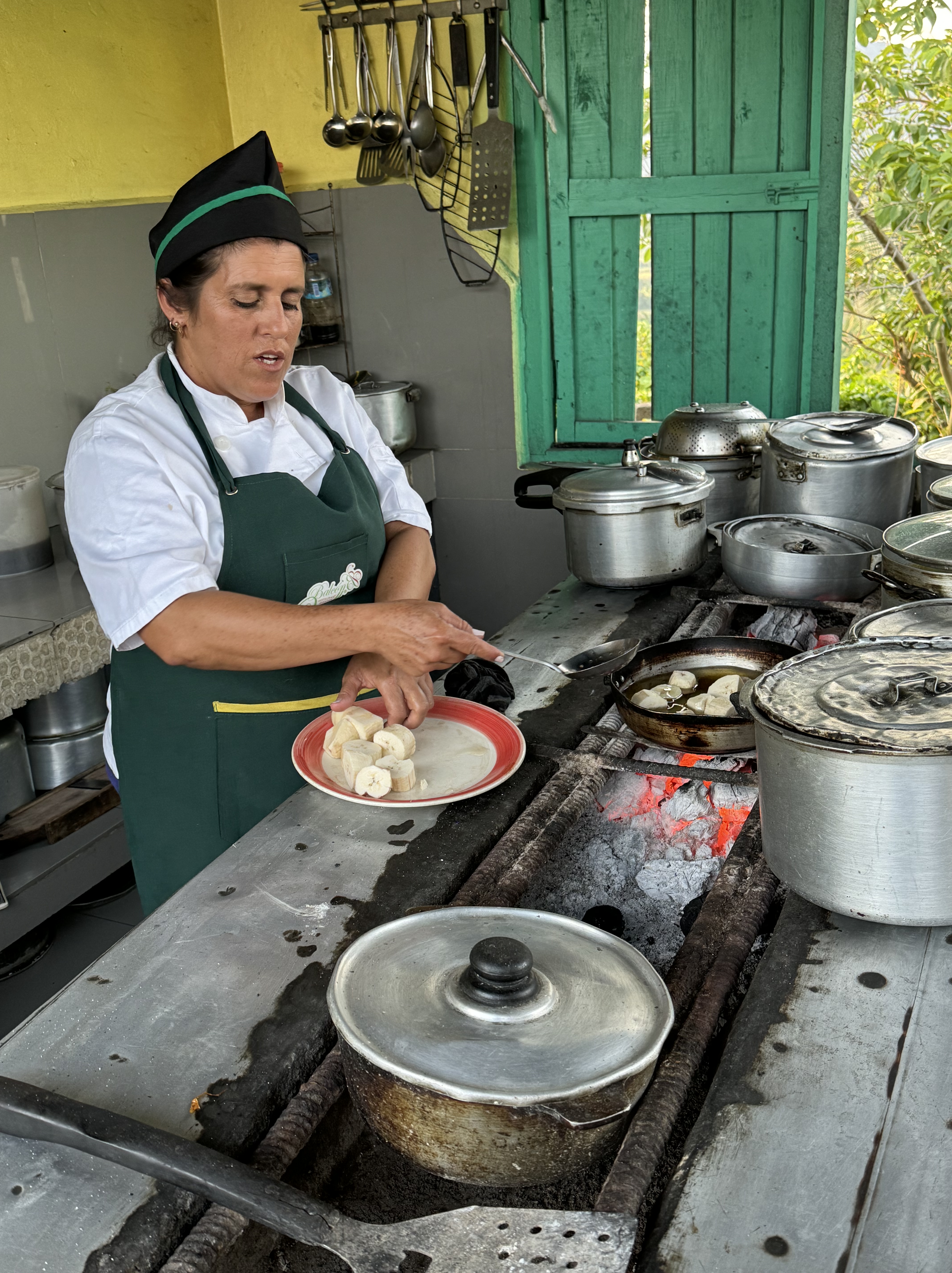
Prior to dinner, Craig volunteered to participate in a cooking demonstration. He donned a cap and apron and proceeded to peel vegetables for soup—beets, tarot, squash, and sweet potatoes. He sliced plantains and marinated pork. Behind the restaurant we watched the real chef fry tostones and cook the rest of our meal over charcoal.
During the tour, there was little variation in our meals—a salad of thin-sliced white cabbage, cucumber, and tomato; root-vegetable soup; fried plantains; beans and rice; stewed pork or chicken; occasionally fish, and flan for dessert. Most of the ingredients are grown locally.
Loose pigs and lost messages
That night, Craig and I heard loud noises outside of our guesthouse door—shrill squealing. Was it a child? Then, nervous barking and gruff yelling. Had there been an accident? Then, silence. We could only guess at what had happened.

The next morning at breakfast on the patio, Toni, the animated proprietor of the guesthouse, explained that a pig had gotten into his garden. Excitedly and comically, he reenacted the catching and carrying of the pig out of the compound. “Not good for sleeping,” he apologized.
On our bus, Rainer reviewed the history of Cuba. “Discovered” by Columbus in 1492, the island was colonized and developed by Spain over several centuries. The native population largely disappeared, due to disease. An estimated six hundred thousand African slaves were imported to work the sugar and coffee plantations.
Slavery was abolished on the island in 1886. Following the Spanish-American War of 1898, Cuba was occupied by the United States.
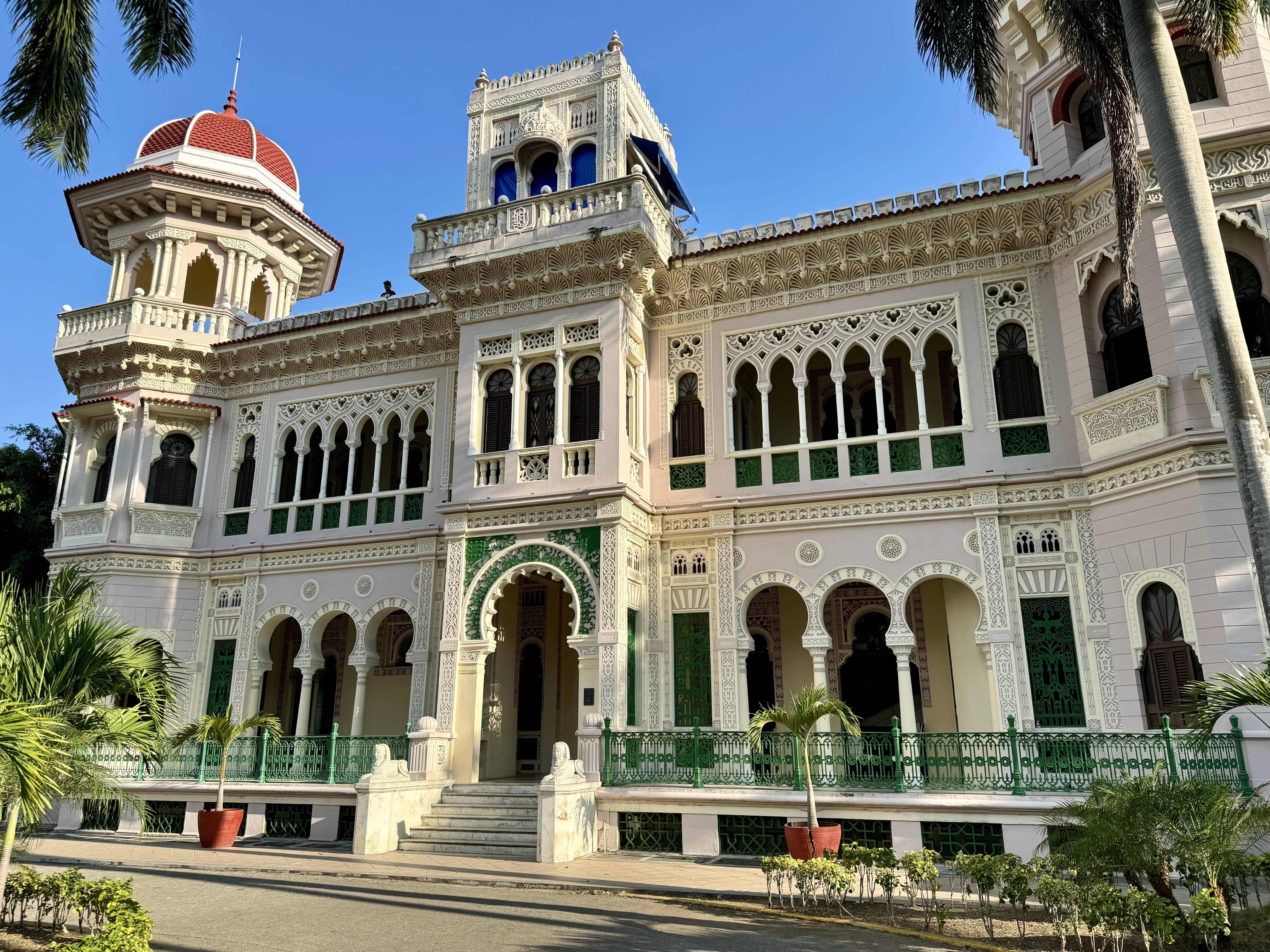
The island gained its independence in 1902. Cuba then experienced a string of governments dominated by corrupt politicians, the military, and American business interests.
Fidel Castro led a guerrilla uprising against the brutal dictatorship of U.S.-backed Fulgencio Batista.
When arrested after his initial failed coup, Castro said, “History will absolve me.”
Batista finally fled the island in 1959 when Che Guevara and an army of rebels captured the city of Santa Clara. In response, the U.S. imposed economic sanctions.
We stopped for lunch at a roadside café, where I watched a cat catch and eat a lizard. Our flatware was wrapped in what I thought was a paper napkin, but turned out to be a few sheets of toilet paper. Another shortage.
We passed an abandoned government-owned resort on the Bay of Pigs. The bay is the site of a failed military invasion in 1961 by Cuban exiles who opposed Castro and were financed, directed, and ultimately betrayed by the U.S. government and the CIA.
The operation took place at the height of the Cold War and its failure influenced relations between Cuba, the U.S., and the Soviet Union for years. In Spanish the name is Bahía de los Cochinos. Cochinos are fish, not pigs. The coast is rocky and beautiful, but there is not much to see for a site with such historical significance.
On the outskirts of Cienfuegos, workers swept harvested rice into piles on the road. Irrigation systems spritzed swaying sunflowers in government-owned fields.

In town we unloaded at three different guesthouses. Craig, Ajani, and I shared one. The owner tried to communicate with me in Spanish to no avail. Finally, he typed his message into a translation app and converted it to English.
Sometimes messages get lost in translation. Sometimes, in autocorrection. His message said, “We have a difficulty with the door in your airplane.”
Once in the room, I realized he meant to tell me the doorknob to the bathroom was missing.
Running on empty
After breakfast, Rainer conducted a walking tour of the historical center of Cienfuegos. The area was first settled by pirates in the 1600s. In the 1800s, Spanish sugar-plantation owners built grand neoclassical palaces with their wealth. Over three hundred buildings from the 1800s stand in the Old Town, earning it a UNESCO World Heritage Site listing.

We headed toward the mountainous park of Topes de Collantes, passing villages of shacks, weedy fields and orchards, scrawny cows, horse-dawn carts, pedestrians on the side of the highway, and a herd of goats in the road. Vendors sold bananas and pineapples from the berm. A man on a motorcycle cradling a live chicken sped by.
A long line of cars at a gas station awaited an opportunity to refuel. In March of this year, the Cuban government increased gas prices five hundred percent, as it struggles with fuel shortages. The crisis has led to long queues that sometimes stretch for miles and require day-long commitments to fill tanks. Rainer said, “In Cuba, it is compulsory to waste time by waiting.”

Cuba imports most of its fuel. Venezuela is the primary supplier, providing oil to Cuba in exchange for the assistance of Cuban doctors in Venezuelan hospitals. The doctors are paid $125 to $325 per month, attractive wages compared to the average salary in Cuba of fifteen to thirty dollars per month.
However, the docs receive only ten to twenty-five percent of their wages. The rest goes to the Cuban government, which freezes the doctors’ pay until they return to Cuba. It is an incentive not to defect.
In the early afternoon, the bus pulled into a clearing with a few open-sided thatched huts. It was a pop-up restaurant that cooked over charcoal. A sort of barbecue, featuring the usual Cuban menu. Soon after, from mountainous overlooks, we could see the town of Trinidad below and the blue Caribbean Sea beyond

Trinidad was founded in 1514 by Diego Velázquez de Cuéllar, a Spanish conquistador and the first governor of Cuba. The town became a center for the sugar trade in the 1700s and 1800s. It is one of the best-preserved cities in the Caribbean from this time period.
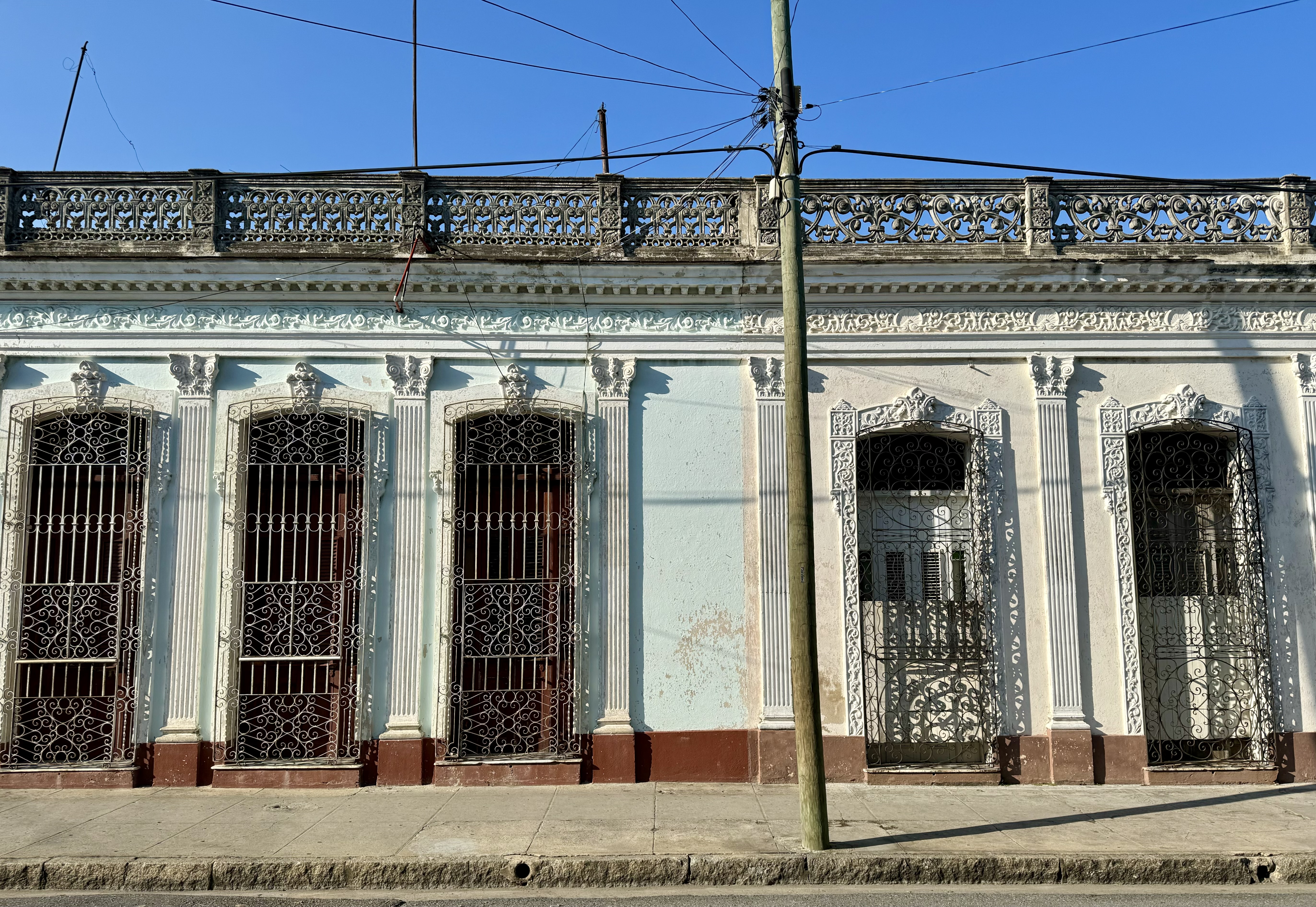
Spanish colonial architecture surrounds its historic main square. Its rough cobblestone streets are lined with brightly colored houses with wrought-iron grilles. Just outside of town is the Valle de los Ingenios, the Valley of the Sugar Mills. During the peak years of Cuban sugar production, thirty thousand slaves operated over fifty sugarcane mills in the valley.
Free day
In the morning vendors walked through the streets calling and whistling to let townspeople know they have fresh produce or bread to sell. Each has a distinctive signal.

Our morning was unscheduled. After breakfast in the courtyard of the guesthouse, Craig and I sauntered around Trinidad exploring.
Several shops keep parakeets in cages hanging outside their doors. We watched an exercise class for senior citizens in the main square and wondered if they would notice our gray hair and invite us to participate.
The door to a one-room school was propped open and we peeked inside. The teacher surprised us by welcoming us into the classroom—and then asked for a donation.
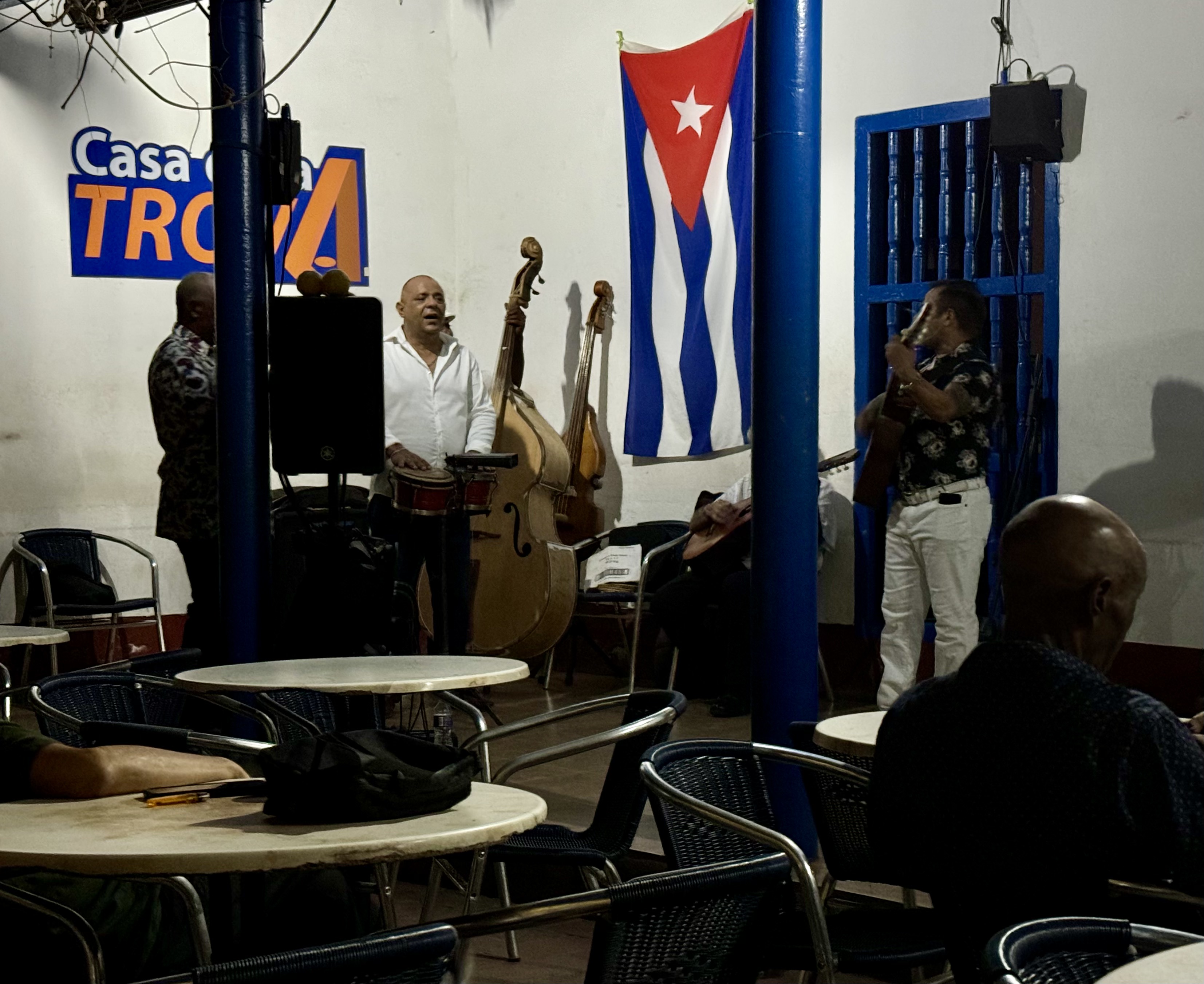
In the afternoon the bus took us to a beach on the Ancón Peninsula. I rented a chair from the hotel and swam. The water was warm and the breeze steady. The beach was largely empty of people and the sea empty of boats. Back in Trinidad, we walked a few blocks to dinner at another guesthouse. Afterward, a few of us went to Casa de la Trova to hear live music.

Trinidad is known for its nightlife. Several clubs are tucked into its historical buildings. At Casa de la Trova, dapper older men danced gracefully with all of the females in the room. The locals sat at tables in front of the musicians, smoked cigars, and drank shots of rum.
The bartender approached us. “We make only three drinks,” he said. “Cuba Libre, Rum Collins, and mojito. Three rum drinks. No beer. No wine. Just rum.”
Temperatures were in the mid-nineties throughout the tour. Whenever I left air-conditioning, a sheen of sweat glazed me like a donut for the rest of the day. I went back to the guesthouse to sleep. As usual, the power was out and the room was a furnace. At 2:30 a.m. even the landlord couldn’t take it anymore and started the generator.
Martyrs
The personages most depicted in Cuba on monuments and posters are José Martí and Che Guevara. Surprising to me, Castro’s image is nowhere to be seen. Supposedly, that was his preference.
In the late 1800s Martí advocated for Cuba’s freedom from Spain through his writings and political activity. He traveled extensively in Latin America and the U.S., raising support for the cause of Cuban independence. He died during military action in 1895.
One of his poems is the basis for Cuba’s folk anthem, “Guantanamera.” Busts of Martí are in every park.
Ernesto Guevara, known as Che, was originally from Argentina. While a young medical student, he traveled throughout South America, where he was shocked by the hunger and disease he found. He blamed Latin America’s poverty on capitalist exploitation by the U.S. and dedicated himself to fighting it.

In Mexico, Guevara found a like-minded revolutionary in Castro and joined his movement.
He was soon promoted to second-in-command. He played a pivotal role in the two-year guerrilla campaign that overthrew the Batista regime.
Not cut out to be a government bureaucrat, Guevara left Cuba to assist with revolutions in various African and South American countries, including Bolivia. There, in 1967, he and his band of rebels were captured and executed.
Forty years after he died, Guevara’s remains were exhumed and returned to Cuba. The town of Santa Clara was chosen as the location for his mausoleum in tribute to Guevara’s liberating of the city from Batista in 1958. We visited the mausoleum and the connected museum dedicated to Guevara’s life.
Inside, bronze plaques on a stone wall list the names of the twenty-nine combatants whose mortal remains are entombed along with Guevara’s. His eternal flame was lit by Castro.

Critics of Guevara say he endorsed violence and promoted authoritarianism. His supporters admire his unwavering commitment to independence and equality for common people. Philosopher, author, and freedom fighter, Guevara was the soul of the Cuban revolution.
Stylized images of Guevara in his beret are pasted everywhere on the island. His visage has become a symbol of rebellion throughout the world.
At the dedication of the mausoleum, Castro asked, “Why did they think that by killing him, he would cease to exist as a fighter?”
Musical diplomacy
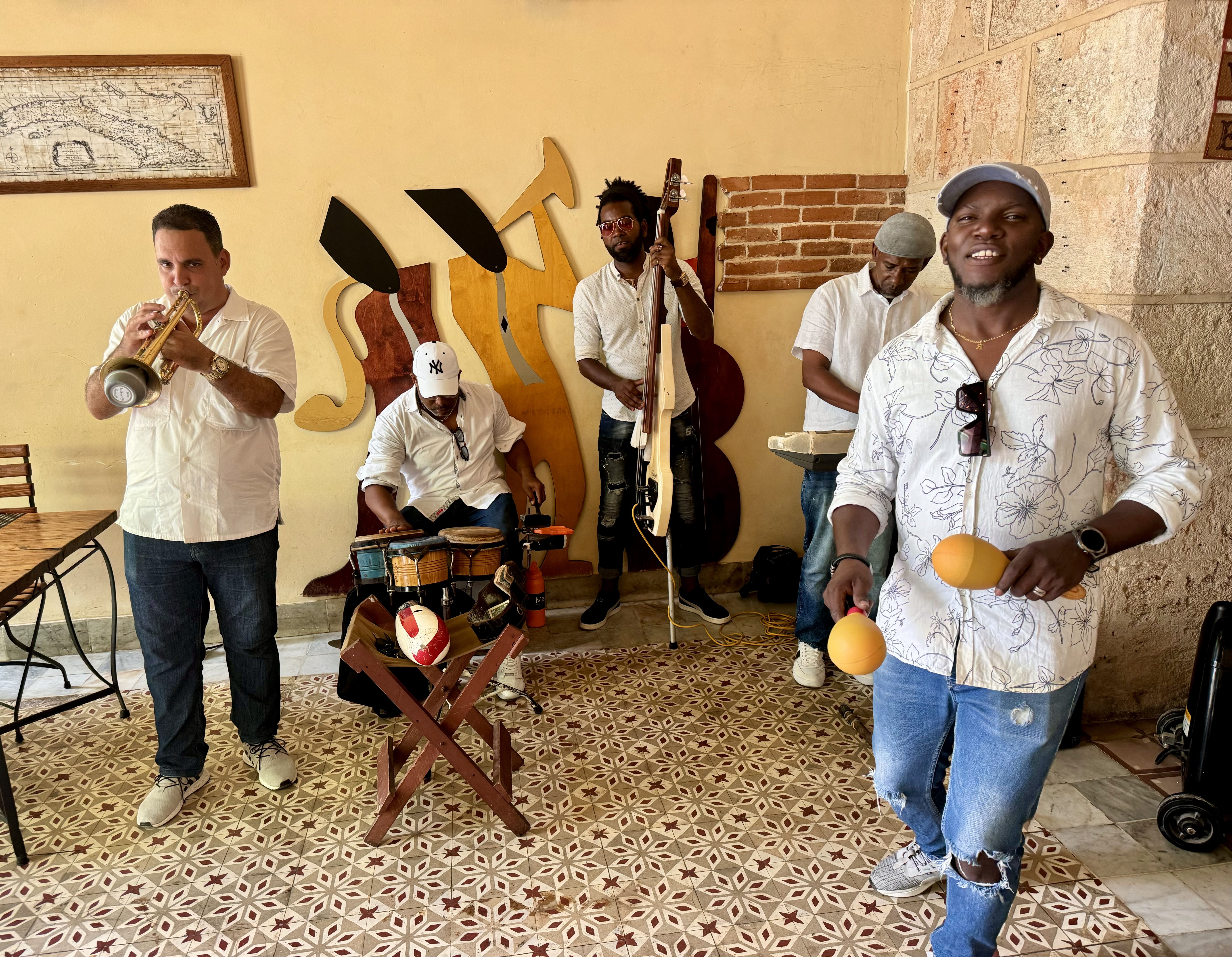
Perhaps Cuba’s greatest export is its music. Live bands played in nearly every restaurant we visited, whether lunch, happy hour, or dinner. The musicians were not shy about passing around the tip jar.
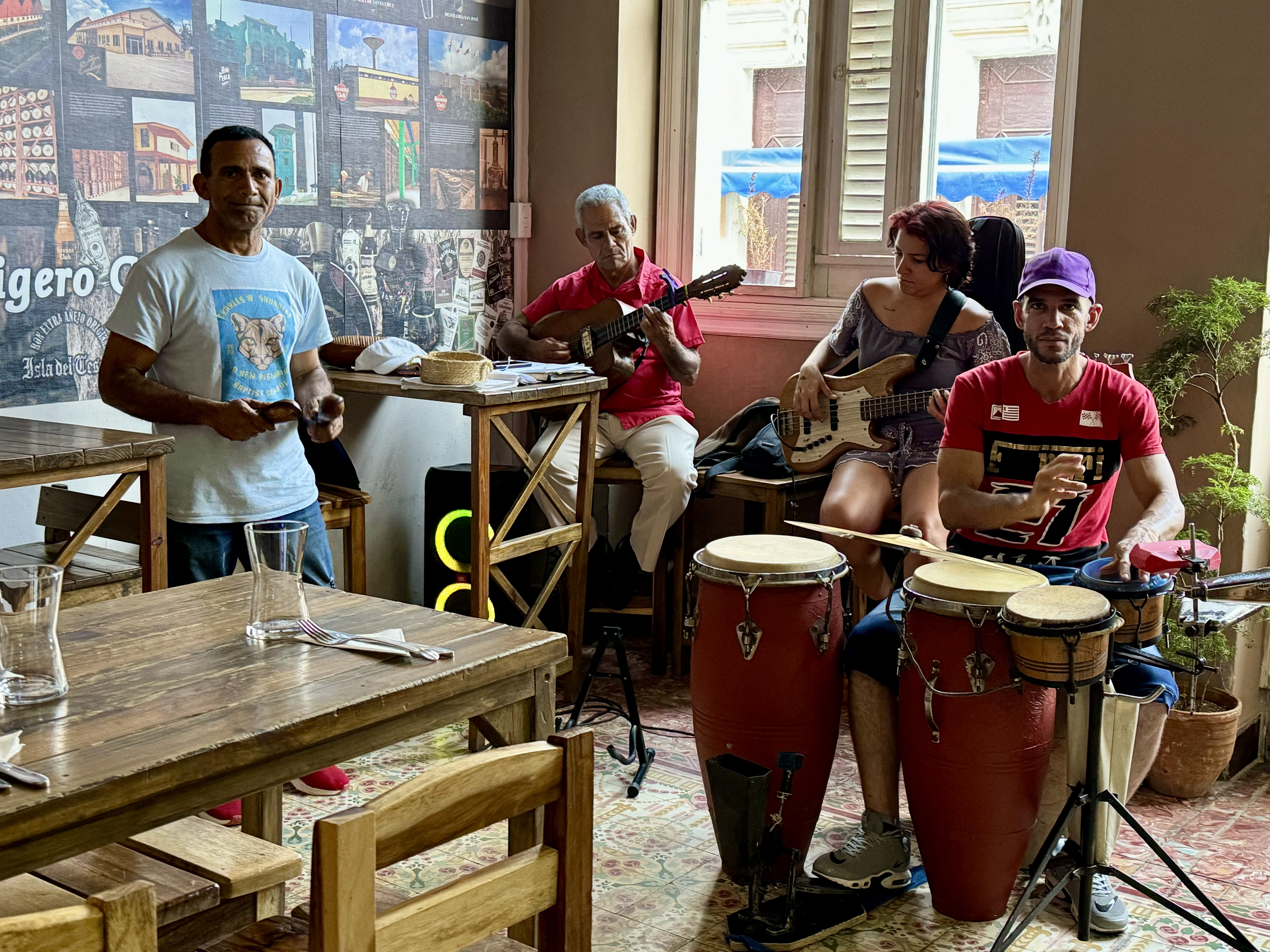
Salsa, mambo, rumba, conga, and cha-cha-chá all originated in Cuba.
The grafting of Spanish and African roots gives Cuban music its unique rhythms.
In Viñales we attended an hour-long salsa lesson at a local dance studio. I was paired with a young student who led me through the steps.
At the end, the instructor was quite diplomatic in her praise of our clumsy efforts to follow the rhythm.
On the main street of Cienfuegos is a life-sized statue of Benny Moré, a Cuban singer, bandleader, and songwriter, known for his fluid tenor voice. Moré began his career in Mexico in the 1940s. He returned to Cuba and, in 1953, formed one of the island’s top bands. Moré is considered the greatest singer in the history of Cuban music.

When I was in grade school, I Love Lucy was a popular TV show. Cuban Desi Arnaz played Ricky Ricardo, the bandleader at the fictional Tropicana night club in New York City.
Arnaz was a bandleader and musician in real life as well. A revolution in 1933 forced he and his family to flee Cuba for Miami. There, he found success performing with Xavier Cugat’s orchestra. His journey led him to Hollywood, Lucille Ball, and one of the most influential TV shows of all time.
On our tour group’s last night in Cuba, we attended a dinner and show at Buena Vista Social Club. The club’s name once belonged to a venue in the Buenavista quarter of Havana in the 1940s. Today it is a brand encompassing multiple venues, ensembles, performances, and albums.
Buena Vista encapsulates Cuba’s music between the 1930s and 1950s. Pianist Rubén González described those golden days as “an era of real musical life in Cuba, when there was very little money to earn, but everyone played because they really wanted to.”
For the 1996 Buena Vista recording, a dozen veteran musicians, some of whom had been retired for many years, were recruited. Both the album and follow-up film won Grammys.
At the show, the music was non-stop, fast, and loud, and the performers electrifying. Part of the show involved pulling people onto the stage to dance. The international crowd was wildly appreciative. The closing song was Cuba’s folk anthem “Guantanamera.”
Tipping point

Over the course of the tour, it became obvious why the Cuban government authorized our visit. Our license, “Support for the Cuban people,” is a way to inject U.S. dollars into the economy. It puts hard cash into the hands of average citizens.
Life is becoming increasingly desperate in Cuba.
Shortages of water, food, medicine, and fuel are ongoing. Power blackouts are widespread. Despite the resilience and inventiveness of the Cuban people, there is growing unrest.
Tours and tips are not the solution for Cuba’s economy, but, in a small way, may provide some relief. For the minority of Cubans who do not work for the government—the guesthouse owners, restaurant servers, classic-car taxi drivers, artists, cigar rollers, dance instructors, guides, and especially the musicians—I was happy to help.
Meanwhile, the lines grow longer.
 YearTripper
Kirk-
Sounds like you had a great visit. You captured the essence of the people and the challenges of their situation. Looking forward to hearing more when we next meet.
Be well,
Jerry
Hi Kirk!
Thanks for an excellent narrative on Cuba’s past and present. Riveting.
Scott
PS: The last time I smoked a cigar was with you in 1997.
What an enlightening piece. With the news here filled with wars and politics, Cuba is little noticed. Had no idea daily life was so hard and you summed up the situation eloquently and succinctly.
Thank you.
Still travelling the world I see and a long time since your west of Scotland trip when Derek and I enjoyed your company for one night only. Good wishes for the future. Anne Robertson x
Many thanks, Anne. All the best to you and Derek!