

To read about my time in Crete, Santorini, and Naxos, please see the previous post, “Cycladean Rhythm.”
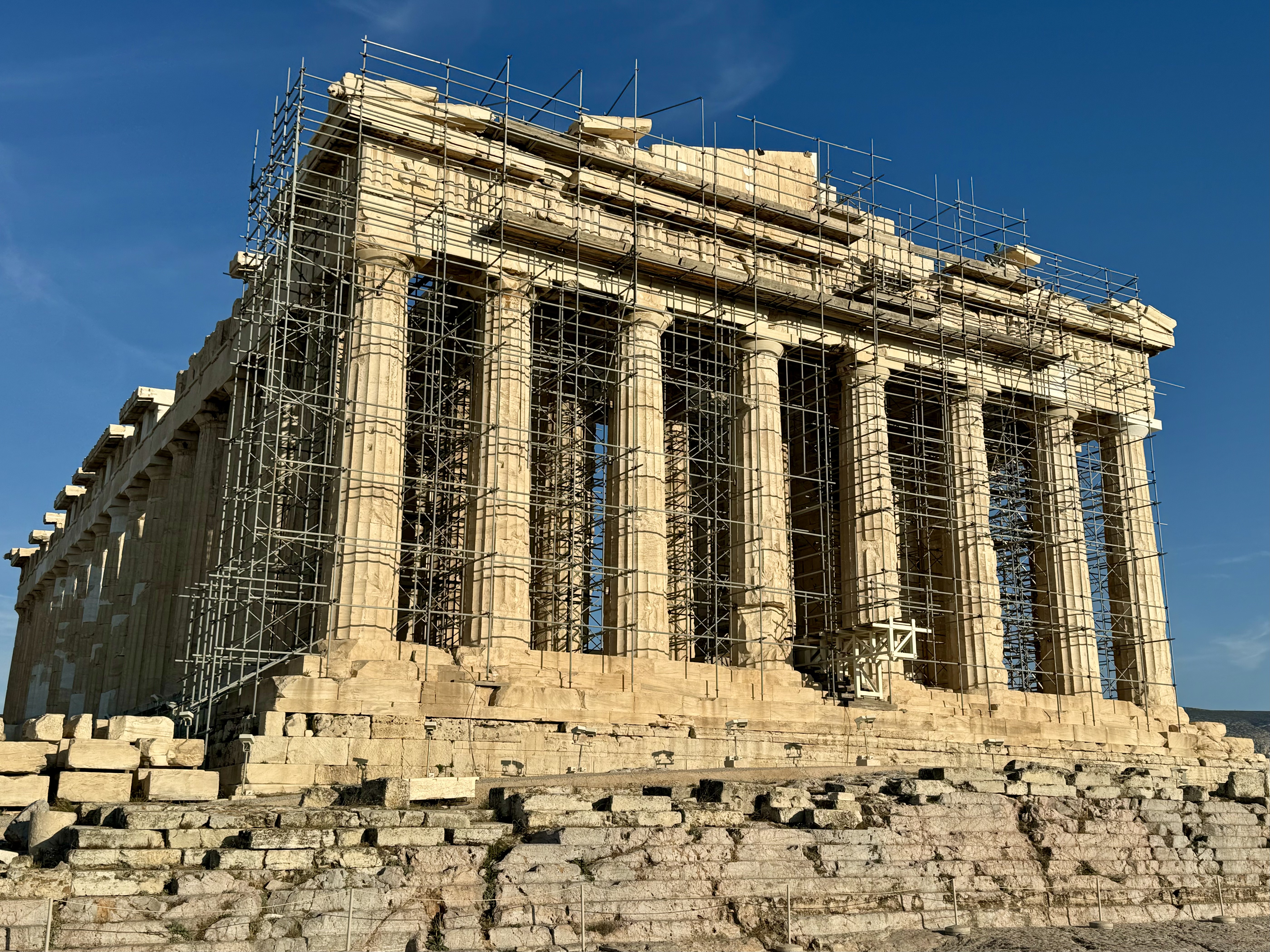
At five hundred feet high, the Acropolis can be seen from everywhere in Athens, including from our hotel room. The weather was perfect and the crowds thinning during our late afternoon visit.
The rocky mesa on which the Parthenon sits was the mecca for several civilizations prior to the ancient Greeks. Homer references the fortifications in the Odyssey. The goddess Athena, the city’s namesake, was worshipped here at least as early as 800 BCE.
The city-state of Athens was invaded by Persia (now Iran) a few times. The decisive battle during the 490 BCE incursion took place at the port of Marathon. The two forces were locked in a stalemate for five days until the Athenians, outnumbered three to one, outmaneuvered the Persians and won.
A courier, Philippides (also spelled Pheidippides and Phidippides) supposedly ran from Marathon to Athens to report the victory before collapsing and dying. His feat is the inspiration behind modern marathon races of 26.2 miles.
But there is more to his story—maybe.
Marathon man
Before the battle, Philippides was ordered to run from Athens to Sparta, about one hundred and fifty miles, to request military reinforcements for Marathon. Then he may have run back to Athens to report, before continuing to Marathon to check on the status of the battle.
He may or may not have returned to Athens to announce the good news. If the legend is true, he ran about 350 miles over the course of a few days.

An ultra marathon called Spartathlon celebrates the 153-mile Athens-to-Sparta leg of the legend.
Around four hundred participants run on trails, through olive groves, and over mountains. The ascent and descent of four-thousand-foot Mount Parthenio occurs in the middle of the night.
An even tougher race is the Authentic Phidippides Run. Runners hump from Athens to Sparta and back again. The 304-mile race must be completed within ninety-eight hours.

Golden age
Ten years later in 480 BCE, the Persians invaded Athens again. While in town, they looted and burned the buildings on the Acropolis. After the war, the Athenians cleared the site and started anew, building the complex of monuments that (mostly) stand today.
At the time of the new construction, Athens was the cultural center of the world. Pericles, Athens’s leading statesman, fostered the development of democracy. Socrates, Plato, and Aristotle conducted classes and founded Western philosophy. Euclid, who we have to thank for geometry, may have studied with Plato.

Aeschylus, Sophocles, and Euripides wrote and staged the earliest known dramas.
Herodotus recorded known history and Hippocrates (of oath fame) medicine. The Apostle Paul preached on Mars Hill.
The 400s BCE was an age of brilliant minds and big ideas—a Golden Age.
All of the arts flourished. The most gifted architects and sculptors of the day were employed in the design of the Parthenon.
The resulting structure, a representation of architectural perfection, is an icon of Western civilization.

The Parthenon was dedicated to the goddess Athena. In later years, the building served as a Byzantine church, a Catholic cathedral, a Turkish mosque, and a powder magazine.
When the Venetians attacked in 1687, their mortars ignited the powder and demolished the temple.
The Parthenon today is what is left after that massive explosion.
In 1822, during the War of Independence, the Greeks reclaimed the Acropolis. An organized effort to preserve and restore buildings and artifacts began in 1975 and continues today.

Lost marbles
In the 1800s further damage was inflicted on the Acropolis by Thomas Bruce, also known as Lord Elgin, a Scottish nobleman and amateur archaeologist. Elgin and his team set out to make casts of the sculptures, but eventually decided to dismantle them and ship them to Britain.
A significant number of the decorative elements of the Parthenon and other nearby temples were vandalized. Some claim Elgin legally removed the marbles, as they are called; some say he stole them.
Poet Lord Byron’s opinion on the matter is clear:
Dull is the eye that will not weep to see
Thy walls defaced, thy mouldering shrines removed
By British hands, which it had best behov'd
To guard those relics ne'er to be restored.
Curst be the hour when from their isle they roved,
And once again thy hapless bosom gored,
And snatch'd thy shrinking gods to northern climes abhorr'd!
The marbles were purchased from Elgin by the British government in 1816 and transferred to the British Museum.

Greece has repeatedly requested their return. In 2015 I visited them in London. A brochure stated the museum’s position that the sculptures are “part of everyone’s shared heritage and transcend cultural boundaries.”
In other words, they’re not going back. Discussions continue.
The nearby Acropolis Museum was built to house every ancient artifact found on the mesa. Pieces of the larger-than-life pediment sculptures are there—Zeus, Poseidon, Athena, Apollo, Hermes, and so on.
The rest of their body parts are in England. Reconstructed miniatures of the pediments show the mighty gods arrayed as if at a meeting of the Justice League of America.

A representation of the Parthenon is laid out on the third floor. White plaster replicas of the missing sculptural elements indicate where the Elgin marbles will go, if someday returned.
It’s an unfinished jigsaw puzzle. Britain holds the missing pieces.
One of the excuses for not repatriating the marbles is that Greece didn’t have a suitable space to properly present and protect them. With the opening of the Acropolis Museum in 2009, that excuse is no longer valid.
OMGs
The ancient Egyptians believed domesticated cats were divine beings. (Cats have not forgotten this.)
Indeed, some Egyptian gods were portrayed with the features of felines. The goddess Bastet appeared as a woman with the head of a cat, a sort of Catwoman. Cats were sacred creatures. Anyone found guilty of harming a cat was severely punished.
As ancient mariners explored the Mediterranean, whether conducting trade or making war, cats were esteemed shipboard companions. In addition to bringing good luck to the crew, they helped protect food stores from rats and mice.

Ancient voyages introduced cats and cat-worship to Greece. Influenced by the Egyptians, Greeks came to believe cats could deliver messages to and from the gods. (Mine deliver the messages at 5 a.m.)
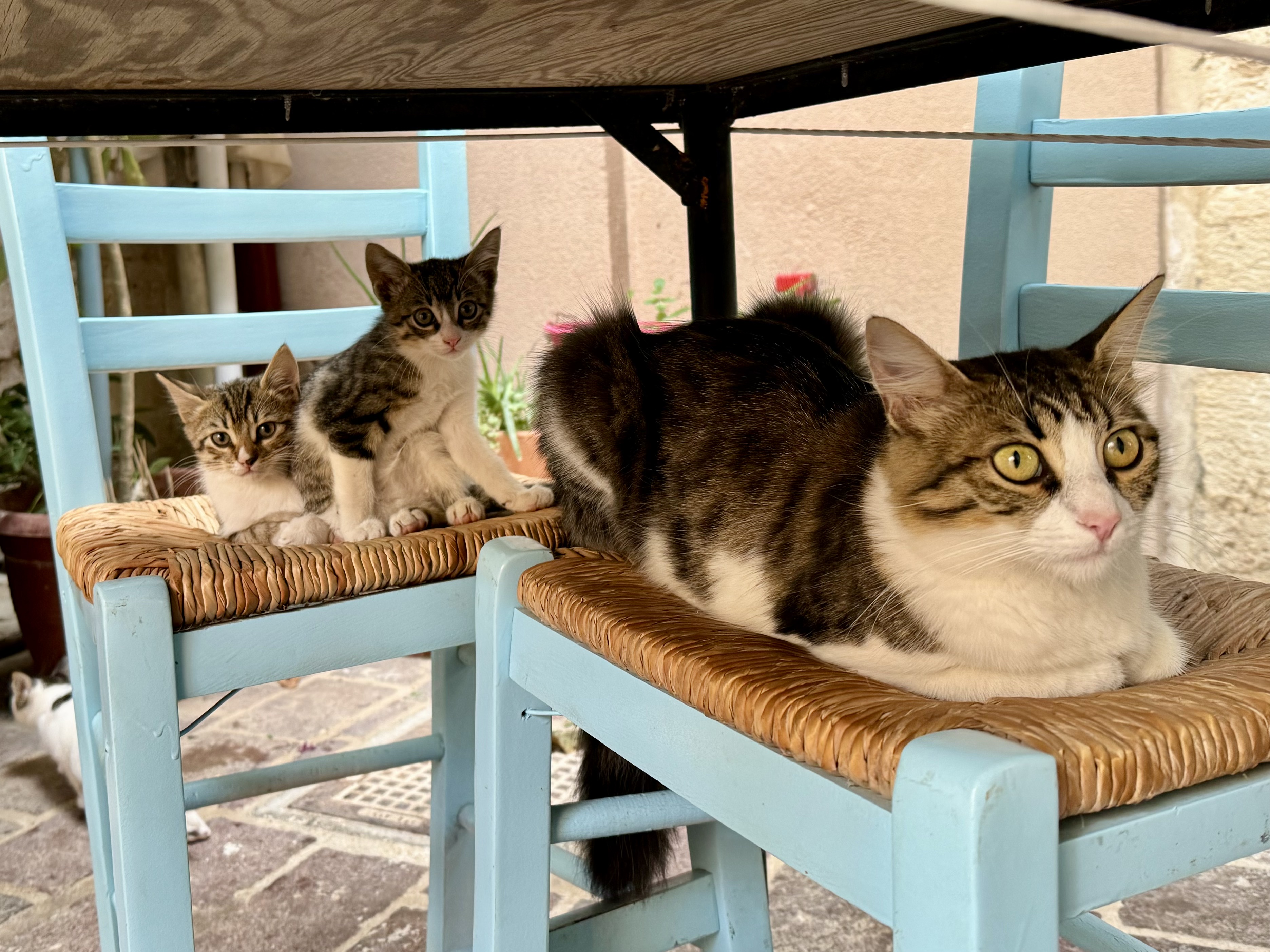
Today, clowders of cats roam freely in Greek neighborhoods. They lounge in the sun on sidewalks. They saunter through shops and restaurants. They pose like fashion models in café chairs, on garden walls, and among ruins. Most of them live outside year-round, which Greece’s mild climate allows.
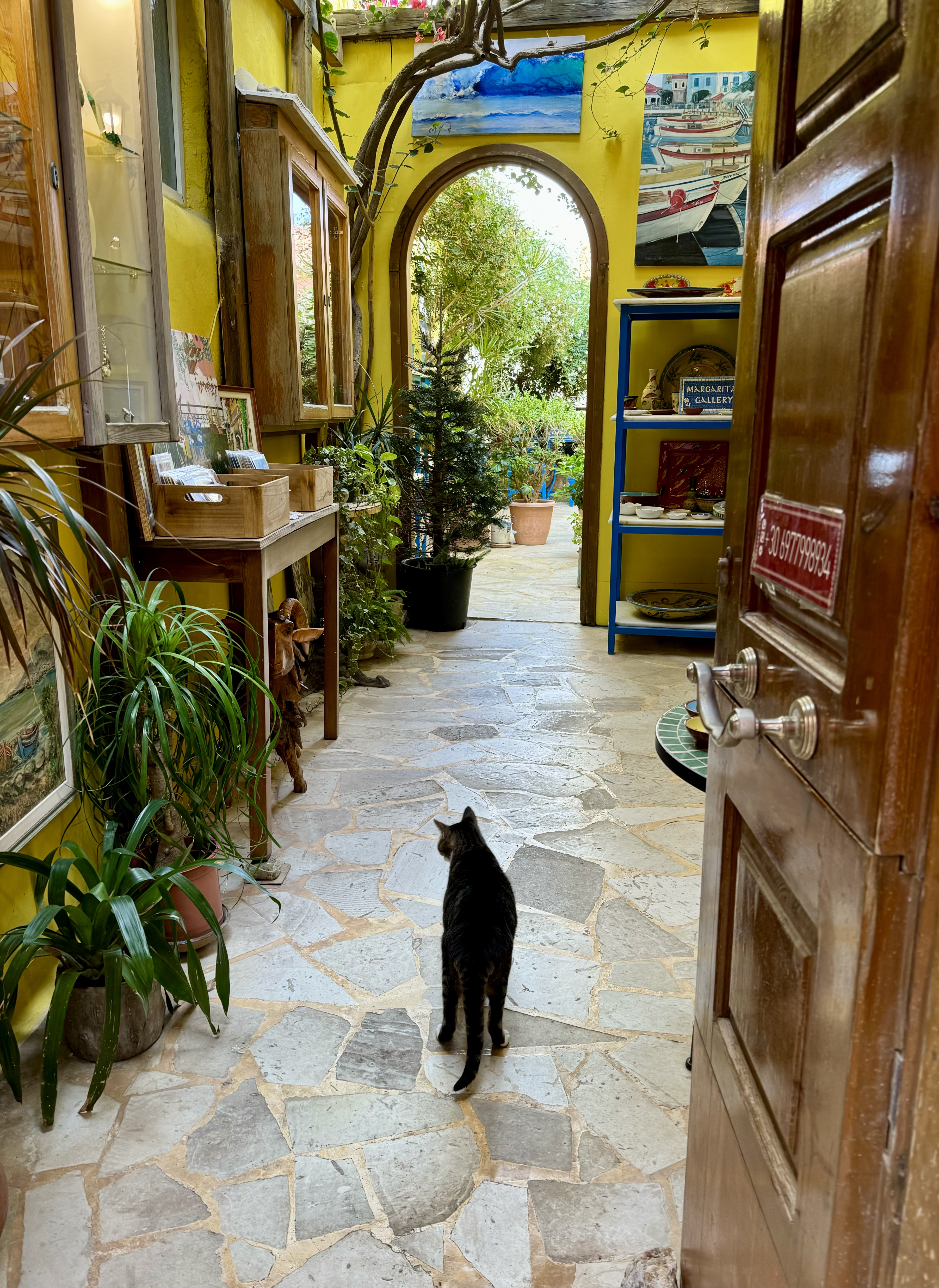
They are not exactly feral, as they are socialized and seek contact with people. Their human neighbors have adopted them, although unofficially. Rough shelters and feeding stations are provided. Residents and shopkeepers leave bowls of food and water for them. Some locals carry treats for them in their pockets. Stray might be a better descriptor.
When Greece joined the European Union in 1981, the country was expected to follow the union’s animal-welfare laws. Apparently Greece’s government does little, but community volunteers have stepped up to help control the population of free-roaming cats.
Through humane trap-neuter-return (TNR) programs, cats are neutered by licensed veterinarians and returned to where they were trapped. Unfortunately, not all TNR programs can afford to diagnose or treat for infectious diseases.
Most of the cats we encountered seemed healthy and friendly. Many are used to receiving treats from tourists. Most sported earmarks distinguishing them as sterile.
Dog’s life
Although we encountered Ohi Day celebrations on the islands, the official holiday occurred while we were in Athens.
We watched a military band form in Cathedral Square. When the dignitaries left the service, the band accompanied them up the street to the Greek Parliament building. Police presence was heavy. Outside the parliament, the Evzone guards strutted in their kilts and pompom-shoes.

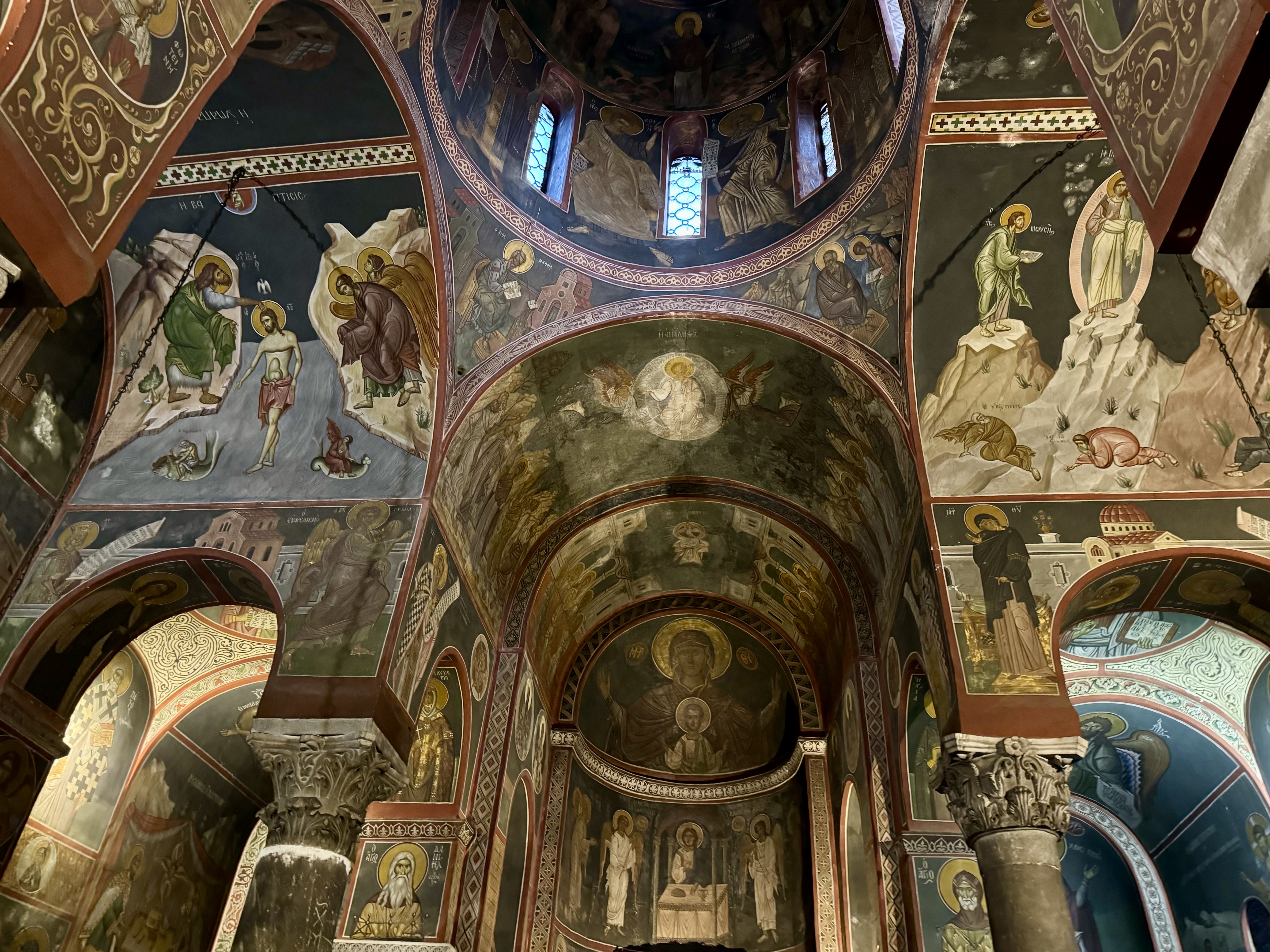
While the citizens were busy saying no, we headed the opposite direction toward the historical sites, free to enter on this holiday. We ticked off a list, including the Church of Kapnikarea with its colorful frescoes (built around 1000 CE), the Arch of Hadrian, the Temple of Olympian Zeus (once the largest in Greece), the Library of Hadrian, the Roman Forum, and the Tower of the Winds.
We explored the tiny neighborhood of Anafiotika on the north slope of the Acropolis, built for personal use by construction workers and stone masons in the mid-1800s. The whitewashed cottages are connected by footpaths and landscaped with bougainvillea, geraniums, and more cats.

Then we entered the agora. In its day, the marketplace buzzed with activity. A frequent visitor to the agora was Diogenes, an ancient philosopher who taught by example.
When Diogenes looked at his fellow humans, he saw arrogance, deceit, and folly. To point out the shallowness of society’s values, he chose to live uninhibited and without material possessions. Today, he might be called homeless.
Diogenes believed humans should emulate dogs, unpretentious beings that live in the moment. They eat anything, sleep anywhere, and relieve themselves in the open. Diogenes did the same.
In the city of Corinth, Alexander the Great, the most powerful man on earth at the time, was intrigued by Diogenes’s indifference toward him. One morning, he found Diogenes relaxing in the sun and said to him, “I will do any favor you wish. What would you like?”

Diogenes replied, “Stand out of my light.”
Alexander’s camp followers sneered at the vagrant Diogenes, but as they walked away, Alexander said, perhaps wistfully, “If I were not Alexander, I wish I were Diogenes.”
Alleys and cellars
The guidebooks often say the most authentic dining experiences can be found in the back streets. In Athens, that would be the neighborhood of Psyri.

In the late 1800s, Psyri was home base for several criminal gangs. As recently as the 1990s, the district was considered dangerous to visit. In preparation for the 2004 Summer Olympics, civic leaders tried to clean up the area and encourage investment.
Yet, Psyri still looks dilapidated and sketchy. Buildings are boarded up and defaced with graffiti. At night, however, the neighborhood comes alive.
Restaurants, bars and live-music venues emerge from the facades of former warehouses. Café tables and chairs spill onto the streets.
It was in grimy, slowly gentrifying Psyri that I enjoyed a couple of unique meals.
Leslie and I walked past Avli three times before we spotted it. We were expecting a well-lit entrance and a sign, but Avli is a neighborhood secret.

An unlit wood sign is attached flat against the building above a dim corridor. On the dark street amid the graffiti we didn’t notice it, but a line of people at the doorway gave the location away.
Avli means courtyard, but this one is more like an alley, decorated with potted plants, strands of garlic, and, of course, prowling cats.
The buildings are whitewashed and the door frames bright blue. The pavement is old flagstone. A sheet of corrugated plastic overhangs a section of the alley. The rest is open to the stars.
The doors in the alley used to open to workshops that made leather and paper goods. Takis, the owner, delivered coffee and food to the workers who took breaks outside of their shop doors.

Over the years his menu grew to include meze, fried chicken, liver, and pork, keftedakia (meatballs), spetzofai (sausage-pepper-and-onion casserole), fried potatoes, omelettes, and wine, beer, and raki.
Leslie raved about the cabbage rolls with egg-lemon sauce. The portions are large and inexpensive. The wine is served in metal pitchers.
“We don’t have live music,” Takis says, “but we have the radio tuned to 98.8—a station with real music, not this new stuff.”
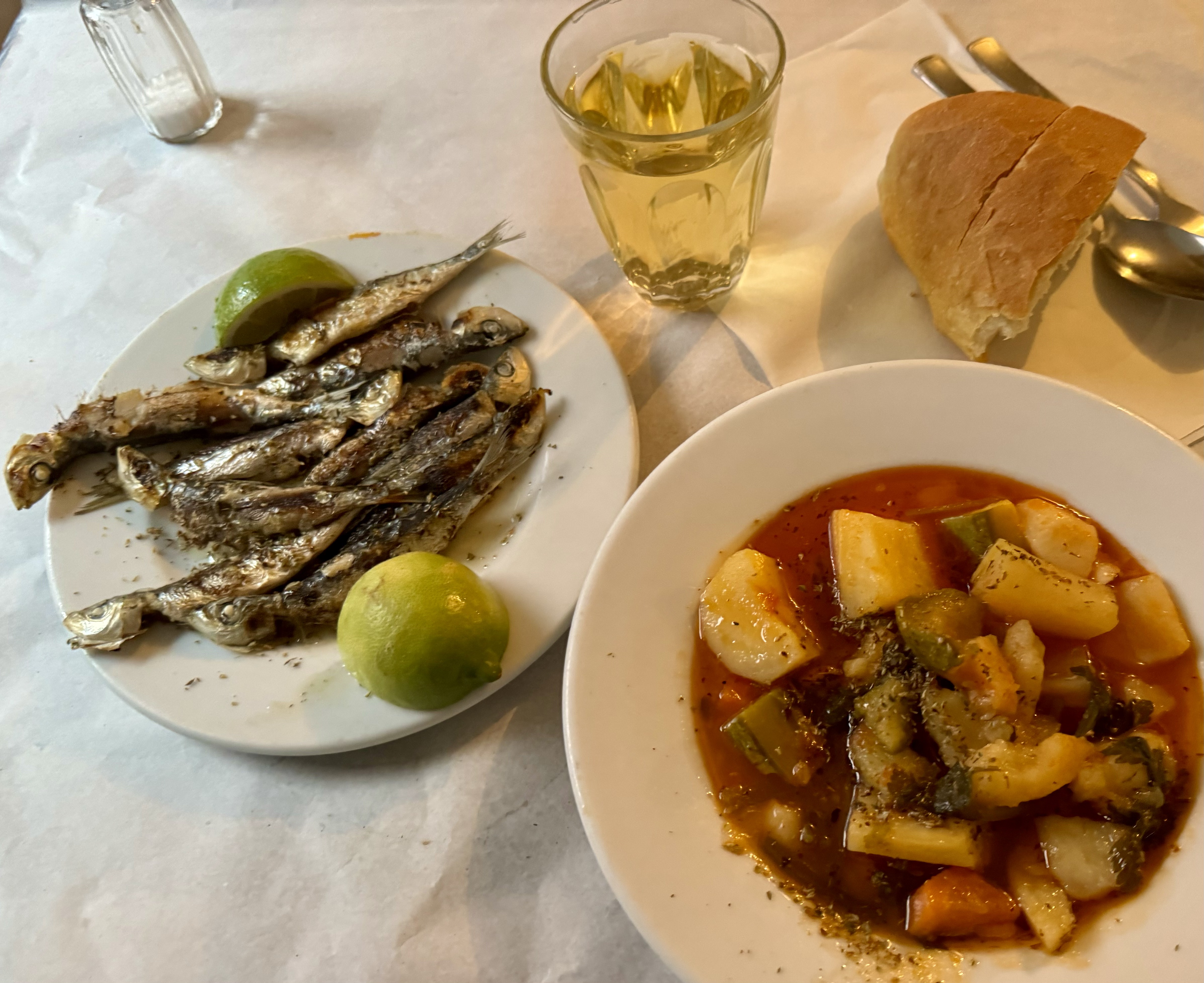
I found unassuming Diporto in the alley behind the market. The property looks abandoned. No signage. A building to be avoided, but two cellar doors were open.
I descended down steep stone steps, as if sheltering from a tornado.
Diporto (meaning two doors) has been in business since 1897. The walls are lined with wooden wine casks. No English is spoken. I held up an index finger. One of the two men who worked there, the younger one, pointed to a wooden table covered with a plastic tablecloth. I sat down. No menu was offered.

The young man returned with a plate filled with ten fried sardines, a bowl of potato-tomato-bean soup, a hunk of bread, and a tumbler of dry white wine.
I looked around. Everyone else in the cellar had received the same fare. The food was rustic and hearty, one of the best meals I had in Greece. I ate, paid, and left.
Not a word was said.
 YearTripper
Outstanding historical information. I spent the summer of 1971 in Athens with a Greek family who had never visited the Parthenon….. I thought it was wonderful but did not know much about it then. The main thing I knew was all about the Elgin marbles being a Scot.
I remember cats though, all over the place.
Thank you for the photos and stories. Happy Christmas and a good 2025 roaming and finding places to explore. Best wishes Anne R.
Thanks, Anne. Happy Christmas to you and Derek!