In 2011, a fifteen-centuries-old fortress in North Macedonia again became the scene of a clash.
On one side of the dispute were North Macedonians who make up approximately sixty percent of the country’s population. Many are Orthodox by faith. On the other side were ethnic Albanians, composing a quarter of the population. The Albanians identify as Muslims.
The issue? The government of Skopje, the country’s capital city, had recently approved the restoration of an Orthodox church within the grounds of the fortress as a museum. The church’s foundations, dating to the 1200s CE, had been uncovered by archaeologists.
Anticipating objections to the project, the government sneakily hired out-of-town workers and instructed them to begin work under cover of darkness.
The Albanians were paying attention. No sooner had the work started than a crowd of a hundred Albanians converged upon the work site, stopped the construction, and vandalized the scaffolding.
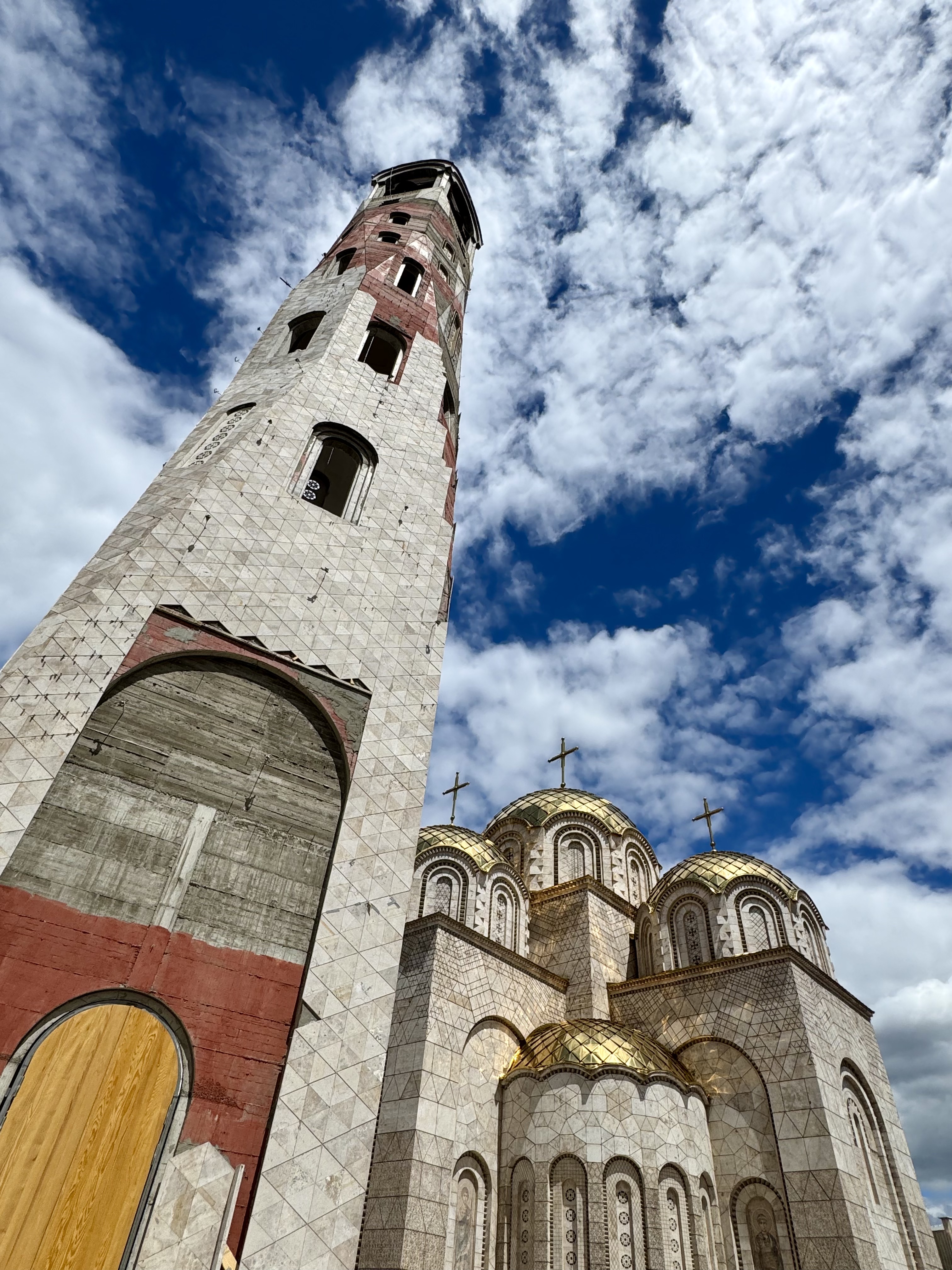
North Macedonia
Albanians claim the grounds of the fort contain older Illyrian foundations, dating to the Bronze and Iron ages, and, that by virtue of their Illyrian ancestry, the site is under Albanian purview. (Illyrian is the collective name for numerous ancient tribes that inhabited the Balkans.)
North Macedonians rallied to protect the site and its workers.
On February 13, 2011, a skirmish between the groups left ten injured, including two policemen.
Each side blamed the other. Even the Turks weighed in: “Turkey pays special attention to preserving and protecting the cultural heritage that is left in Macedonia from the Ottoman Empire.”
Layers of imperialism. Is Skopje’s fortress site North Macedonian, Albanian, or Ottoman? Orthodox or Muslim?
It is all of those and much more.
Welcome to the Balkans.
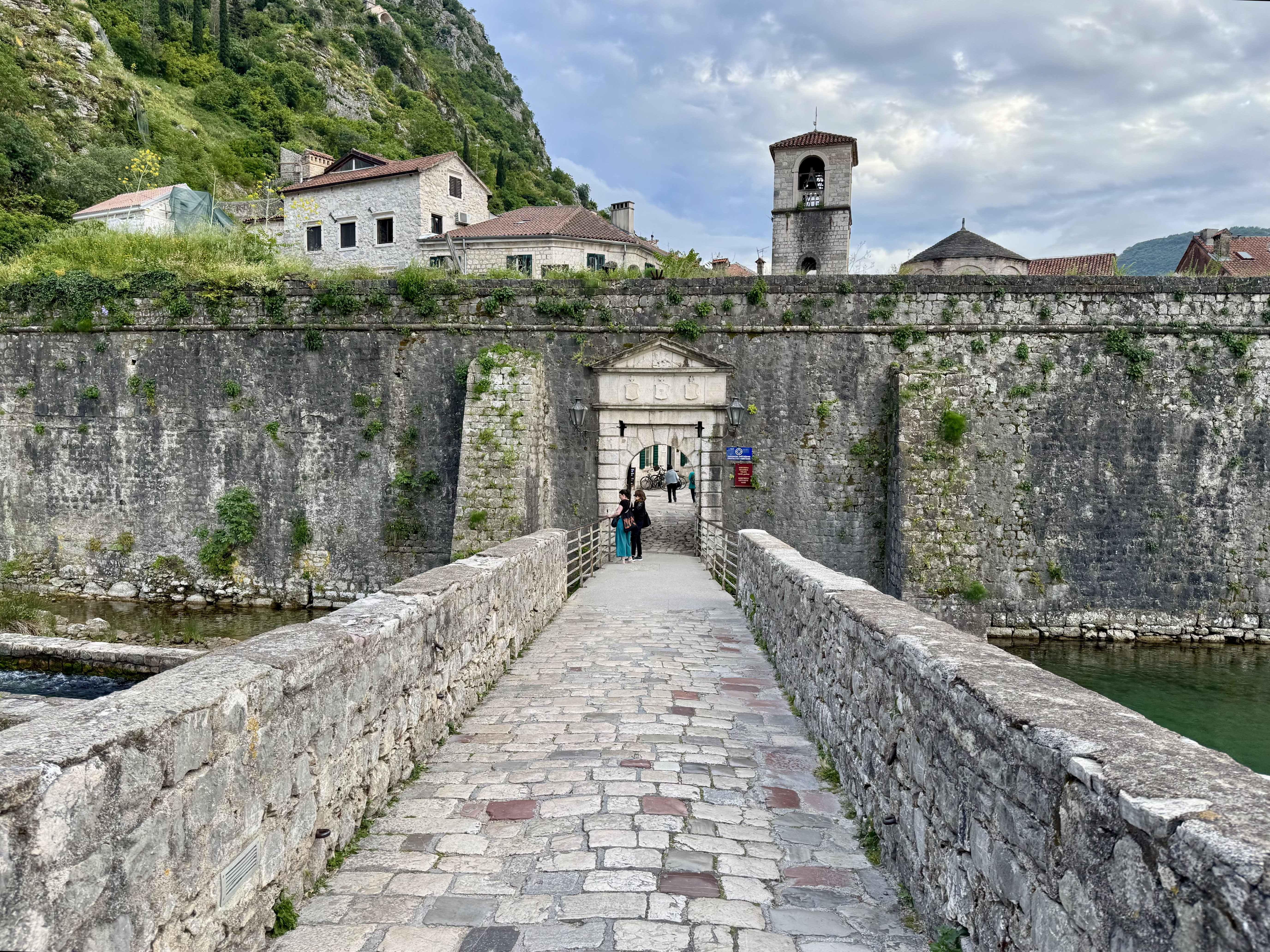
Sea to sea
The Balkans is a region in southeast Europe, taking its name from the mountains that punctuate the Balkan Peninsula.
The boundaries of the region are not well defined, but usually include the countries of Albania, Bosnia-Herzegovina, Bulgaria, mainland Greece, Kosovo, Montenegro, North Macedonia, and portions of Croatia, Serbia, Romania, and Turkey.
Due to the peninsula’s location between the Adriatic Sea on the west and the Aegean and Black seas on the east, the Balkans have been coveted and occupied by many cultures over the centuries.
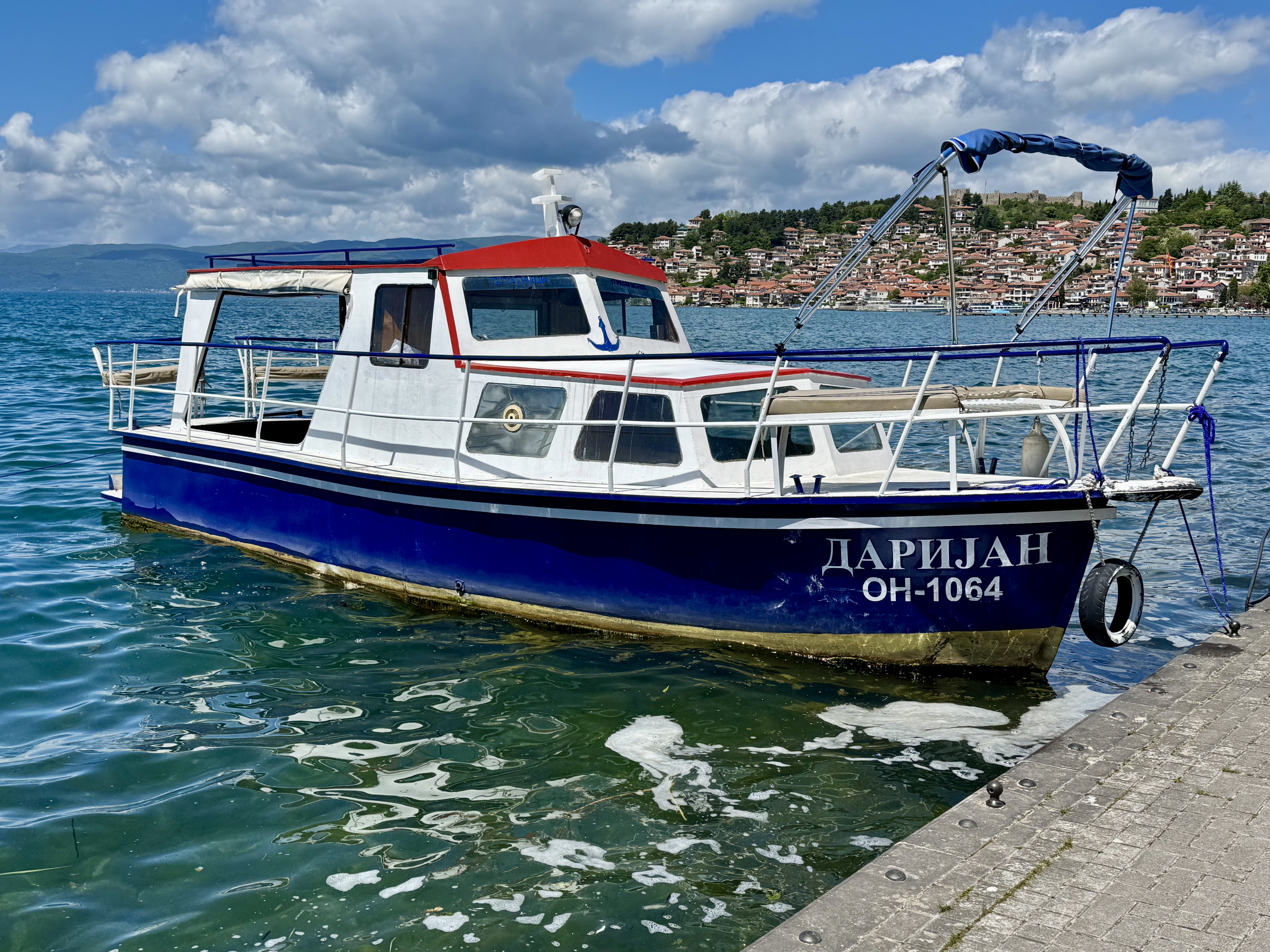
It’s a who’s who of occupiers: Illyrians, Macedonians, Thracians, Pæonians, Persians, Greeks, Romans, Byzantines, Bulgarians, Normans, Goths, Huns, Slavs, Venetians, Austro-Hungarians, Serbs, Ottomans, Yugoslavians, Italians, Germans, and Russians.
To more easily navigate the languages and customs of the Balkan countries, I joined a tour group of twelve, made up of Canadians, Australians, and my longtime friend and former college roommate, Craig.
We met our Serbian leader in Dubrovnik, Croatia, and headed southeast through Montenegro, Albania, and North Macedonia. The tour concluded in Athens, Greece.
I visited Dubrovnik once before in 2019. To read about that experience, please see the post Coasting through Croatia. To read about my time in Athens in 2024, please see Golden aging in Athens.
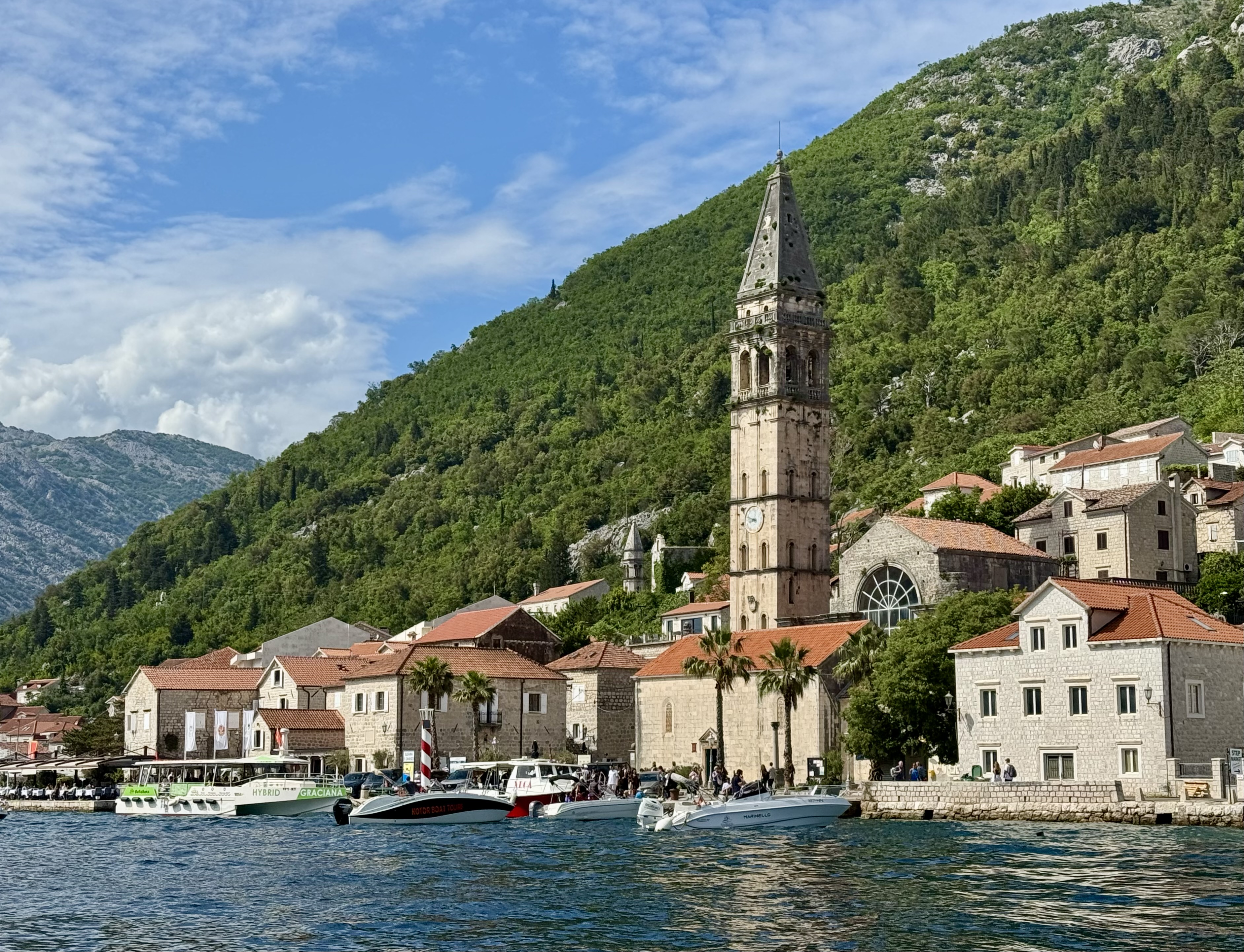
Disappearing borders
With a stack of passports in hand, a young North Macedonian border-control officer entered our van and walked down the aisle. His face was solemn. One by one, he held the passport photos up to our faces and looked for matches. Old school.
In 2026, all European Union (EU) border crossings in the Schengen Area switched to a new system. (The Schengen Area currently comprises twenty-nine European countries.) Now, when travelers first enter the area, photos of their faces and scans of their fingerprints are required. These images are stored in a database for three years.
When travelers enter and exit the area, border-control officers simply verify digital IDs.
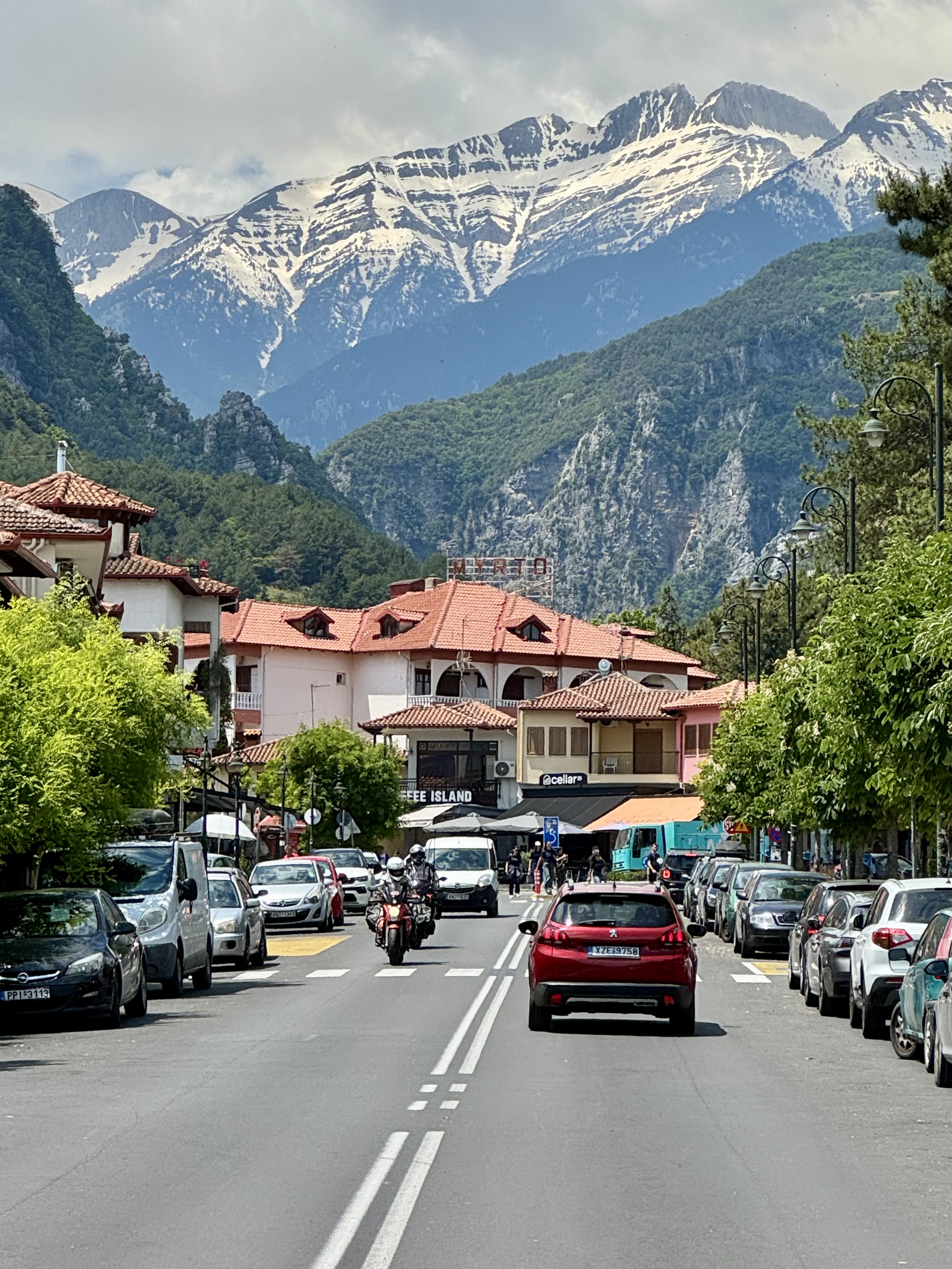
Passports are still required, but no longer stamped. The process is faster and more secure. Once inside the area, borders between countries are open.
During the tour, we crossed the borders of five countries, only two of which, Croatia and Greece, are EU members with up-to-date technology.
Montenegro, Albania, and North Macedonia are currently in the process of applying. To join the EU, a country must promote its common values—freedom, democracy, human rights, human dignity, and the rule of law. Meeting the required conditions takes an average of nine years.
Upon acceptance, Montenegro, Albania, and North Macedonia’s member-facing border stations will disappear. Until then, crossing into and between these countries is time-consuming.
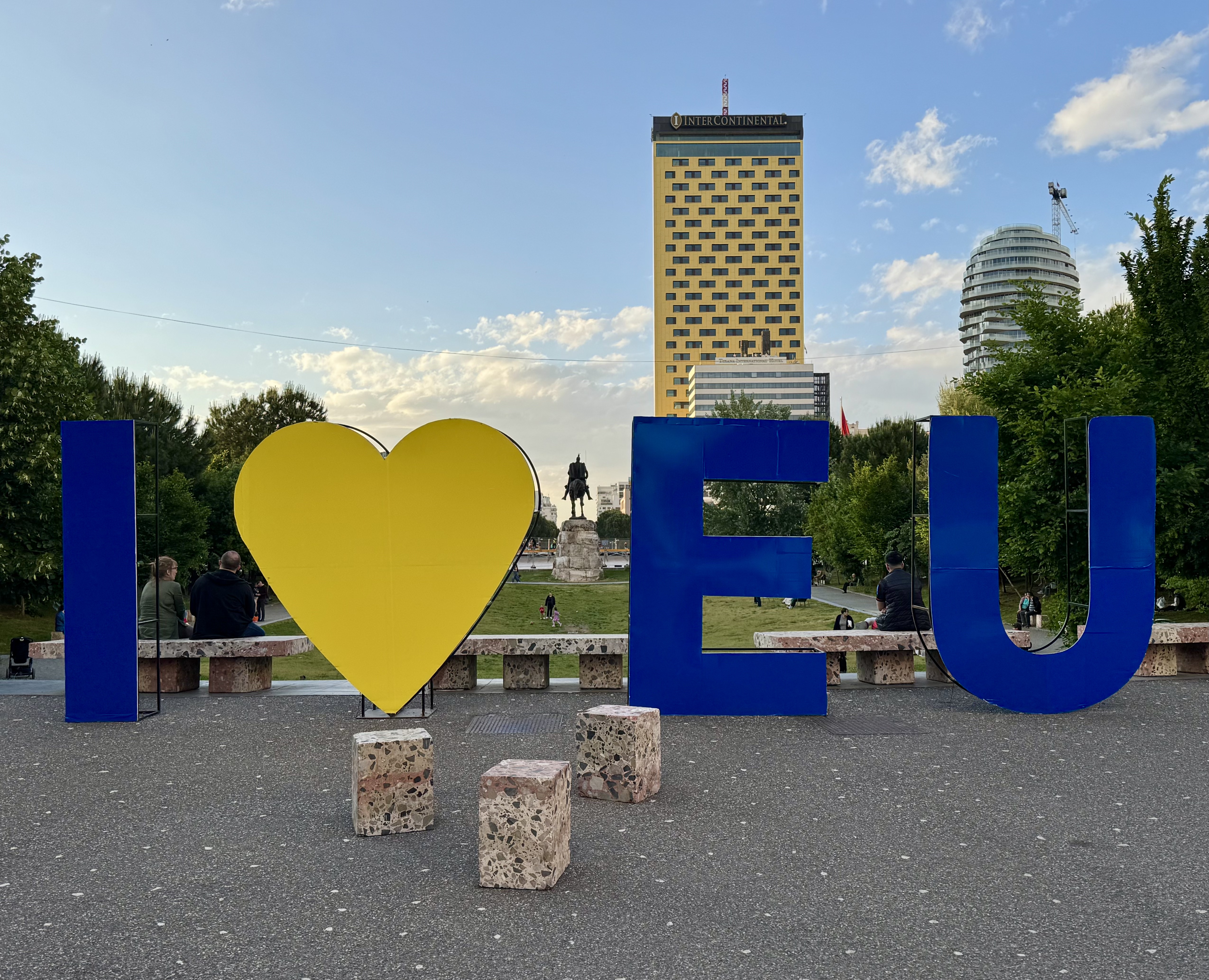
Albania is building public support for its membership process through a public-relations campaign.
Signs reading I♥️EU are posted all over Tirana, the country’s capital.
Sea dogs and cats
Passing numerous wild-boar crossing signs, we headed southeast through Croatia toward Montenegro. Our driver anticipated a traffic jam at the usual border crossing and took a back road to a more remote checkpoint.
Montenegro is slightly smaller than Connecticut with a population of over six hundred thousand. The name means black mountain. The country, independent for only twenty years, has five official languages—Montenegrin, Serbian, Bosnian, Albanian, and Croatian.
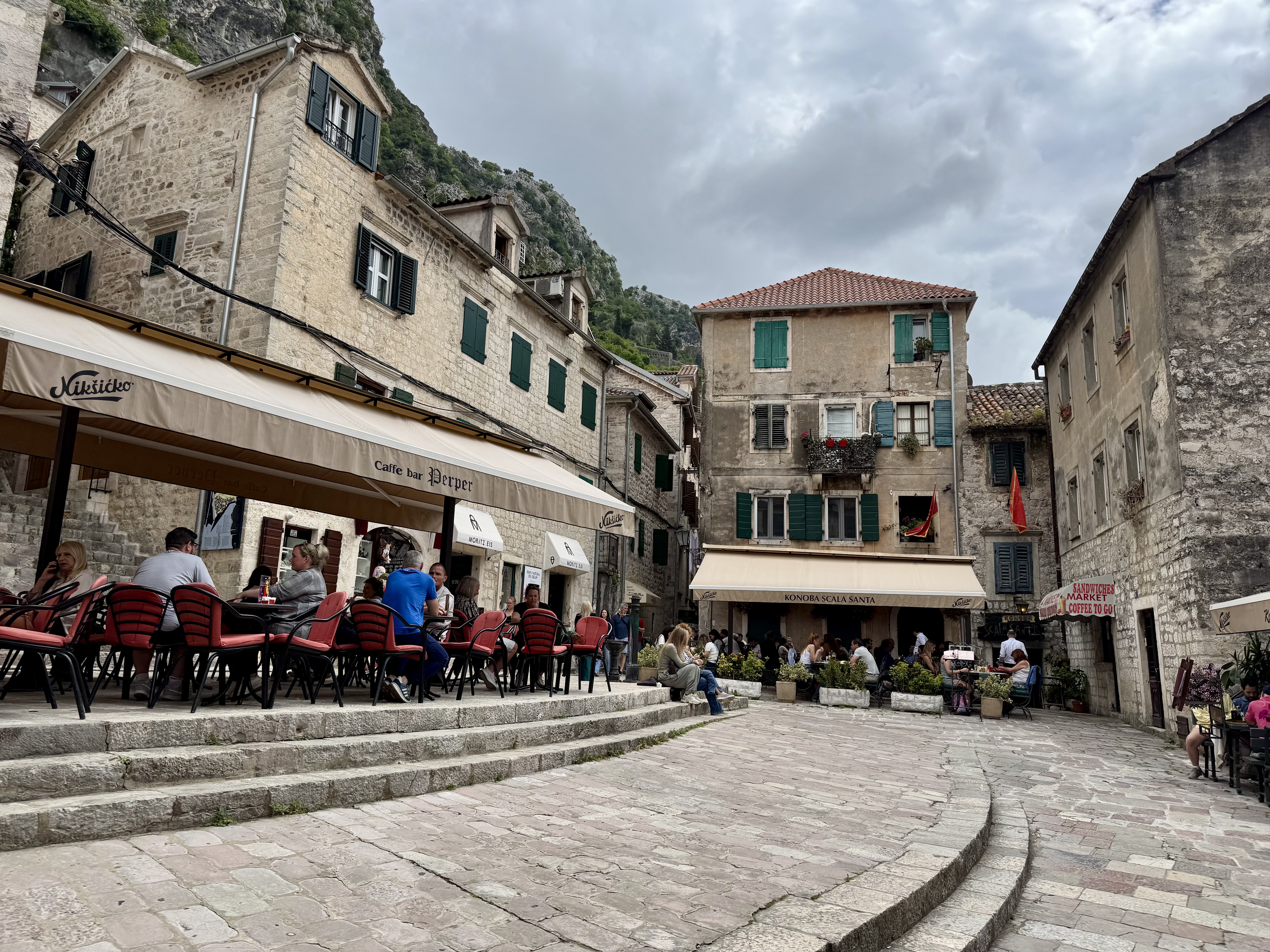
Montenegrins share their Cyrillic alphabet, Orthodox religion, and culture with their Serbian neighbors. Seventy-five percent of Montenegrins see themselves as either Serb or descendants of Serbs.
We arrived in Kotor, a town of thirteen thousand on Kotor Bay, which connects with the Adriatic Sea.
The town, the surrounding cliffs, and portions of the bay have been designated a UNESCO World Heritage Site twice—once for the area’s natural beauty and once for the town’s architecture and extensive fortification system.
Kotor was part of the Republic of Venice for nearly four centuries and benefited from the Venetians’ building skills. On top of the peak behind the town is the Fortress of Saint John.
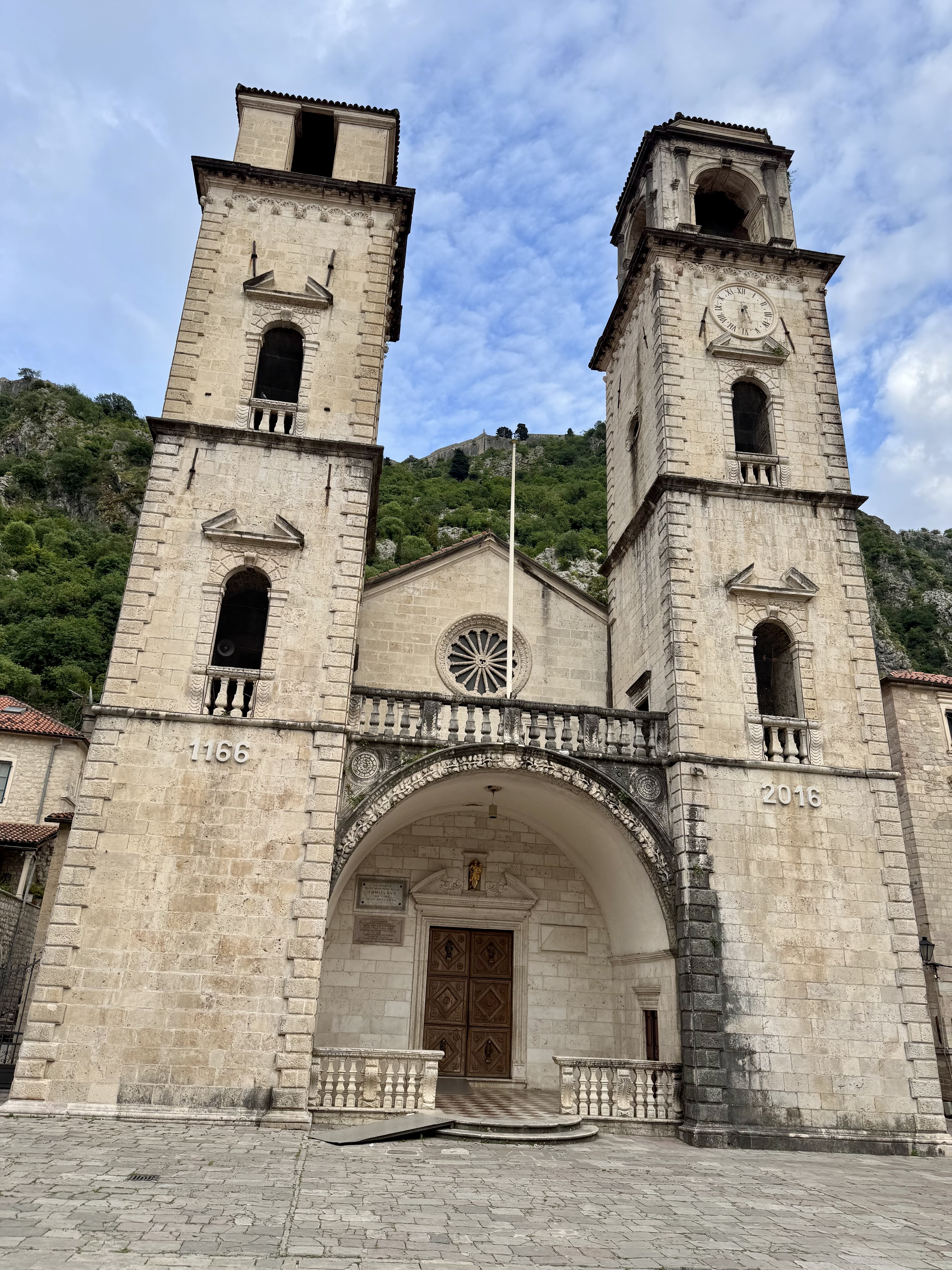
Kotor, Montenegro
Walls and towers zigzag down the face of the crag from the fort to the town below, which is protected by additional gates, ramparts, and towers. Kotor is one of the best preserved medieval towns in the Adriatic.
An abandoned Cold War naval base quietly flanks the entrance from the Adriatic Sea into Kotor Bay. The base, built by Yugoslavia in the 1970s, had three tunnels, their entrances camouflaged with vegetation and fake rocks.
The tunnels were used to hide submarines from enemy aircraft and launch torpedo boats against enemy ships.
The base fell into disuse after Yugoslavia dissolved in 1992. The largest of the three tunnels is a popular destination for boat tours, and once hosted a late-night party featuring techno music and dancing.
Kotor is home to hundreds of stray cats. They range freely around the old town, accepting treats and lounging on park benches.
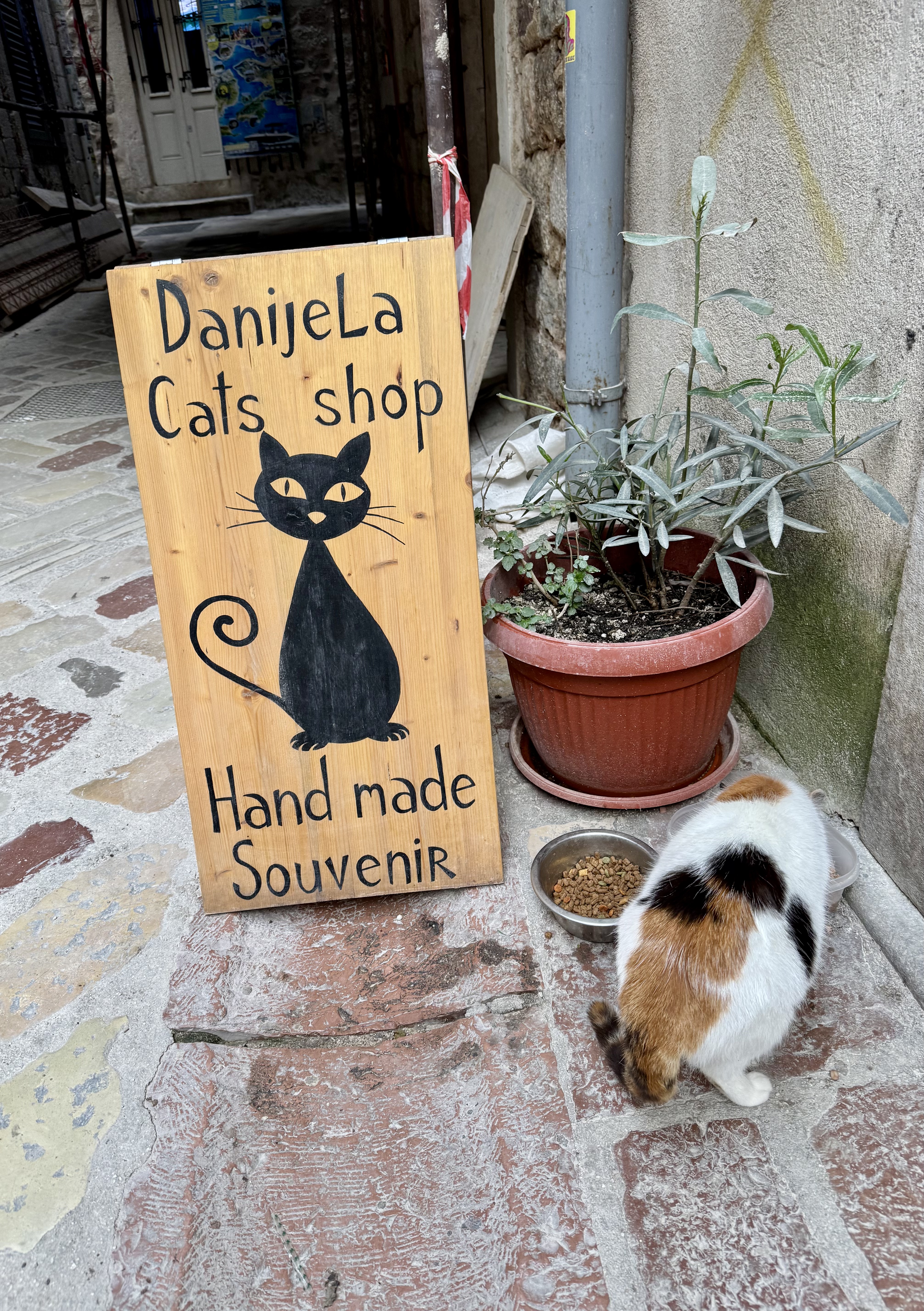
Some locals say the cats were brought to Kotor by Austro-Hungarian sailors who were anchored in the area during World War I. In 1918, an insurrection, called the Cattaro Mutiny, occurred, involving thirty warships and over three thousand sailors. (The Venetian name for Kotor is Cattaro.) The rebellion ended after three days. Four sailers were court-martialed and executed.
Meanwhile, the cats have flourished and emerged as a hallmark of Kotor. The town has a cat museum, a cat park, and numerous stores selling cat-themed souvenirs to tourists. A tourist-funded charity works to neuter, medicate, and provide food for the population.
Stealing from pirates
A few miles down the coast is the island of Saint Stephen. According to legend, community members paid for the construction of fortifications against pirates—by robbing pirates. During the siege of Kotor in 1539, they looted the ships of the pirate-turned-Ottoman-admiral Hayreddin Barbarossa, also known as Redbeard.
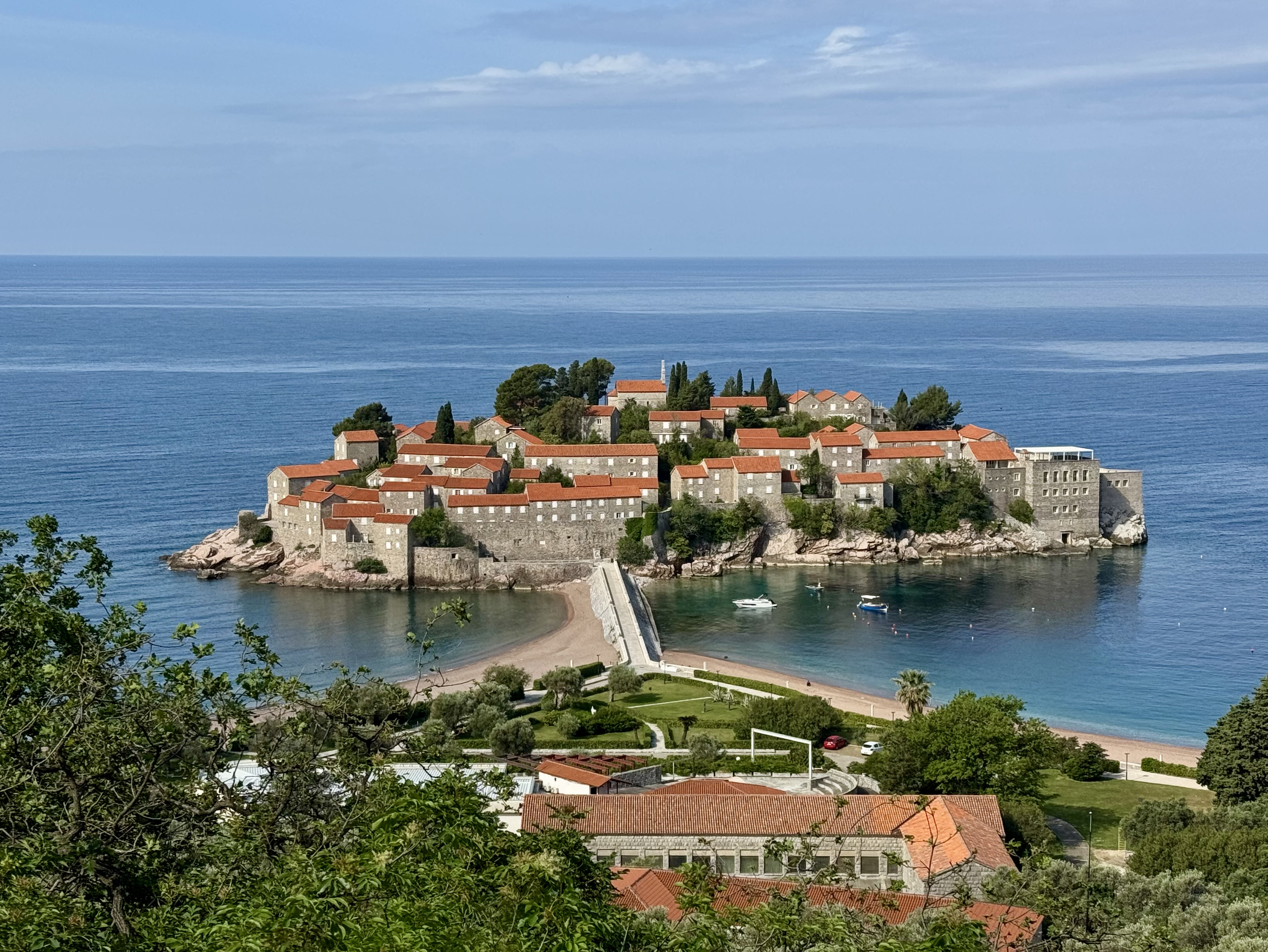
The island is known for its five-star resort and glamorous history. Some of its visitors have included Sophia Loren, Princess Margaret, Kirk Douglas, Orson Welles, Doris Day, Sidney Poitier, Sylvester Stallone, Jeremy Irons, Elizabeth Taylor, Marilyn Monroe, Claudia Schiffer, Soviet astronaut Yuri Gagarin, and chess grandmaster Bobby Fischer.
While waiting in line for the border crossing into Albania, we bought strawberries and figs from vendors on the side of the road.
Albania is slightly larger than Maryland with a population of two-and-a-half million. Although ruled by the Ottomans for nearly five centuries, the country has retained its distinct cultural identity. However, because atheism was promoted during nearly fifty years of communism, most Albanians do not practice religion.
The Albanian language fascinates linguists because it is a descendant of the ancient Illyrian tongue, spoken during the Bronze and Iron ages.
Sacrificial act
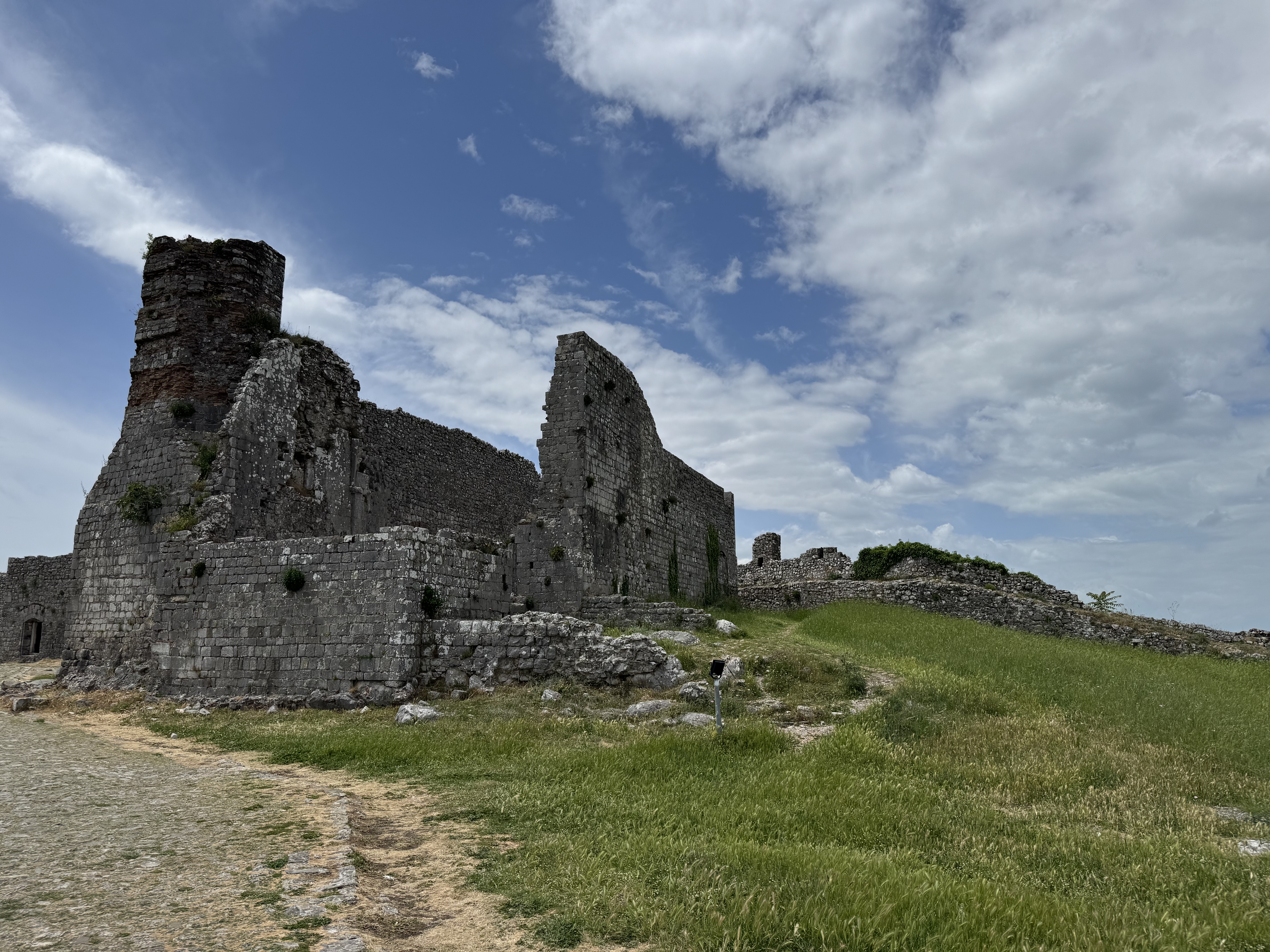
We disembarked near Shkodër to hike to Rozafa Castle. The earliest walls were built by the Illyrians and are dated to the 300s-200s BCE. However, the most visible walls of the castle are Venetian.
Rozafa Castle has been the site of several sieges, as well as a famous Albanian legend that goes like this: Three brothers were working to build the castle. Each day they erected walls, each day their wives brought them a midday meal, and each night the walls collapsed.
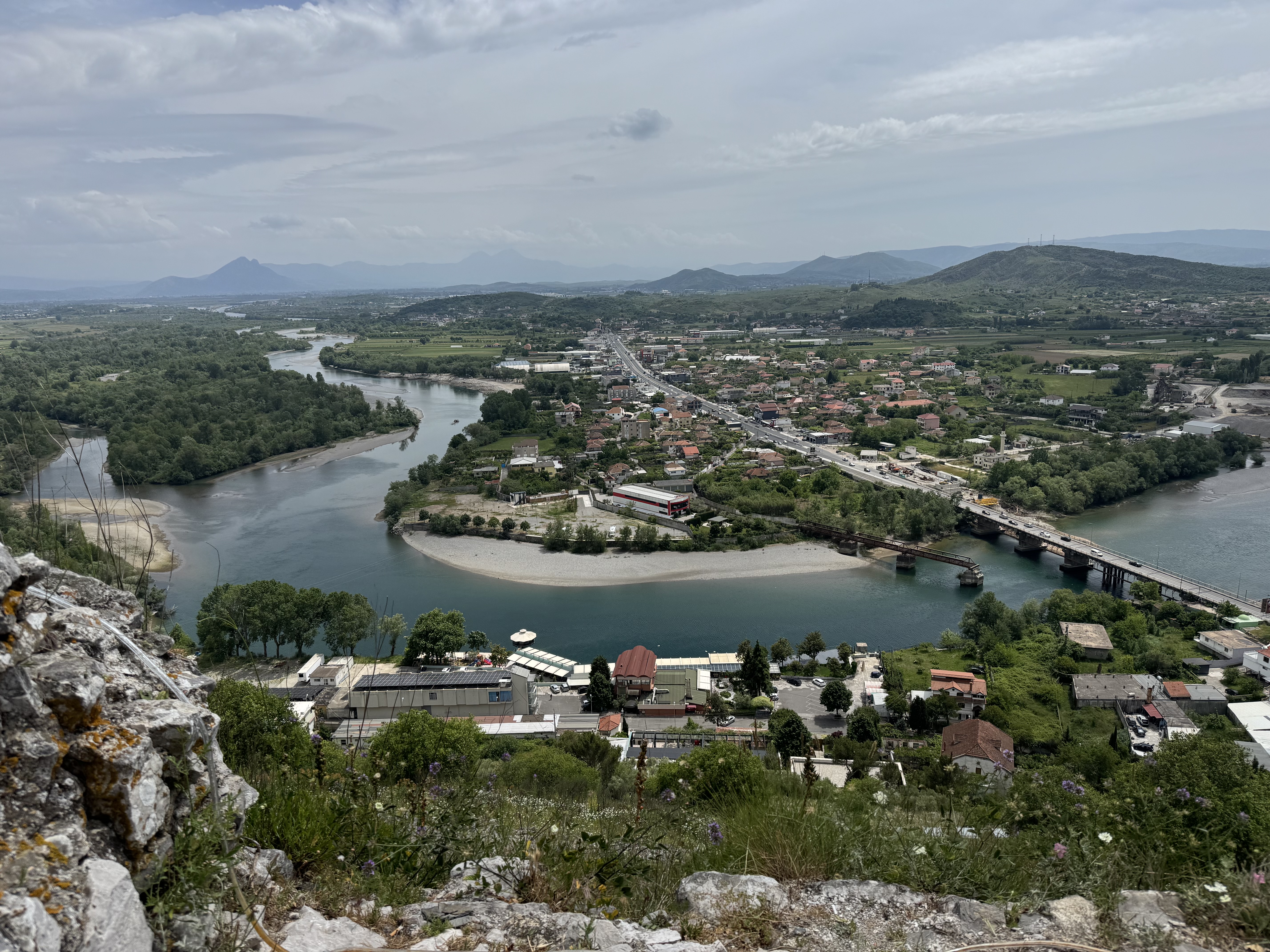
They consulted a village elder who said, “Your walls will never stand and protect your people unless you bind them with a human sacrifice. If you want to finish the castle, the first wife who brings you food tomorrow must be buried alive within the walls.”
The three brothers swore to each other not to reveal the plan to their wives, but that night the two older brothers broke their vows. The youngest kept his oath and said nothing.
The next day, the wives of the two older brothers made excuses for delaying their visits to the work site. However, Rozafa, the wife of the youngest, delivered food to her husband as usual.
Upon her arrival, she was given the bad news. She didn’t protest, but made a request. “When you wall me in,” she said, “leave a hole so that I may comfort my young son when he cries.”
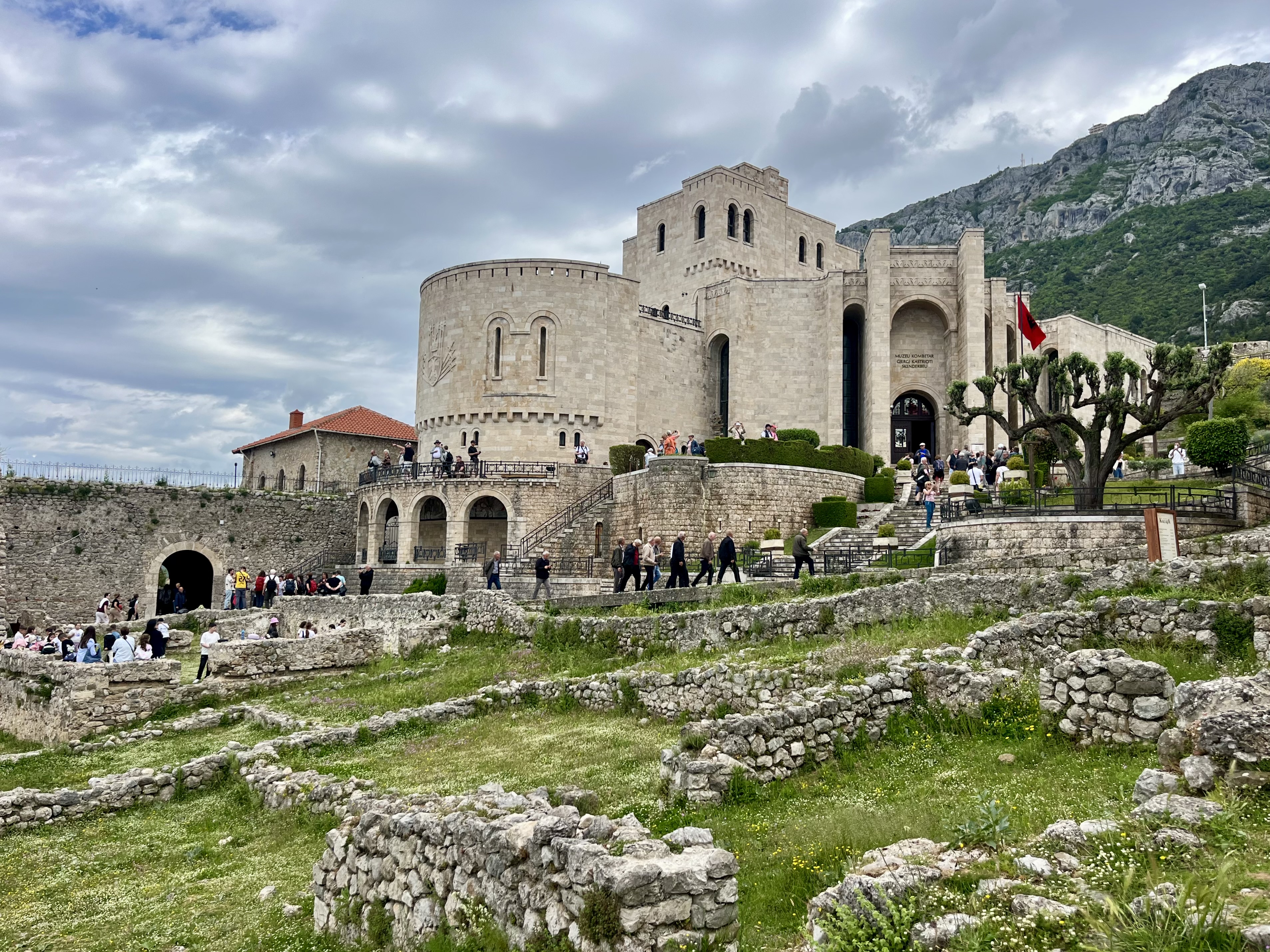
Krujë, Albania
Traditionally, this story has been interpreted by Albanians as an example of how personal sacrifice (Rozafa’s) serves the well-being of the community (Albania). A contemporary reading recognizes misogyny and murder.
Father of his country
The van climbed a steep winding road though a jumble of crumbling yellow and white high-rises seemingly sliding down the face of the mountain. On top, another castle awaited us in the village of Krujë (KRU ya), once the capital of Albania and now home to a museum chronicling the life of Albania’s greatest hero, a former Ottoman hostage.
The Ottoman (Turkish) Empire existed for more than six hundred years, from the 1300s to the 1900s. As it expanded into the Balkans in the early 1400s, the Turkish sultan employed a cruel strategy for guaranteeing the loyalty of conquered regions. He took as hostages the sons of the noble families his forces had defeated.
An insurance policy.
The boys were not held in prisons, however. Instead, they attended the best military schools and were trained to become future leaders.
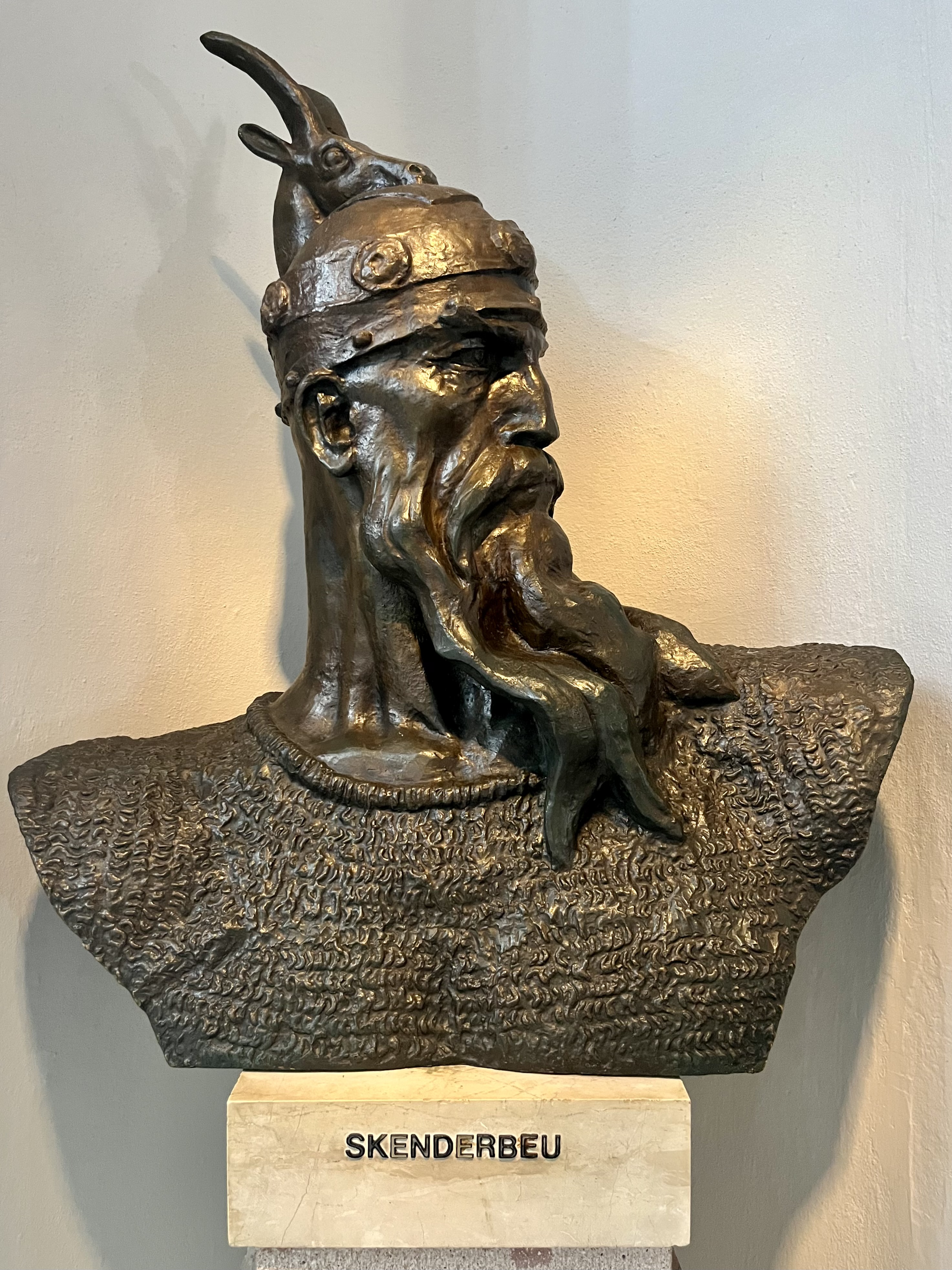
One such hostage was an Albanian boy named Gjergj Kastrioti. Gjergj was tall and powerfully built. The swing of his sword, it was said, could cleave a man in two. He served the sultan for twenty years.
Then, in 1443, he deserted the Ottomans, abandoned Islam, and became the ruler of Krujë, the then-capital of Albania. He unified the Albanian tribes under his family’s coat of arms, which depicted a black double-headed eagle on a blood-red field.
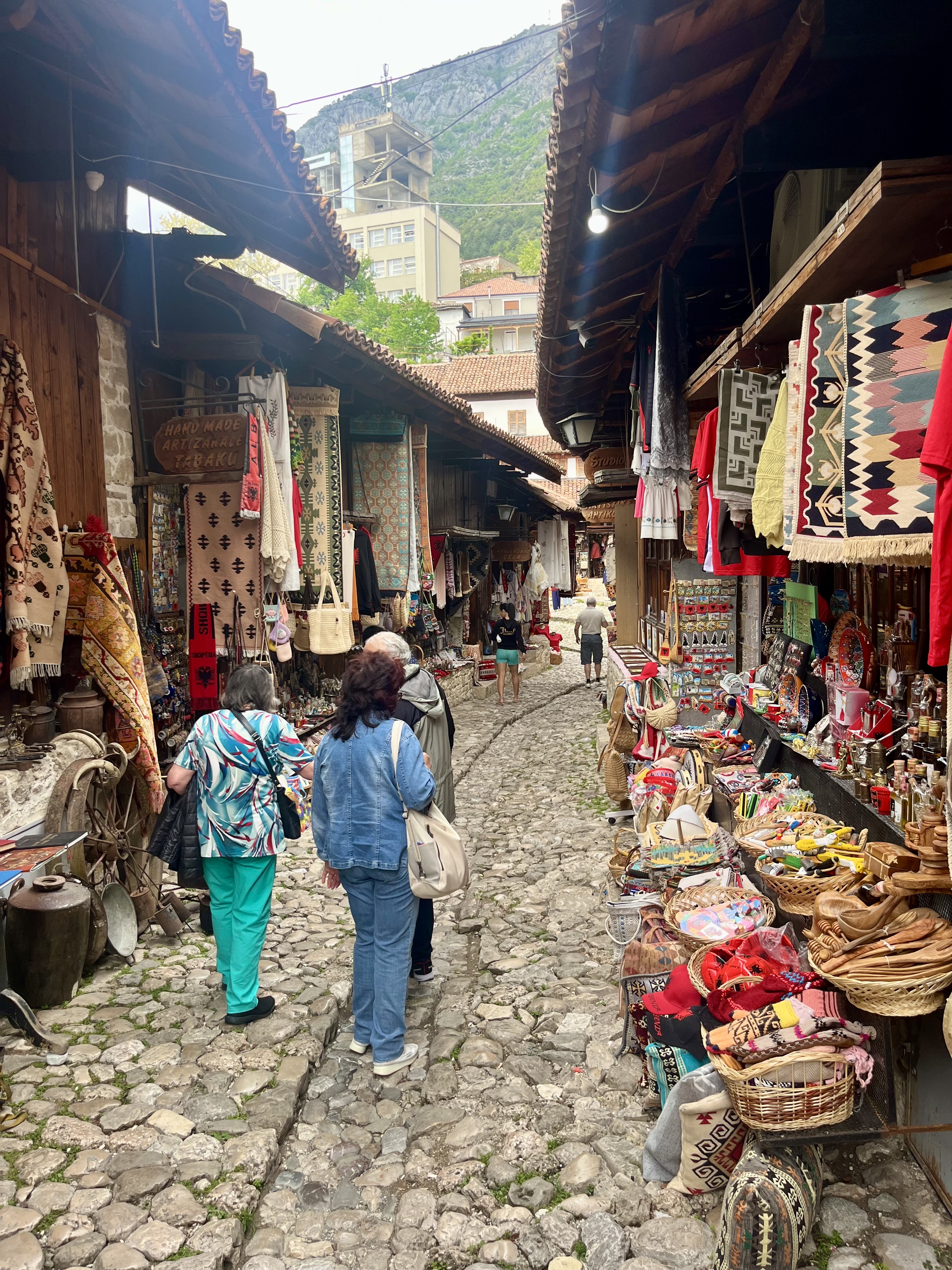
The Ottomans called him Iskender beg (in Albanian, Skanderbeg), meaning Alexander the Lord, a begrudging nod to the military prowess of Alexander the Great.
For twenty-five years, Skanderbeg’s army of ten thousand stymied Ottoman advances.
Using guerrilla tactics and the rugged Albanian terrain to his advantage, Skanderbeg forced the Ottomans to divide their troops, thus exposing them to hit-and-run attacks.
Skanderbeg successfully defended Krujë against three Ottoman sieges—1450, 1466, and 1467—winning against larger and better-supplied forces.
Skanderbeg unified Albania and inspired its quest for independence. He is as revered by Albanians as is George Washington by Americans. When Albania finally gained its independence from the Ottoman Empire in 1912, Skanderbeg’s flag was adopted as its national flag.
He is commemorated widely in literature, theater, film, sculpture, an opera by Antonio Vivaldi, and a poem by Henry Wadsworth Longfellow:
Anon from the castle walls
The crescent banner falls,
And the crowd beholds instead,
Like a portent in the sky,
Iskander's banner fly,
The Black Eagle with double head;
And a shout ascends on high,
For men's souls are tired of the Turks,
And their wicked ways and works,
That have made of Ak-Hissar
A city of the plague;
And the loud, exultant cry
That echoes wide and far
Is: "Long live Scanderbeg!"
The museum also honors Pyrrhus, a Greek general who lived during the 300s-200s BCE. He was a fierce opponent of ancient Rome. Hannibal called Pyrrhus the second greatest commander the world had ever seen, behind Alexander the Great.
Several of Pyrrhus’s wins resulted in heavy losses.
Following one such victory, he remarked, “If we are victorious in one more battle with the Romans, we shall be utterly ruined.” Thus, the phrase Pyrrhic victory.
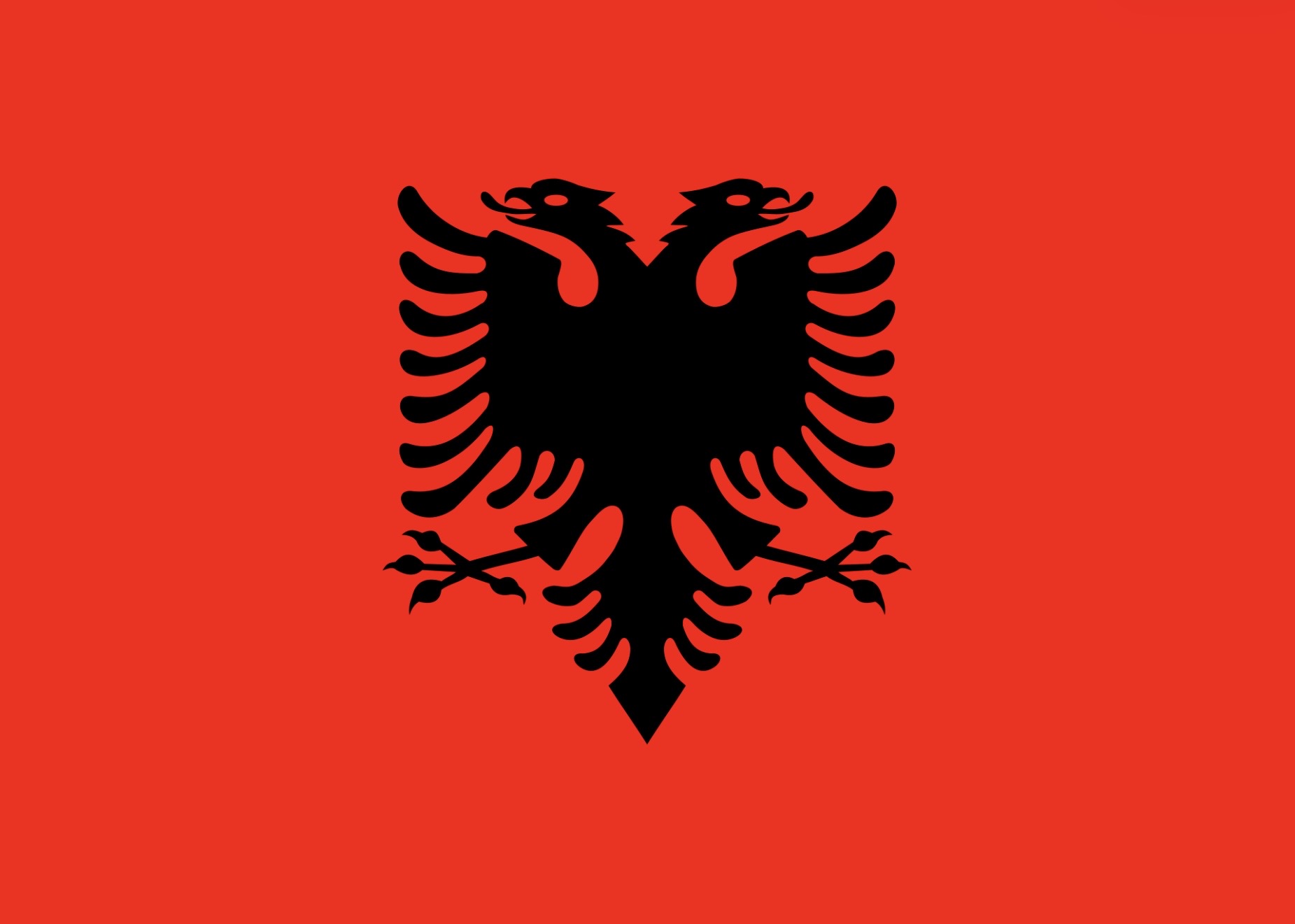
After touring the museum, we strolled through a steep, cobbled bazaar, still thriving since Ottoman times. Artisans were making leather shoes and weaving carpets. Goats and sheep roamed through the village.
Bunker mentality
In the center of Tirana, a statue of Skanderbeg sits at the edge of Skanderbeg Square and surveys a new high-rise in the shape of Skanderbeg’s head. The medieval warrior’s visage is portrayed through irregularly curved balconies that wrap around the new twenty-six-floor building.
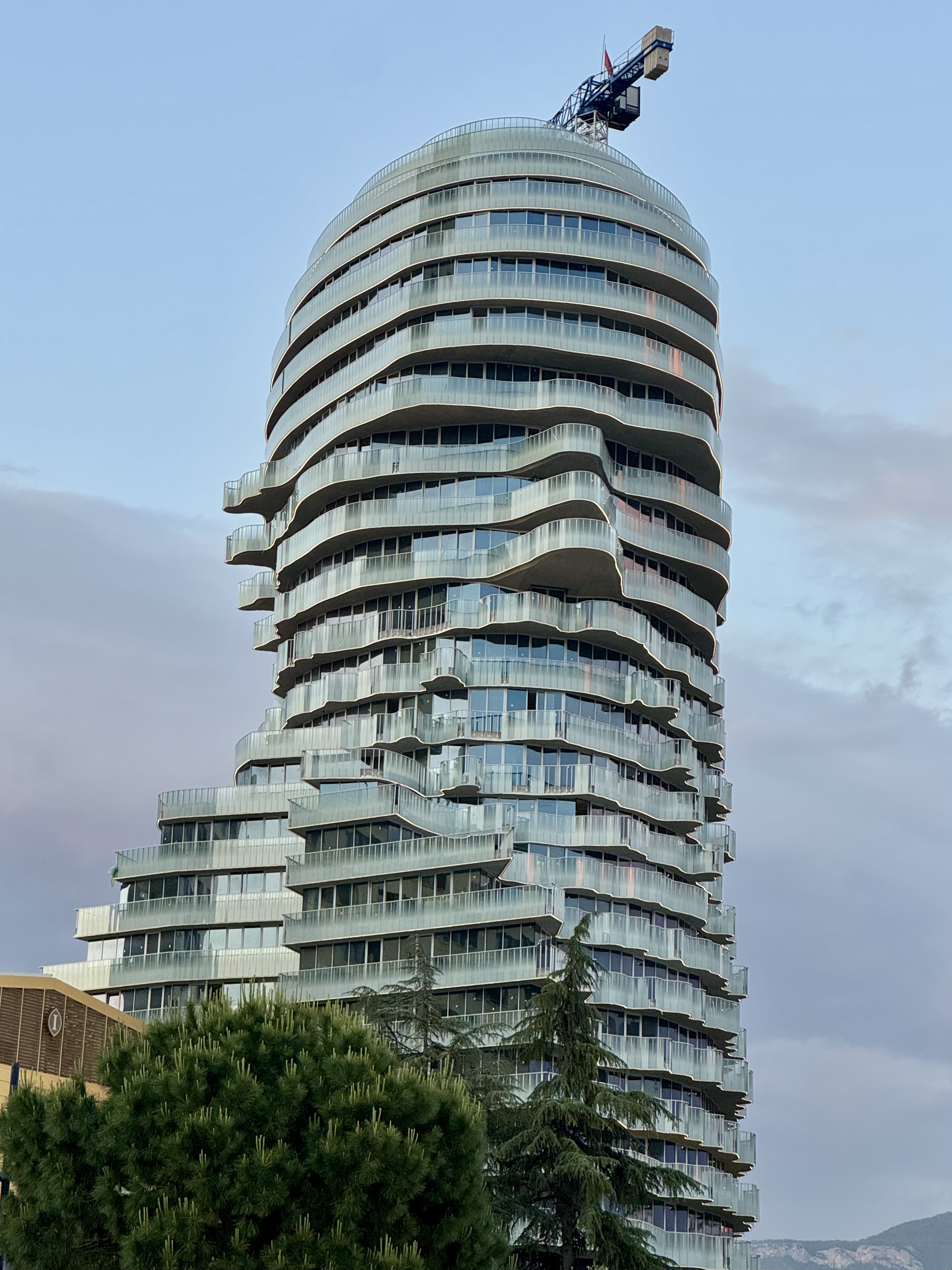
Tirana, Albania
The Skanderbeg Building is not the only fanciful architecture in Albania’s modern capital of eight hundred thousand. A team of internationally renown architects, handpicked by Albania’s prime minister, is dramatically transforming the skyline and redefining the city as cutting-edge and future-facing.
Yet, there are vestiges of the city’s oppressive past. Albania’s communist dictator, Enver Hoxha, isolated the country from the outside world for over forty years. He was paranoid about the possibility of nuclear or chemical warfare. In the 1970s and 1980s, he bunkerized Albania; that is, he directed the building of over 175,000 bunkers around the country.
The war never came. The bunkers were abandoned following Hoxha’s death in 1985 and the dissolution of the government in 1992. Most are now derelict, although some have been repurposed as homes, cafés, warehouses, or shelters for the homeless.
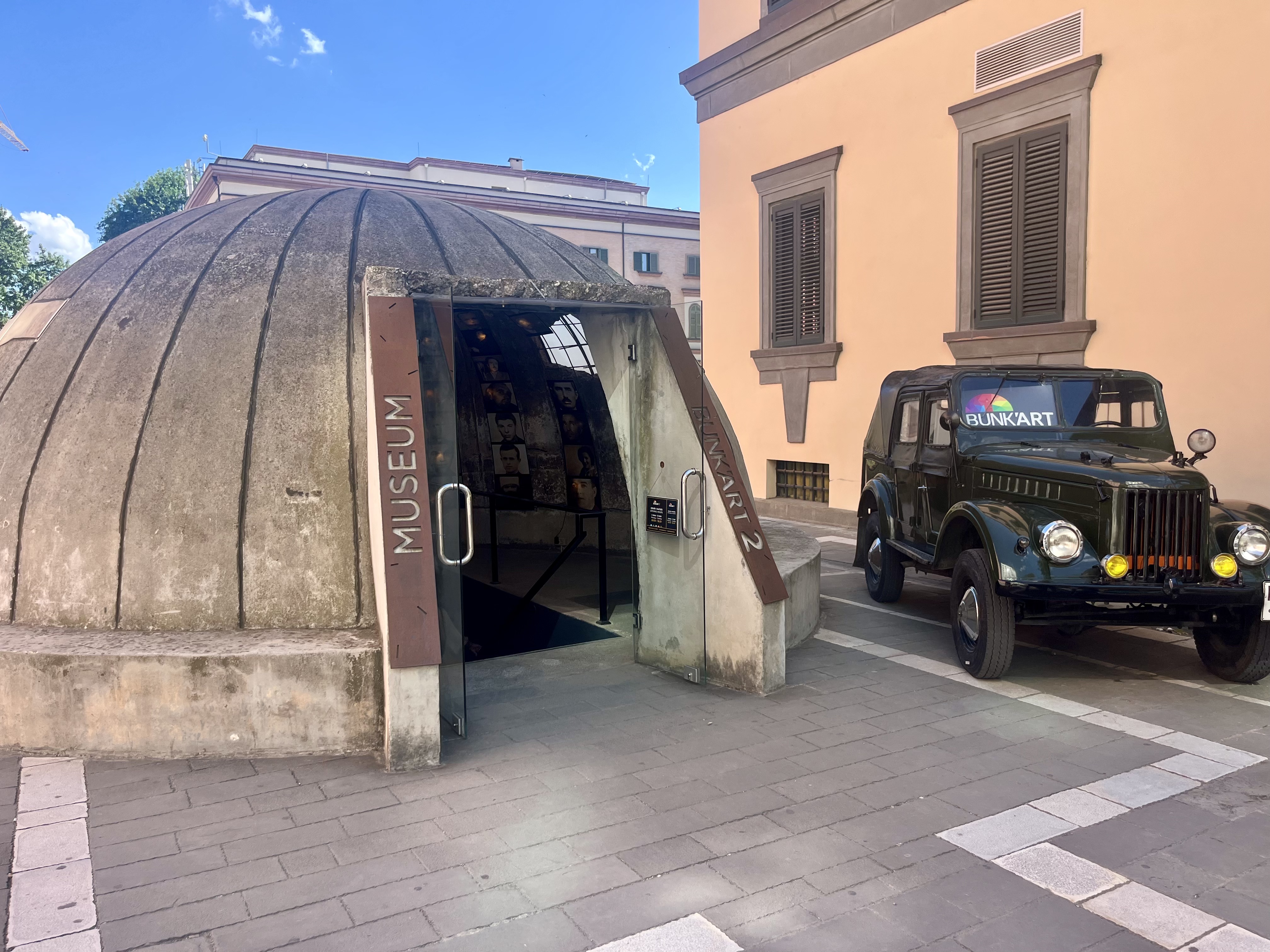
Craig and I visited Bunk’Art 2, a bunker-cum-museum that tells the story of the persecution of Albanian citizens by secret police. Built in the 1980s, this large bunker had twenty-four rooms, an apartment once reserved for the minister of internal affairs, and a large hall once dedicated to spying.
We also visited the Museum of Secret Surveillance (also known as the House of Leaves), located in the former headquarters of Sigurimi, the government’s brutal spy agency. Sigurimi was organized into units addressing censorship, public records, prison camps, security, counterespionage, and foreign intelligence.
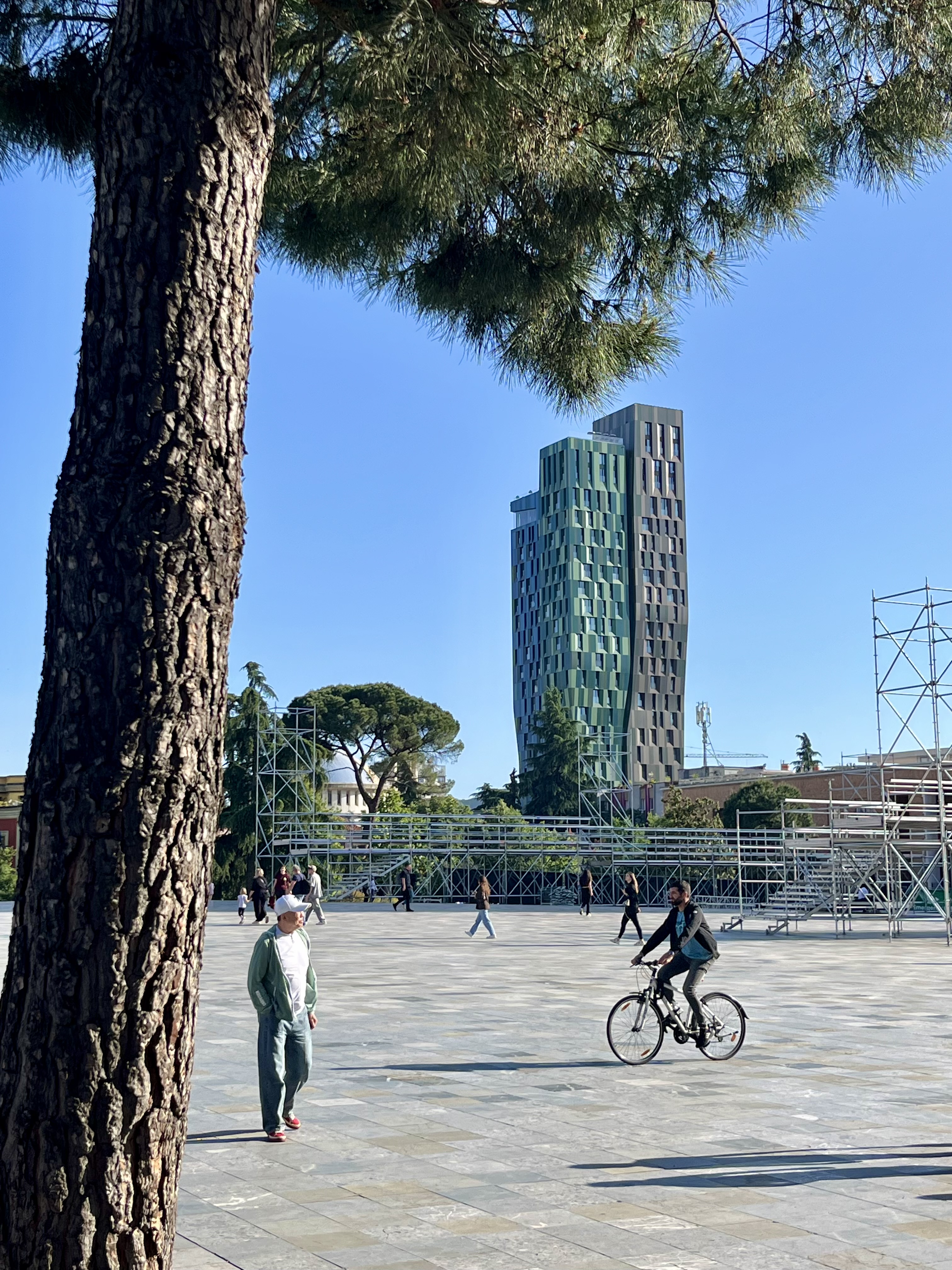
During Sigurimi’s existence, every third Albanian citizen was interrogated at the House of Leaves or served time in a labor camp. Most of the records of the atrocities have been destroyed. The museum is dedicated to “the innocent people who were spied on, arrested, prosecuted, convicted, and executed during the communist regime.”
President George W. Bush visited Albania in 2007, the first U.S. president to do so. A street in Tirana was renamed for him. In the village of Fushë-Krujë, we spotted a statue of Bush, as well as a bakery and bar named for him.
In 2008 he approved NATO membership for Albania and Croatia.
Vicious cycle
Before the tour I read Broken April by Albanian Ismail Kadare. Author of over eighty works, Kadare was nominated for the Nobel Prize fifteen times, so often, he joked, that people assumed he had won it.
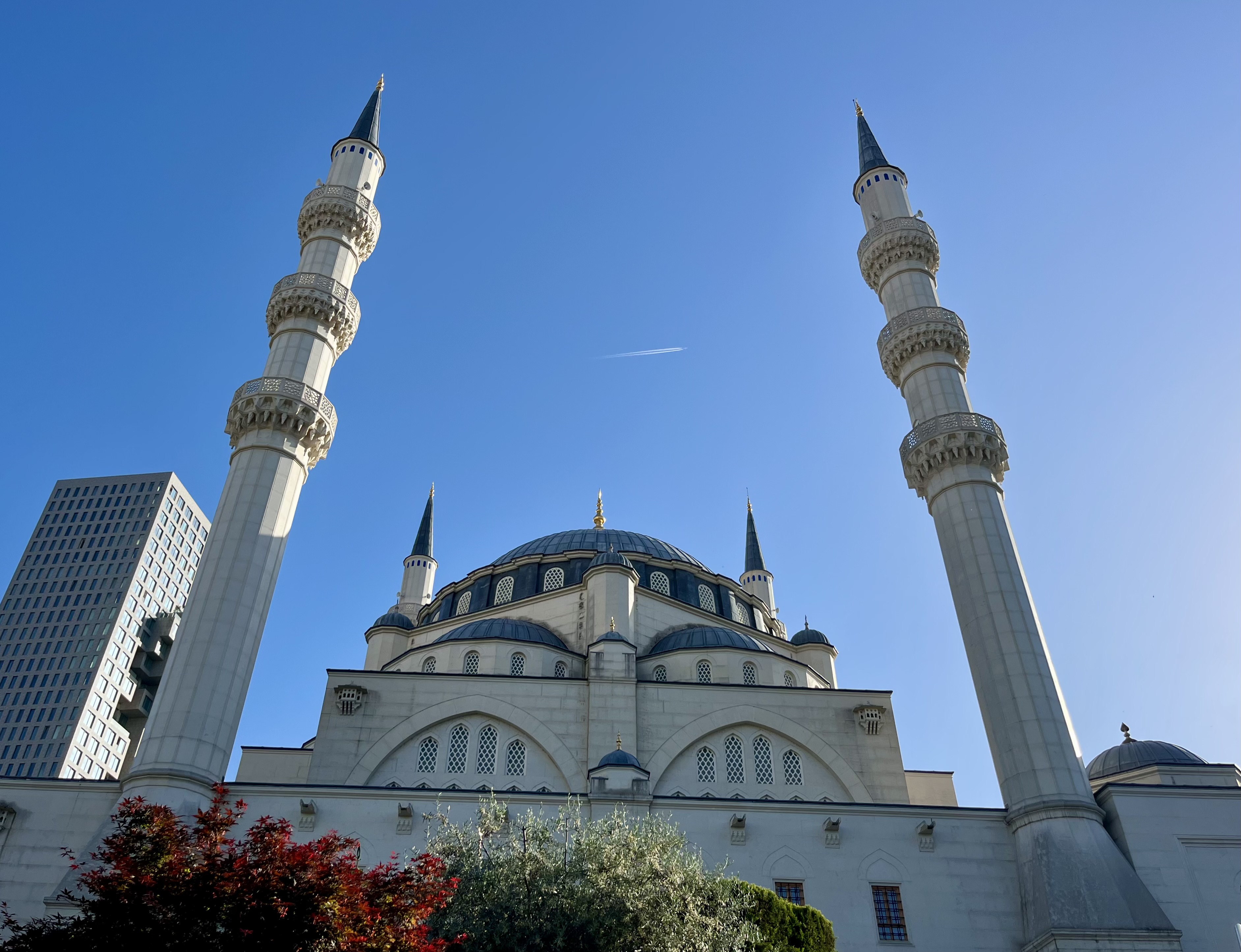
Kadare’s stories often needled Albania’s ruling party and, because dictators are typically thin-skinned, incurred its wrath.
“This novel was published by the bourgeoisie and this cannot be accepted,” said one report by the secret police.
Kadare lived in Tirana for thirty years in an apartment that now houses his museum. With each published book, his international reputation grew. Ironically, Kadare’s fame saved him from execution. After offending the authorities in 1995, he was sentenced to a work camp near the town of Berat for two years.
Broken April is set in the Accursed Mountains. The Accurseds are a subrange of the Dinaric Alps in northern Albania with sixty summits over a mile high. Few people live in the Accurseds, one of the most rugged areas of Europe.
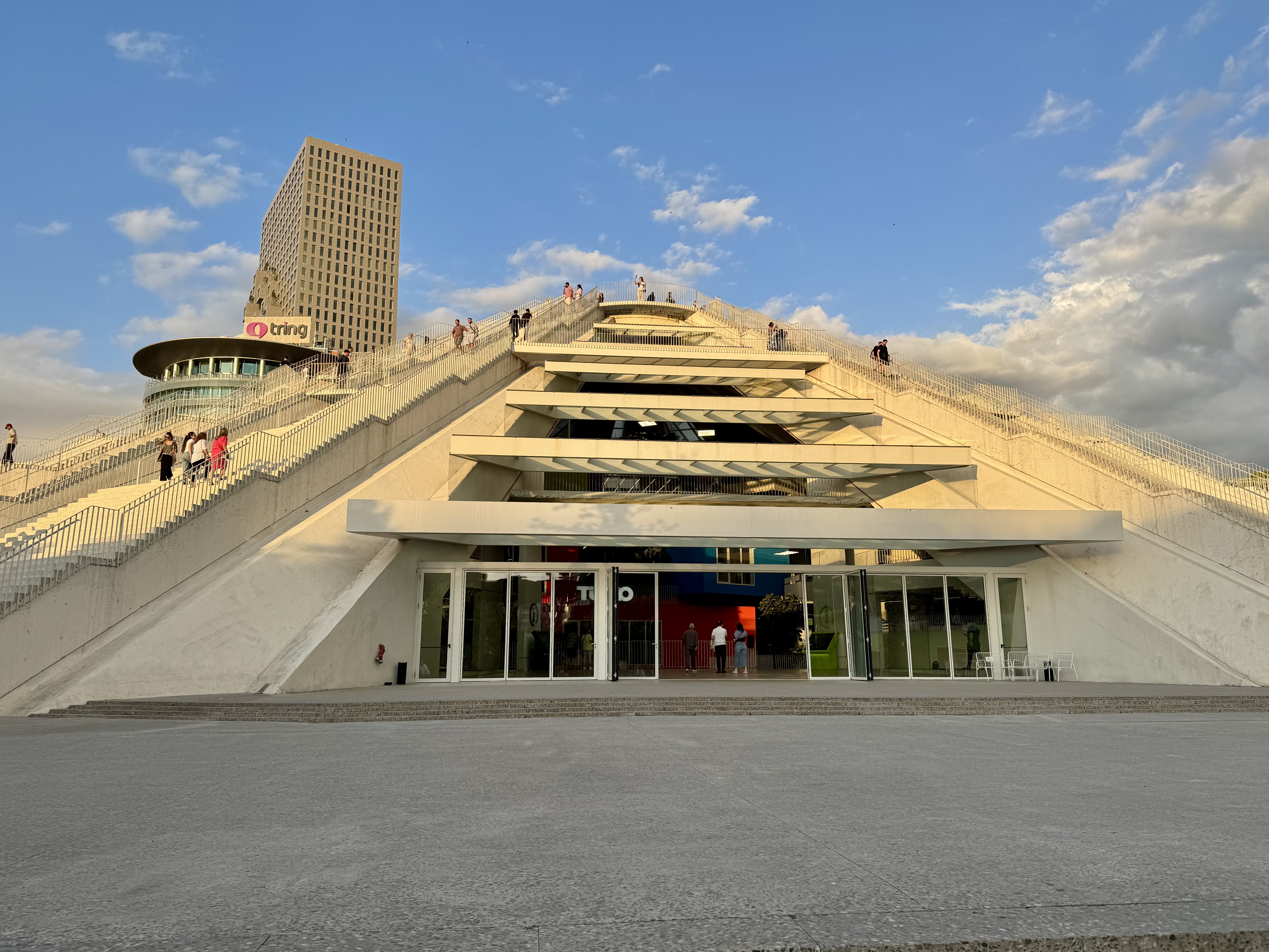
The novel describes a centuries-old set of customary laws called the Kanun, which give guidance to Albanian society.
An important component of the Kanun is the solemn oath that promises made to family and friends must be kept.
In the story a young man is obliged to commit a murder in order to avenge his family’s honor and, in doing so, continues a cycle of revenge killings.
Friends and family
We headed south from Tirana and found a wasteland of abandoned factories and mines, followed by farmland with olive trees, goats, sheep, and donkeys. In one village, every single yard sprouted a rusty oil-well pumping jack. Scores of them.
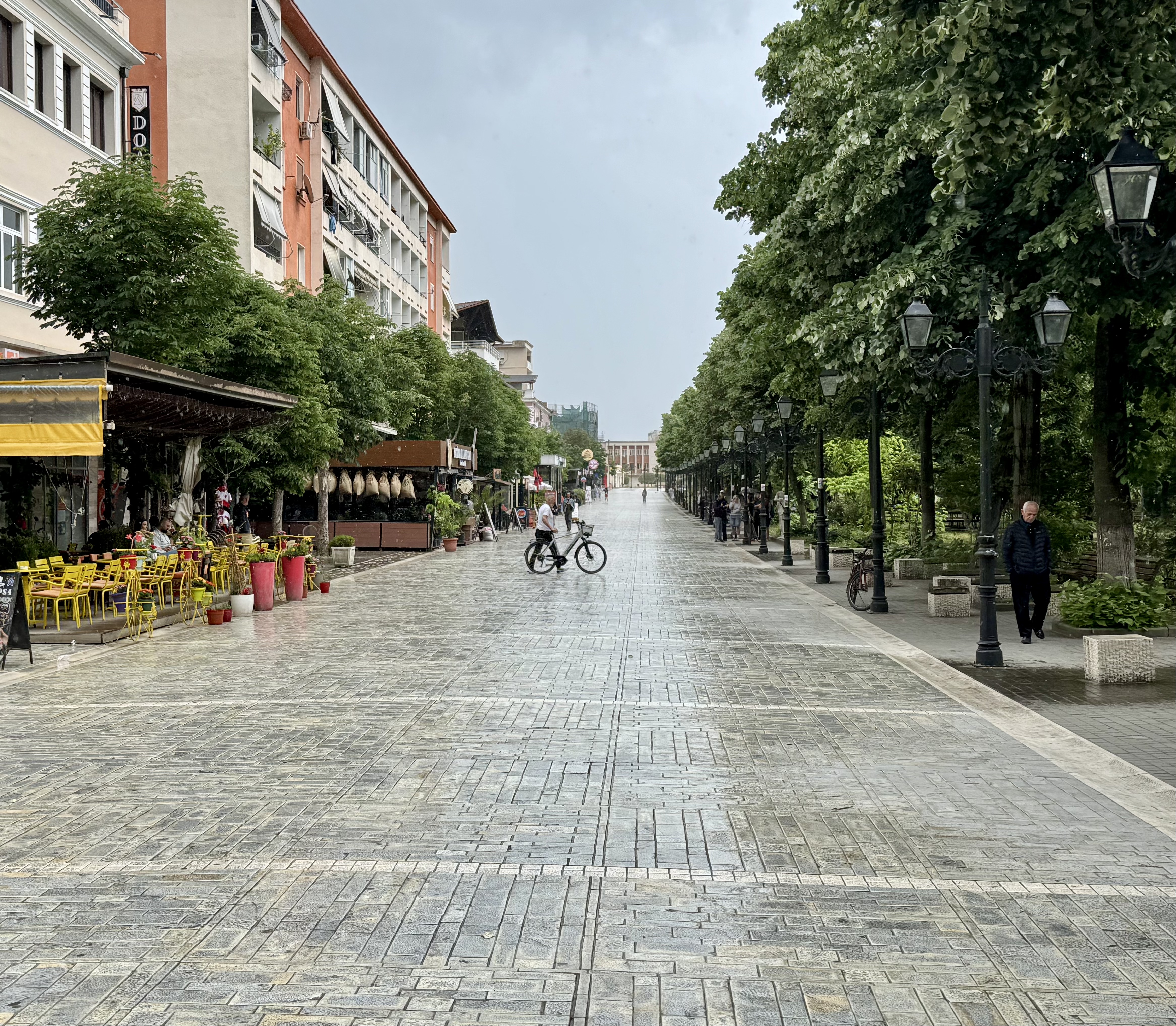
We arrived in Berat, known as the Town of One Window Above the Other, due to the many homes stacked over the Osum River.
Above the town are the remnants of Berat Castle. The original fort was burned down by the Romans in 200 BCE, then rebuilt and razed a few more times. The current ruins date from the 1200s and once contained twenty Orthodox churches and a mosque.
During World War II, sixty Muslim and Orthodox families in Berat concealed Jews in their homes, making Albania the only country in Nazi-occupied Europe to see an increase in its Jewish population. The Jews were shielded in observance of the Kanun, as described in Ismail Kadare’s book—the solemn vow to defend one’s neighbors and friends.
Villas and huts
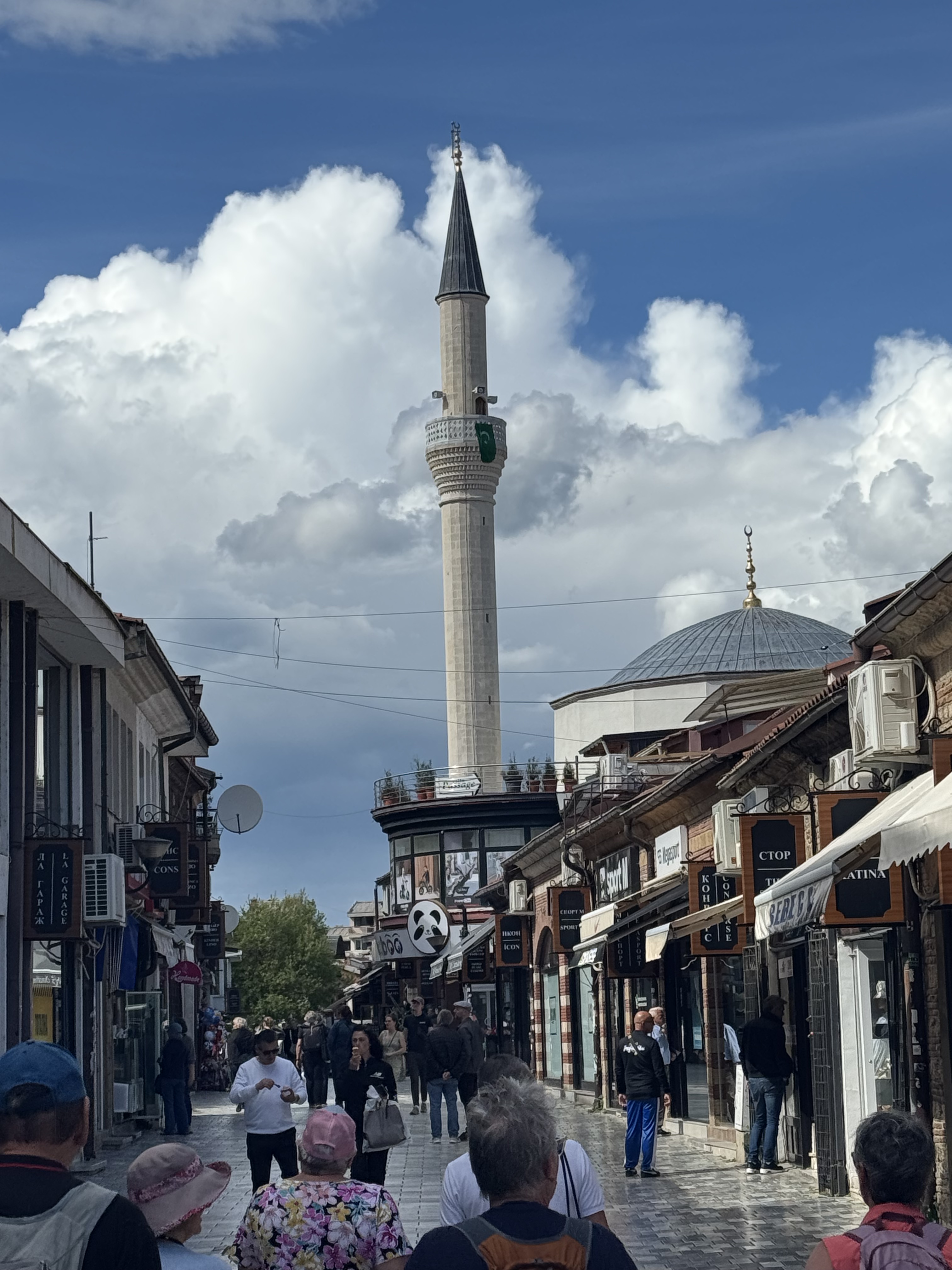
After an evening of wine and song in a rainy garden restaurant, we crossed another border, this time into North Macedonia, a landlocked country similar in size to Vermont. In the lakeside town of Ohrid we visited an ATM to acquire denari, North Macedonia’s currency.
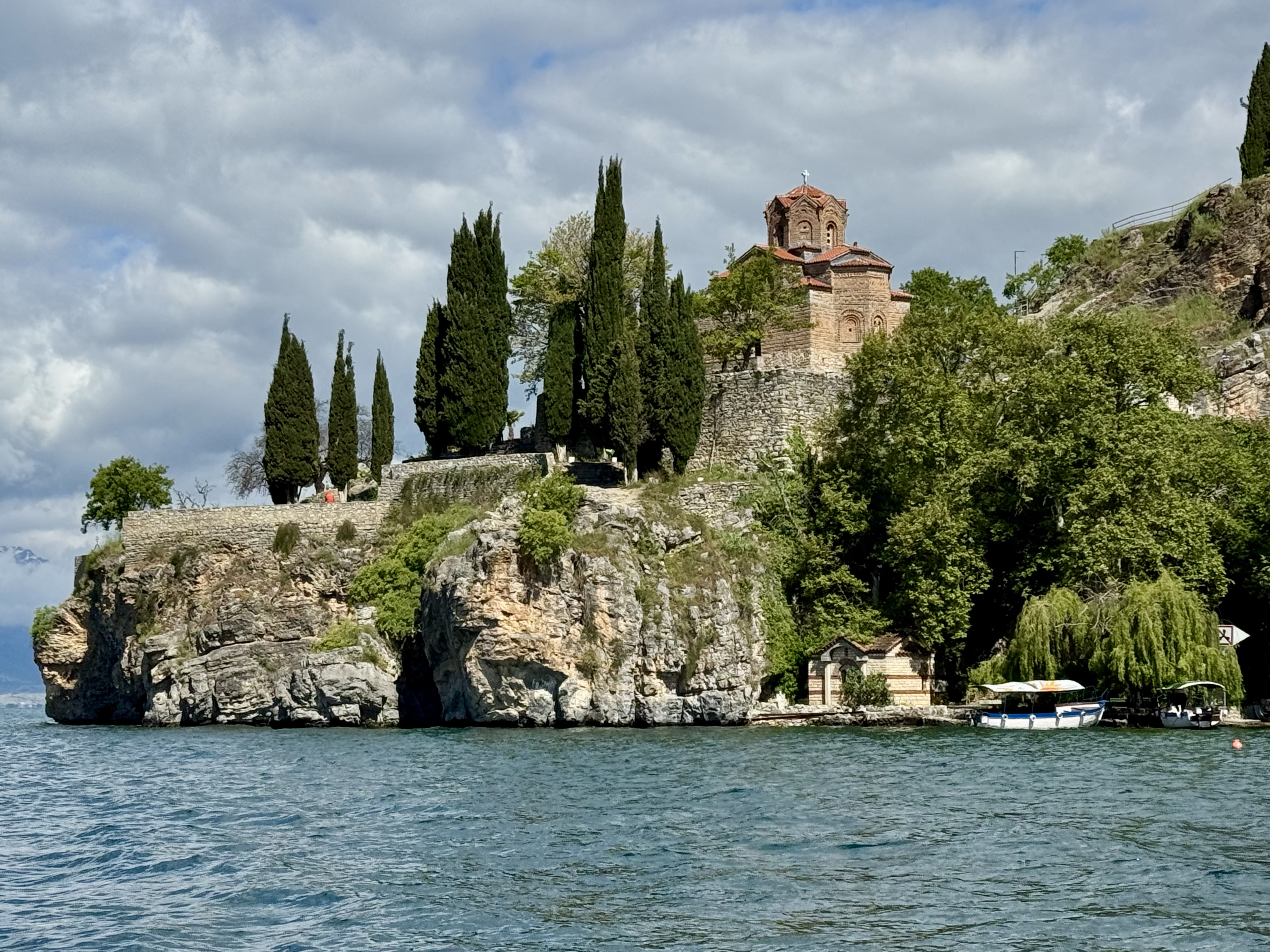
Lake Ohrid straddles the mountainous border between North Macedonia and Albania. The lake, covering 138 square miles, is one of the oldest in the world. In 2010 NASA named a gaseous lake on one of Saturn’s moons after Lake Ohrid.
After World War II, the country of Yugoslavia was formed as a federation of six republics: Croatia, Slovenia, Bosnia-Herzegovina, Serbia, Montenegro, and Macedonia. (Albania was not part of the group.) The commander of the Balkan resistance against Nazi Germany, Josip Broz Tito, became president of the federation.
After Tito’s death in 1980, the republics split apart.
North Macedonia
A series of ethnic wars followed during the 1990s, primarily involving Bosnia-Herzegovina, Croatia, and Kosovo.
During his decades in office, Tito accumulated dozens of grandiose properties for both official and personal use, including one on a rocky cliff overlooking Lake Ohrid. Today, the villa is owned by the North Macedonian government.
Down the shore from the villa is a village of huts. During archaeological excavations at the lake between 1997 and 2005, researchers found six thousand wooden piles driven into the lake bed, covering an area of two acres. At the base of the piles, the team found stone artifacts, broken ceramic vessels, and fragments of animal bones.
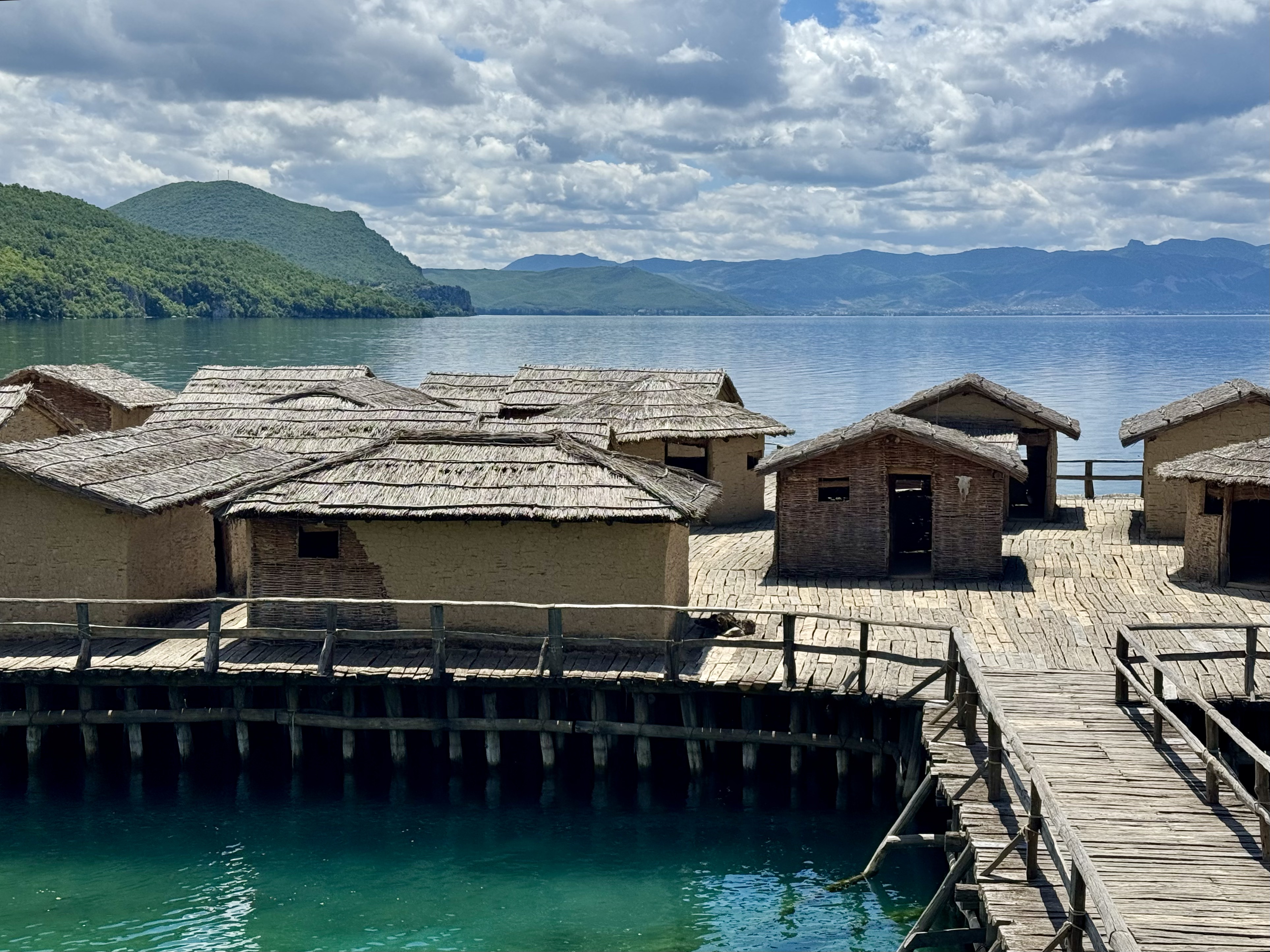
The piles once served as the foundation of an ancient settlement of around twenty huts, built upon a wooden platform over the water. The settlement is dated between 1200 to 700 BCE.
Living on the platform over the lake would have provided villagers with easy access to fish and protection from intruders.
At a reconstruction of the settlement at the Museum on Water in Lake Ohrid’s Bay of Bones, we walked among the huts, while scuba divers swam in clear water beneath the platform.
Naming rights
Alexander the Great became king of Macedonia at the age of twenty and spent all of his life conquering his neighbors.
He was born in the town of Pella, which at the time was within the empire of Macedonia, but is now within the country of Greece. He was tutored by the philosopher Aristotle until the age of sixteen. By the age of thirty, he had expanded Macedonia’s reach from Greece to Egypt to India, making it one of the largest empires in history.
The portion of ancient Macedonia that is in the Baltics includes both the current country of North Macedonia and a territory in northern Greece, sometimes called Greek Macedonia. Also, parts of Bulgaria, Albania, Serbia, and Kosovo.
Alexander died at the age of thirty-two, of either natural causes (fever) or murder (poison), depending upon the source. He was never defeated in battle and is considered one of history’s greatest military commanders.
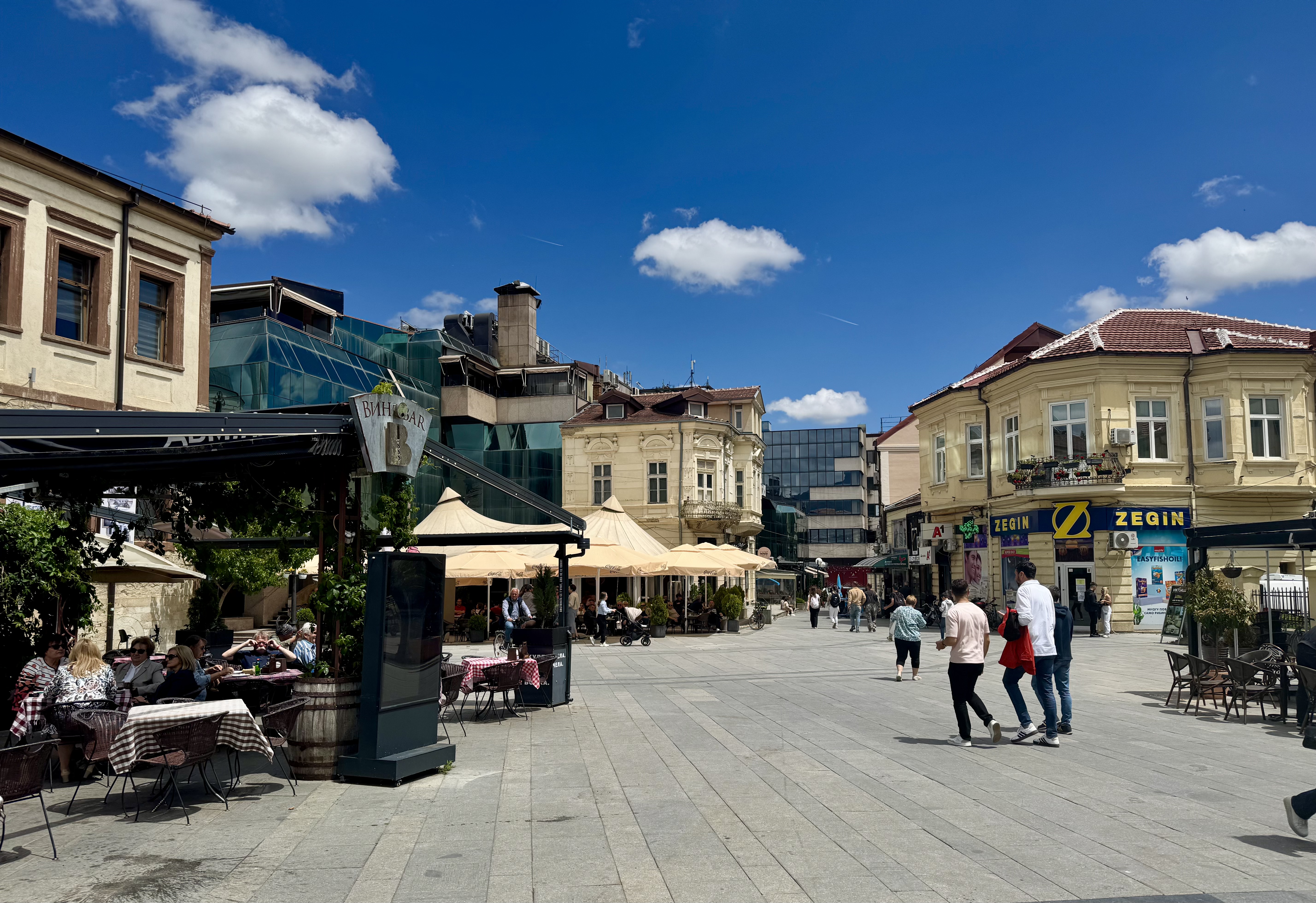
Macedonia was divvied before World War I among Greece, Bulgaria, and Serbia. The Serbian portion became the Republic of Macedonia. When the republic declared its independence from Yugoslavia in 1991, Greece objected, arguing that “republic of” in the name implied territorial claims to Greek Macedonia.
This dispute lasted for almost twenty years until the United Nations helped settle it. Finally, the Republic of Macedonia agreed to change its name to the Republic of North Macedonia.
The new country also agreed to stop appropriating symbols of Greek heritage, such as the images of Alexander the Great and his father, Philip II.
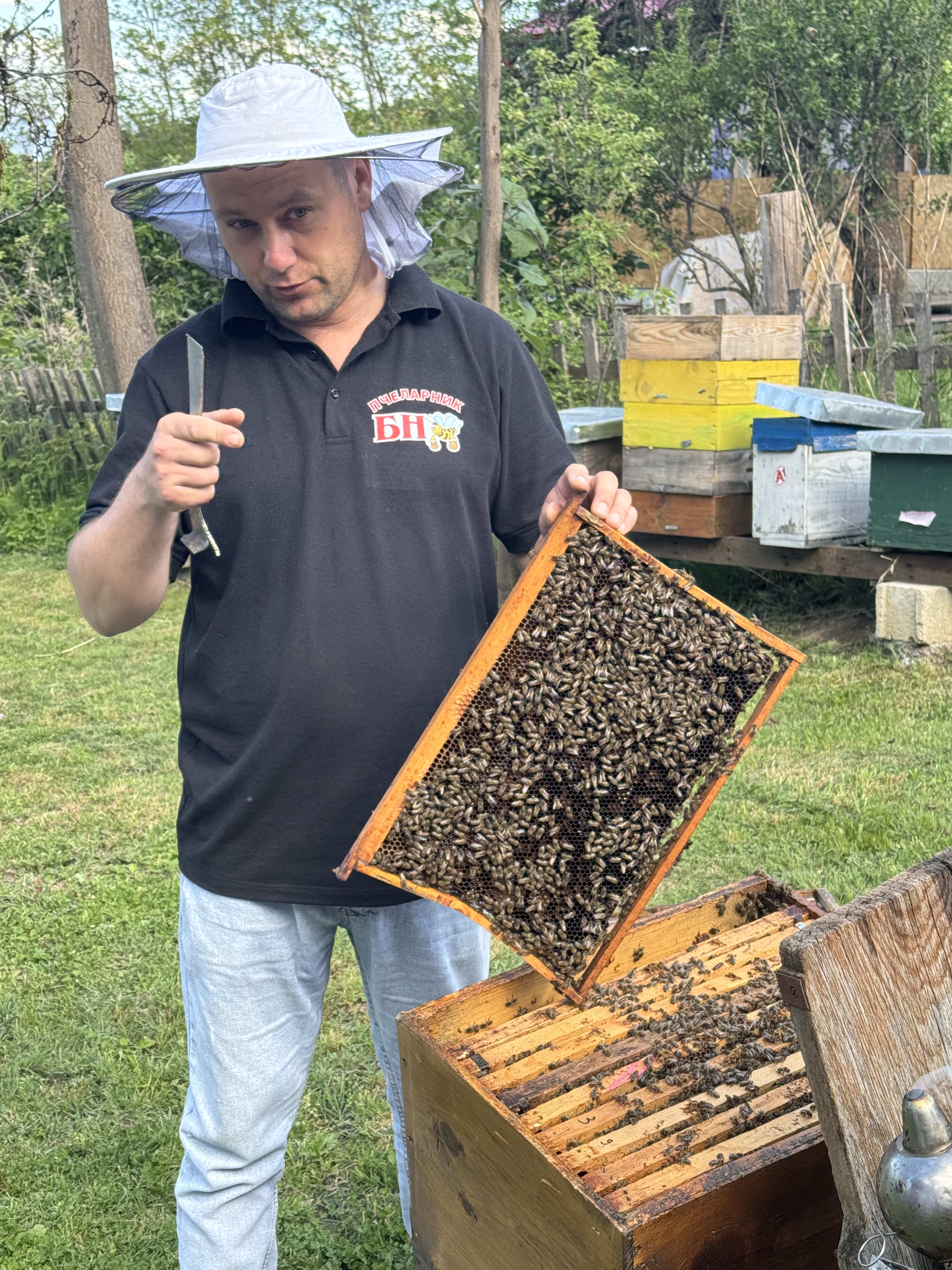
The agreement recognized that the Macedonian language, a south Slavic language, is distinct from Greek. Shortly thereafter, North Macedonia was approved to join NATO and is on track to become a member of the EU.
Theme park
We headed north through dramatic green mountains to Skopje (SKOHP yah), North Macedonia’s capital. Clumps of bright red poppies bordered the highway. The city is home to a quarter of the country’s population of almost two million.
An earthquake in 1963 leveled eighty percent of Skopje. To help rebuild, an architectural competition was arranged by the United Nations, resulting in a cityscape of brutalist design.
Brutalism is known for minimalist construction using bare building materials, such as unpainted concrete.
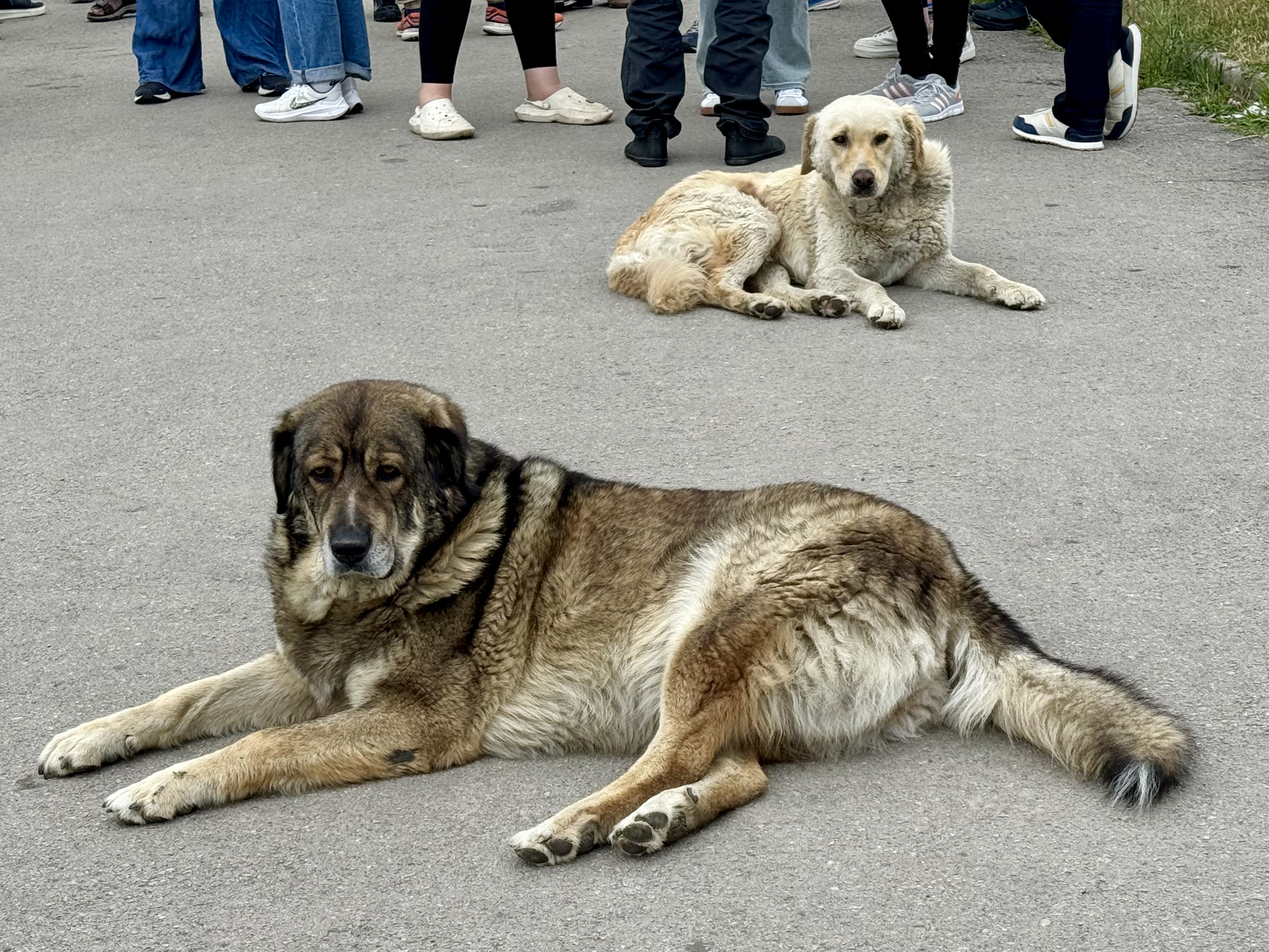
All around the city we saw a large breed of dog called Šarplaninac, named for the Šar Planina mountain range in the Balkans. It has also been called an Illyrian, Yugoslavian, or Macedonian Shepherd Dog. In Ottoman times, the breed guarded flocks of sheep. Now they lounge quietly around the city, apparently neutered and vaccinated.
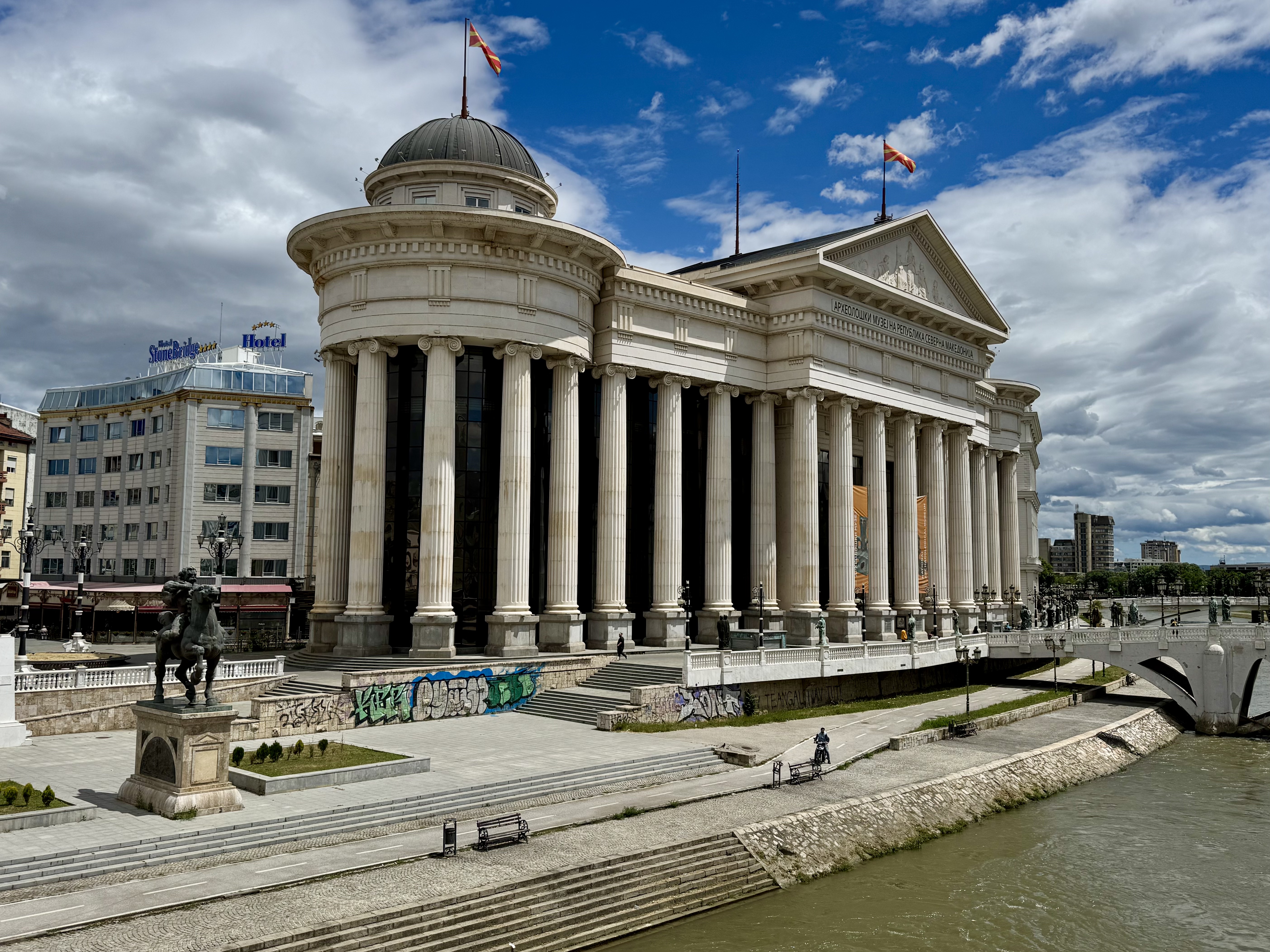
In 2008 Skopje embarked on another transformation of its downtown, this one intended to define its identity and attract tourists. Brutalism offset by showiness. Now, a seven-story triumphal arch greets visitors. Three Disneyesque pirate ships, one of which is a restaurant, clog the Vardar River—ironic, given that Albania is a landlocked country.
The upgrades feature extravagant neoclassical buildings and titanic statues of warriors.
The centerpiece is a seventy-two-foot equestrian statue of Alexander the Great. However, due to North Macedonia’s settlement with Greece the statue is now called Warrior on Horseback.
The locals know who the statue depicts.
Nearby, another towering statue, Founder of Heraclea, raises its fist in defiance. Locals know it to be, wink, wink, Alexander’s father, Philip II.
In the end, Skopje’s efforts at reclaiming ancient Macedonia’s glory look artificial, like a Universal Studios theme park.
The cost of constructing the kitschy statues and ornate buildings is estimated at seven hundred million dollars. Critics have asked if that money would have been better spent on infrastructure and social services.
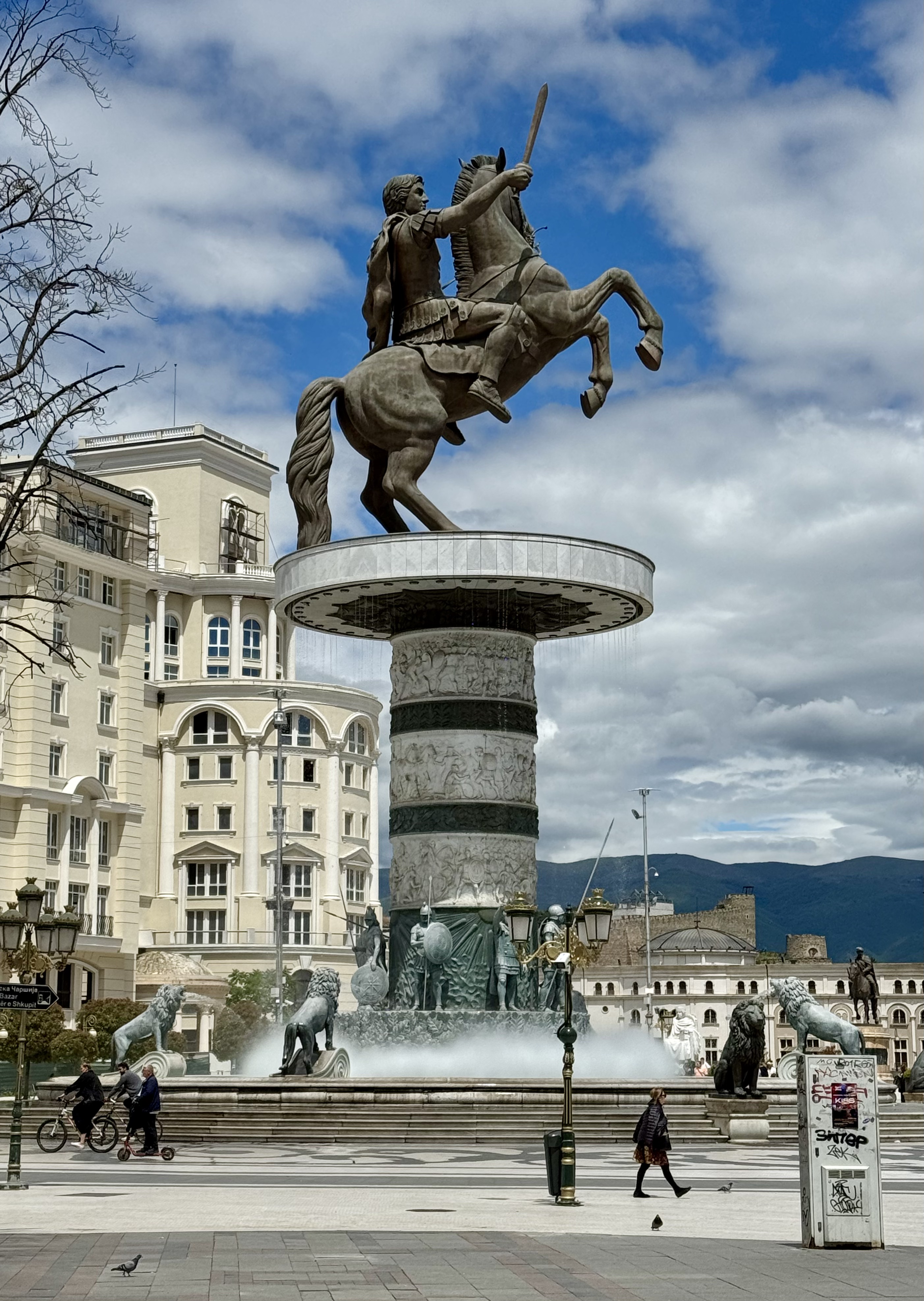
(formerly Alexander the Great),
Skopje, North Macedonia
Peace in the world
Anjezë Gonxhe Bojaxhiu was born in Skopje, North Macedonia, in 1910 to an Albanian family from Kosovo. Anjezë translates to Agnes. At the time Skopje was under Ottoman control.
Fascinated at an early age by missionary work, Agnes left home at age eighteen to join the Sisters of Loreto, a Catholic congregation, in India. She took her religious vows in 1931, choosing to be named Teresa after Thérèse de Lisieux, the patron saint of missionaries.
In 1934 her family moved to Tirana, Albania. Under Albania’s communist rule, Mother Teresa was considered a potentially dangerous representative of the Vatican. She was denied any opportunity to visit her family. She never saw her mother and sister again.
While teaching in India, Mother Teresa was increasingly disturbed by the poverty she saw. In 1950, she founded Missionaries of Charity in order to care for “the hungry, the naked, the homeless, the crippled, the blind, the lepers, all those people who feel unwanted, unloved, uncared for.”
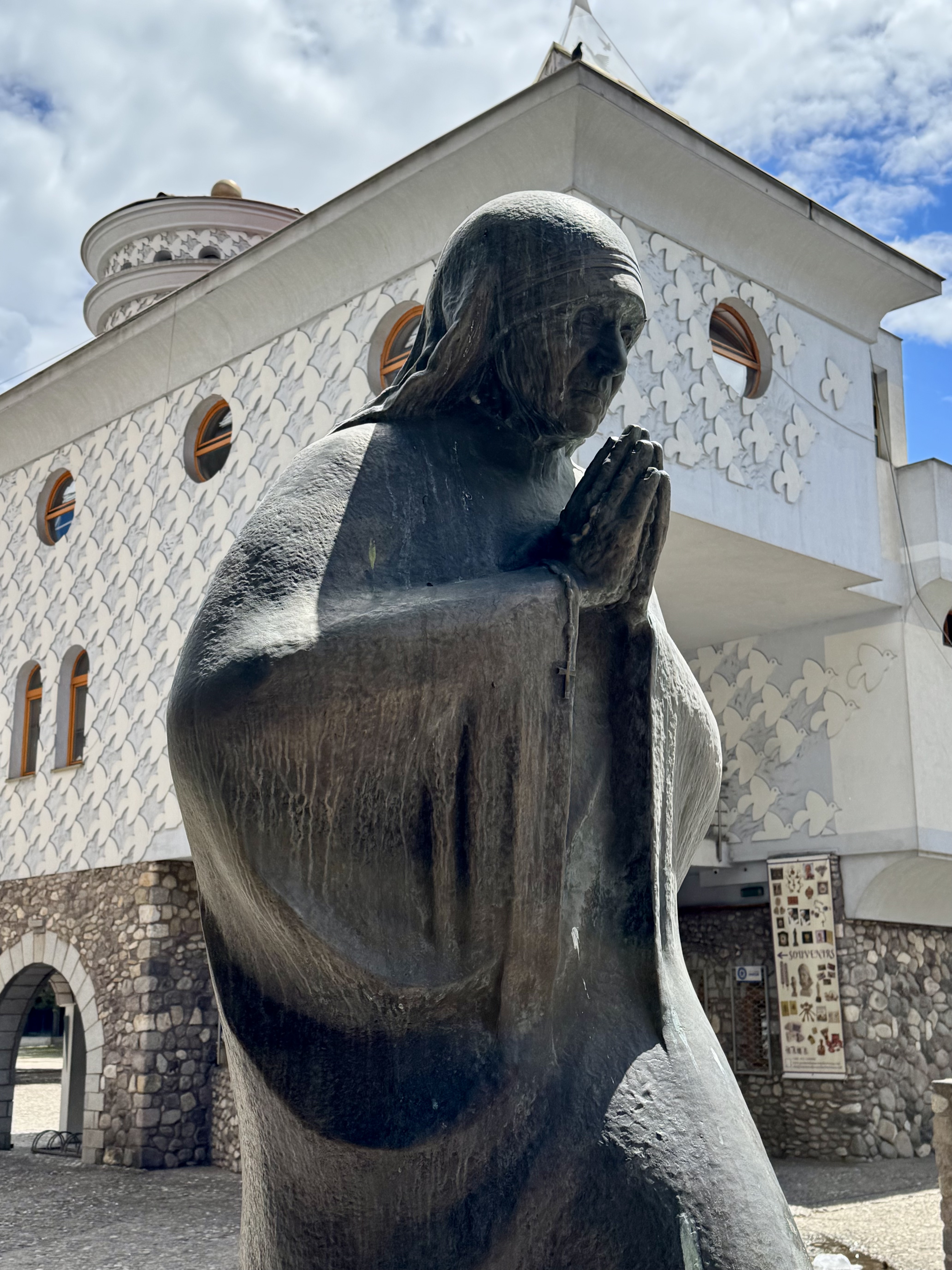
In 1979 Mother Teresa received the Nobel Peace Prize.
At the time of her death in 1997 at the age of eighty-seven, Missionaries of Charity operated missions in over one hundred and twenty countries. Four thousand sisters managed over six hundred hospices, orphanages, soup kitchens, counseling centers, schools, and homes for people with leprosy, tuberculosis, and HIV/AIDS.
In 2009, the Memorial House of Mother Teresa opened in Skopje. The design of the memorial has been roundly criticized by architects as being tasteless and inconsistent with her essence. One architect said, “If it weren’t for the Christian cross, it could be a disco or casino.”
Of Mother Teresa, United Nations Secretary-General Javier Pérez de Cuéllar said, “She is the United Nations. She is peace in the world.”
Shared histories
One evening Craig and I climbed to the grounds of Skopje Fortress, the location of the recent cultural dispute described at the beginning of this post. From the crenellated towers crowning the hilltop, we could see the city fanning out below us.
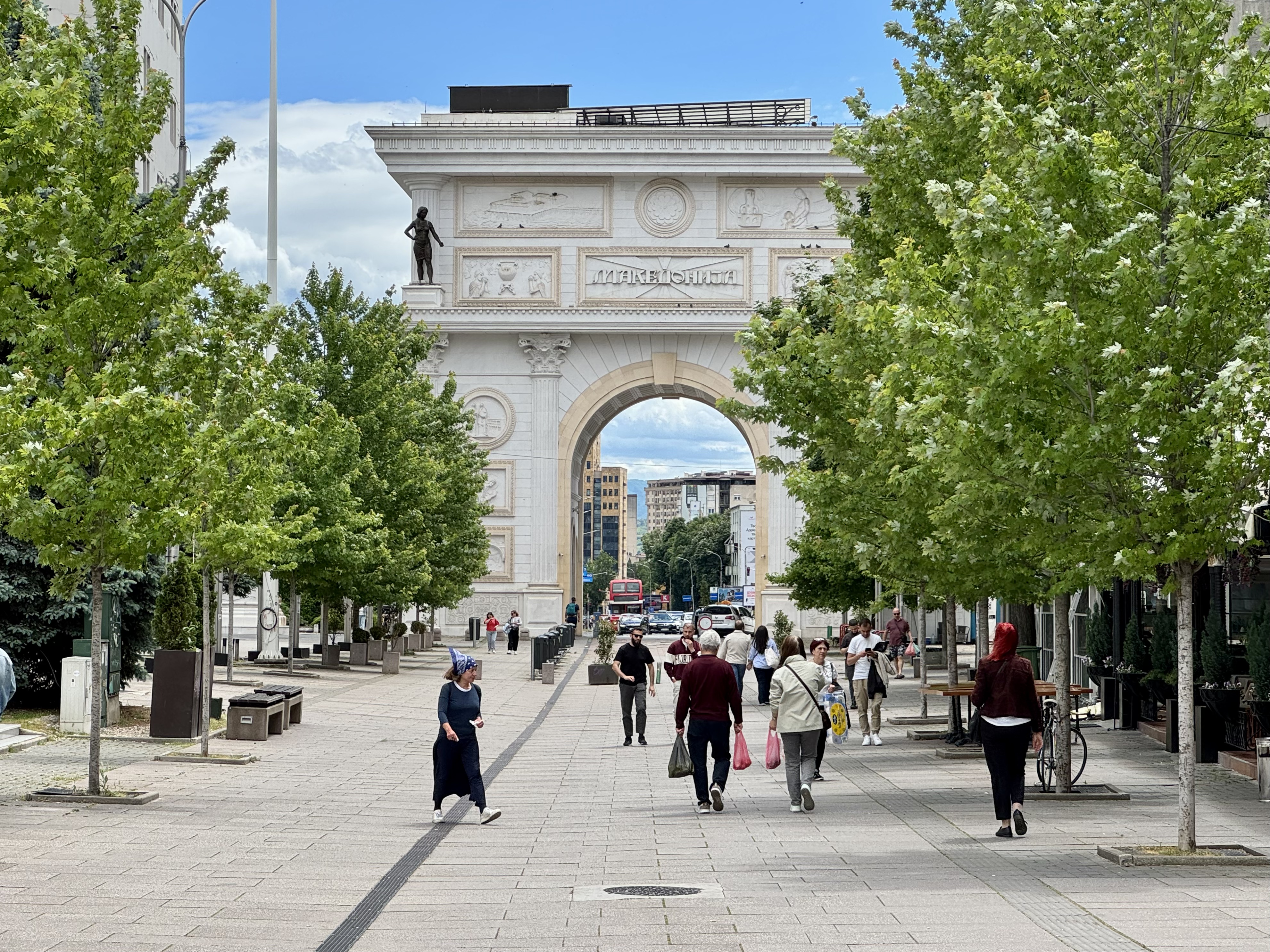
An image of the citadel is on the city’s coat of arms and flag, yet inside the bailey we found a jumble of ruins, weeds, trash, and disturbed earth. Given the hundreds of millions spent on garish monuments in the city below, why has the restoration of the fortress been ignored?
The answer has to do with the competing claims of historical precedence.
Skopje, like the entire Balkan Peninsula, is layered in history. The city was settled around 4000 BCE by the Paionians, a tribe of Illyrian origin mentioned by Homer in the Iliad. Archaeologists have found artifacts dating to 3000 BCE at the fort. The first walls were built in the 500s CE by the Romans. Their reign was followed by the Byzantines, Slavs, Bulgarians, Serbs, Turks, Yugoslavians, and Germans.
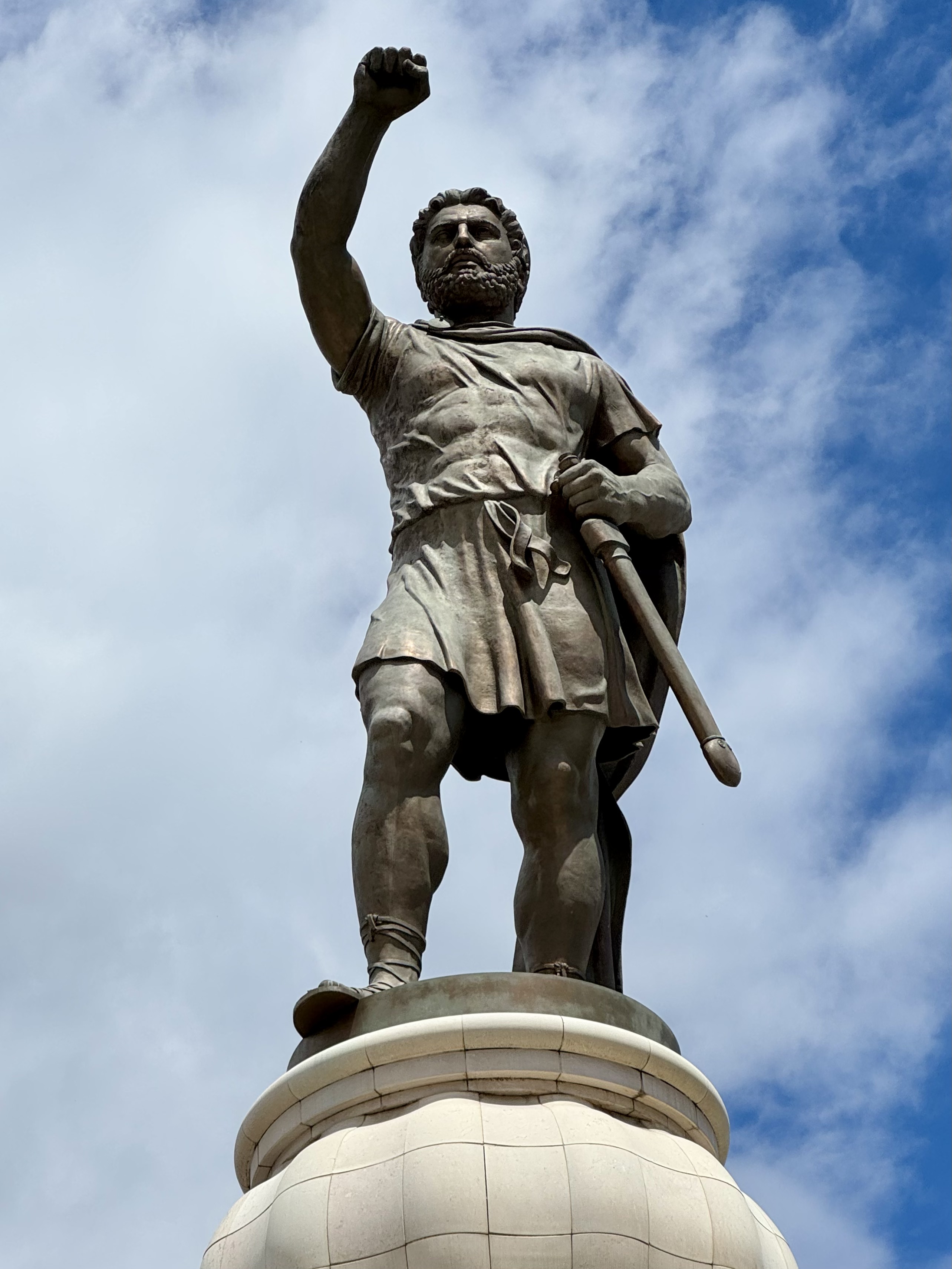
Skopje, North Macedonia
Which of them outranks the others for posterity?
Every empire from the ancient tribes to the Cold War communists has added a layer to Balkan culture, sometimes blending, sometimes damaging, always influencing.
Occasionally, disturbances on the surface—fault lines, such as the excavations at the fortress—expose a deeper layer and old wounds.
Independence is new to the Balkan countries. As they chart their futures, they will occasionally wrestle with their pasts.
 YearTripper