The clerk at the airport’s car-rental center reviewed traffic laws and driving tips with me.
“Park the car facing into the wind,” she said, “so that your door doesn’t get blown off when you open it.”
She continued. “Leave the headlights turned on at all times while driving. Spaces are available in the one-lane tunnels to pull over when vehicles approach from the other direction.”
There was more. She cautioned me regarding crosswinds, flooding, sandstorms, snow and ice, blind curves, blind summits, gravel roads, one-lane bridges, and animals in the road.
Was I about to embark on the Ring Road or the Oregon Trail?
What would you do if your home were invaded? Five options come to mind.
Act as though nothing unusual was happening and hope for the best.
Conceal yourself and hope not to be discovered.
Jump out of a window and run to a neighbor’s home for safety.
Grab a baseball bat and confront the intruders.
Share a meal with your uninvited guests and reveal where your neighbors hide their valuables.
Adapt, hide, escape, resist, or collaborate.
None of us knows which strategy we would adopt in a risky confrontation. The choice would be even more complicated if the lives of family and friends were at risk.
In the Baltic countries, millions of residents were faced with this stressful dilemma—every day for fifty-one consecutive years.
Twenty-three years ago my dad, brother, kids, and I joined a big-bus tour of central Europe. One of our stops was the city of Prague, capital of Czechia, where we spent two nights. I always hoped to return and explore it more fully. Recently I did.
My first stop was Tourist Central—Prague’s Old Time Square. At 8 a.m the streets were pleasantly empty, except for a few delivery trucks and street sweepers.
The square, one of Europe’s grandest, is surrounded by architectural masterpieces of every style. Prague escaped much of the continent-wide destruction of World War II.
Some of the more prominent buildings on the square were built in the 1300s, such as the Old Town Hall and the Church of Our Lady before Týn. Saint Nicholas Church was constructed on the site of a previous church, dating to the 1200s. Toward the end of World War II, Saint Nick’s was the underground home of Radio Prague.
Church of Our Lady before Týn
In the center is the enormous memorial to Jan Hus, a theologian and preacher whose ideas about reforming a corrupt church predated Martin Luther by a hundred years. Hus’s accusations, however, were poorly received by the church hierarchy. He was burned at the stake in 1415.
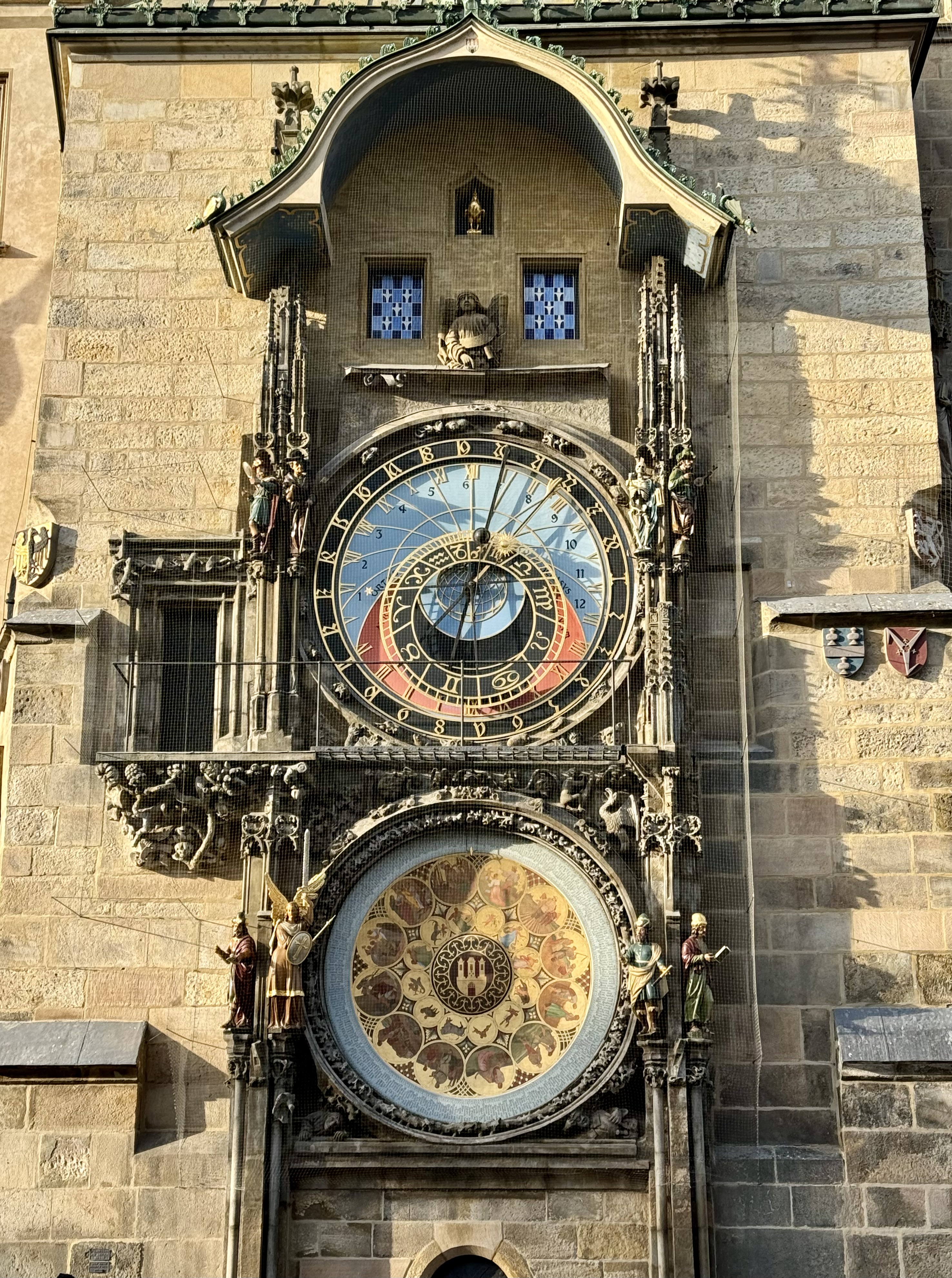
The big draw in the square is the marvelously complex clock, installed on the side of the Old Town Hall in 1410.
The clock has two huge faces surrounded by animated figures representing vanity, lust, greed, and death. The apostles put in an appearance every hour and a golden rooster crows.
But shortly after its unveiling the clock was cursed—and stayed that way for most of a century.
To read about my time in Crete, Santorini, and Naxos, please see the previous post, “Cycladean Rhythm.”
At five hundred feet high, the Acropolis can be seen from everywhere in Athens, including from our hotel room. The weather was perfect and the crowds thinning during our late afternoon visit.
The rocky mesa on which the Parthenon sits was the mecca for several civilizations prior to the ancient Greeks. Homer references the fortifications in the Odyssey. The goddess Athena, the city’s namesake, was worshipped here at least as early as 800 BCE.
The city-state of Athens was invaded by Persia (now Iran) a few times. The decisive battle during the 490 BCE incursion took place at the port of Marathon. The two forces were locked in a stalemate for five days until the Athenians, outnumbered three to one, outmaneuvered the Persians and won.
A courier, Philippides (also spelled Pheidippides and Phidippides) supposedly ran from Marathon to Athens to report the victory before collapsing and dying. His feat is the inspiration behind modern marathon races of 26.2 miles.
The White Mountains on the island of Crete are bare of vegetation; thus the name. They are a moonscape of limestone.
The range has more than thirty summits over sixty-five hundred feet.
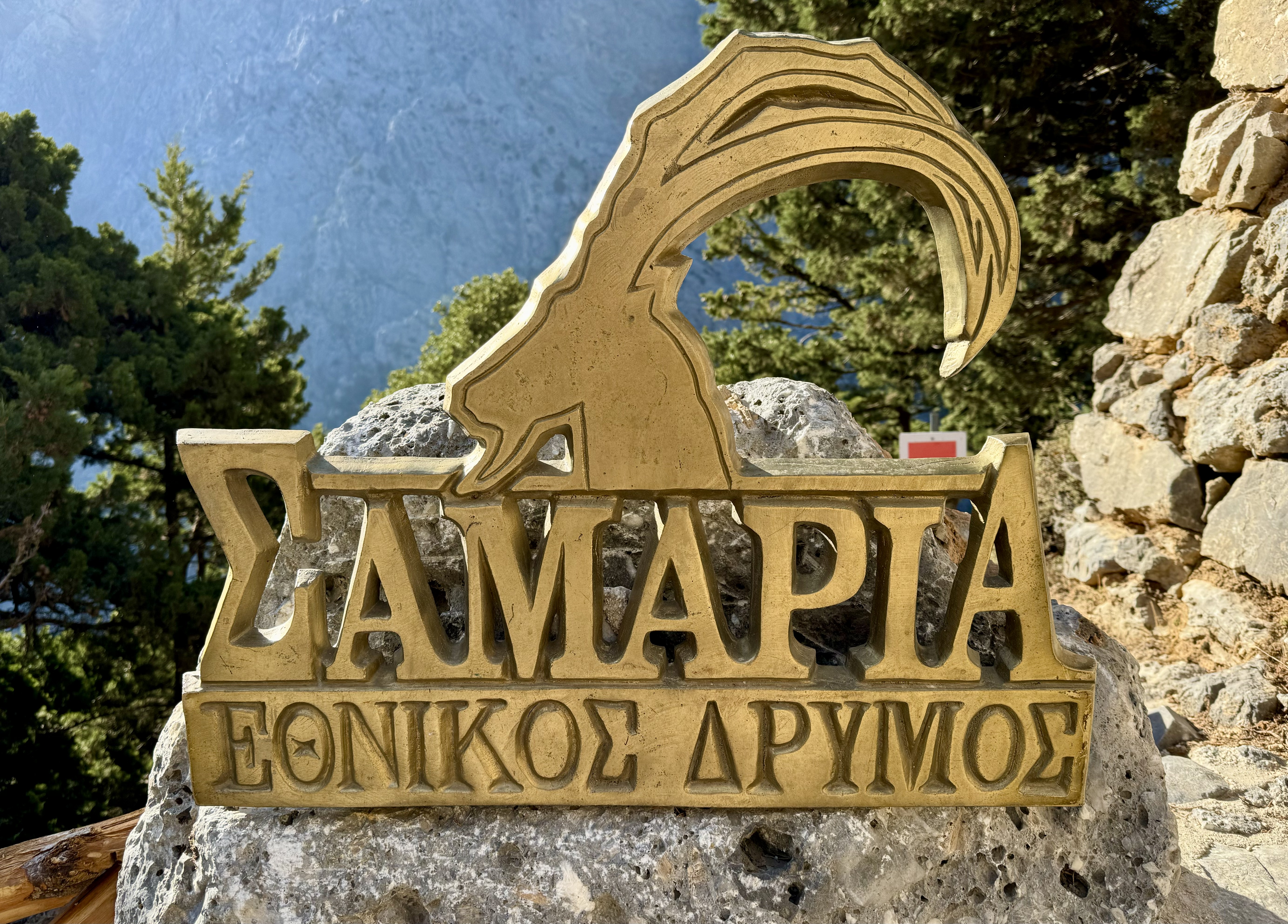
Concealed among the mountains are over fifty gorges, the most famous being the Samaria Gorge. At nearly ten miles, Samaria is the longest canyon in Europe. Since ancient times, people have hidden in the gorge from invaders or holed up between rebel skirmishes.
Today, it is the hideout of the rare kri-kri, the Cretan goat. The kri-kri was the only meat available to mountain guerrillas during the Nazi occupation of World War II. The goats were once common throughout Greece, but now one of their last preserves are the almost vertical three-thousand-foot cliffs within Samaria National Park.
Samaria Gorge, Crete
At 7:45 a.m. Leslie and I boarded a bus and left Chania for the northern entrance of the gorge. Outside of town, the bus began climbing through farmland and forests. The peaks of the mountains were obscured by clouds. Once above the tree line, sheep and goats huddled in the road. Each time, the bus stopped and honked until the herds moved.
The bus labored up the narrow road, switchback after switchback. An hour later we were at Xyloskalo, where we were required to present passes to enter the trail.
A cold wind howled at the start, but once we climbed below the rim the canyon walls served as a shield. The gorge trail is all downhill, starting from an altitude of four thousand feet and ending at the village of Agia Roumeli on the Libyan Sea. Over nine miles in length.
Easy, right? Except that the descent is steep and the footing strewn with treacherous scree.
For the Allies, capturing the French port of Cherbourg in the northwestern corner of Normandy was a top priority.
The invasion force needed a deep-water harbor from which to readily unload troops, equipment, and supplies for its push onto the continent. Early control of Cherbourg was critical to Operation Overlord’s success.
Hitler believed any Allied invasion would fail without Cherbourg and ordered the city to be made invincible.
Over the centuries the city and port, surrounded by cliffs, had been fortified many times. The Nazis bolstered the historical battlements with a nine-mile perimeter of forts and pillboxes, mortar and machine-gun emplacements, tunnels, minefields, anti-tank ditches, and barbed wire.
Twenty artillery batteries were installed. Twenty-one thousand defenders were dug in.
Twelve days after D-Day the Allies launched their attack on Cherbourg. Meanwhile, the Germans began to demolish the port’s facilities and mine the harbor.
Allied progress through the barriers was slow and the fighting furious. In support of the ground troops, United States Navy ships bombarded the city. Finally, at the end of June, Cherbourg was captured, but at a high cost. Twenty-eight hundred Americans gave their lives to take the port. Over thirteen thousand more were wounded. Thousands of German troops surrendered.
Most of the mines were swept from the harbor by mid-July. Six weeks after D-Day and two weeks after the capture of Cherbourg, transport ships from England began to arrive.
My dad was aboard one of them. He was barely eighteen.
On the way into the city of Gdańsk, Poland, my taxi passed a few cars with Ukrainian license plates. The driver told me 2½ million refugees from Ukraine have crossed the three-hundred-mile border.
Since the invasion began, Poland has welcomed more refugees than any other European country. Poles have provided food, shelter, health care, and even jobs to their besieged neighbors. Poland is a leading contributor of military aid to Ukraine.
The citizens of the two countries share a mutual concern about the imperialistic fixation of Putin’s Russia.
In my hotel lobby were a row of clocks on the wall indicating the current time in major cities of the world, including New York, London, and Beijing. A Ukrainian flag covered the Moscow clock.
Frequently, Gdańsk has been at the forefront of earthshaking events. In 1939 the city was the scene of the first battle of World War II. In 1989 a Gdańsk-based labor union ended communist-party rule in Poland, an event that influenced the eventual breakup of the Soviet Union.
And now, in the 2020s, Poland is leading the European response to the Russo-Ukrainian War. Touring Poland during the invasion, according to my guide, “gives a big middle finger to Putin.”






 YearTripper