At the National Museum in Zürich is a display of Swiss cultural icons. The obvious are included: Swiss cheese, Swiss chocolate, and Swiss watches. Also cowbells, alphorns, and a model of the Matterhorn.
Surprisingly, there are no Swiss army knives. Heidi, however, was not forgotten.
The novel Heidi is about a young girl and her grandfather living in the Alps. Published in 1881 by Johanna Spyri, it is one of the best-selling books ever written.
And then there is the story of Swiss folk-hero William Tell who, like Robin Hood, may never have existed.
Only fourteen percent of the Alps are within Switzerland, yet sixty-five percent of Switzerland is within the Alps. And nowhere but Switzerland are a nation’s culture and the Alps so intertwined.
By Alpine standards, a mountain is high if it crests four thousand meters, just over 2½ miles. Most of the highest and most famous are in Switzerland.
Due to their massiveness, the Alps have long been an attraction. Stone-Agers left behind artifacts. Hannibal crossed with a herd of elephants. The Romans established settlements.
The “golden age” of mountaineering in the 19th century raised awareness of the Alps around the world. Train lines and hotels were built and tourists flocked. Still, residents of the Alpine areas of Switzerland retain a strong cultural identity, based upon mountaineering, hiking, skiing, farming, woodworking, cheesemaking, and, yes, yodeling.
I sampled four of the ranges within Switzerland—the Appenzell, Bernina, Bernese, and Pennine. (To read about the Appenzell Alps, please see a previous post, “More cowbell!”)
While traveling in Italy, I stayed in three towns with names beginning with the letter V—Varenna, Vernazza, and Volterra. I was constantly referring to one as the other.
Now, in Switzerland, I confuse the L cities—Luzern (pronounced loot SAIRN), Lugano (loo GAH no), and Lausanne (loh ZAHN). The Swiss often tried to correct me. When I said, “Lausanne,” they would say, “Oh, you mean Luzern.”
No, I meant Lausanne. It just sounded like Luzern.
Of course, the L cities could not be more different from each other. Luzern is in a German-speaking canton; Lugano, Italian, and Lausanne, French. (Cantons are like our states.) Switzerland also recognizes Romansch, a language left over from the Romans.
As I crossed from canton to canton every few days, I frequently mixed up my bonjours, buongiornos, and guten morgens. Cédric, a merchant I spoke with in Pontresina, shrugged, “Switzerland is a mini-Europe.”
“People make fun of us,” said Madeleine, owner of the lodge where I was staying in northeastern Switzerland.
“Why?” I asked.
“Because we hold on to our traditions, our costumes, our celebrations.”
She thought for a minute. “Because we are stubborn.”
She was talking about the citizens of the Appenzell region, specifically Innerrhoden, known for its exotic holiday festivals, show-of-hands’ elections, and cow parades.
. . . the universe is often stumbled on by accident, or visualized in dreams. Only when the stars concur do we arrive.
Ciaran Carron, last night’s fun
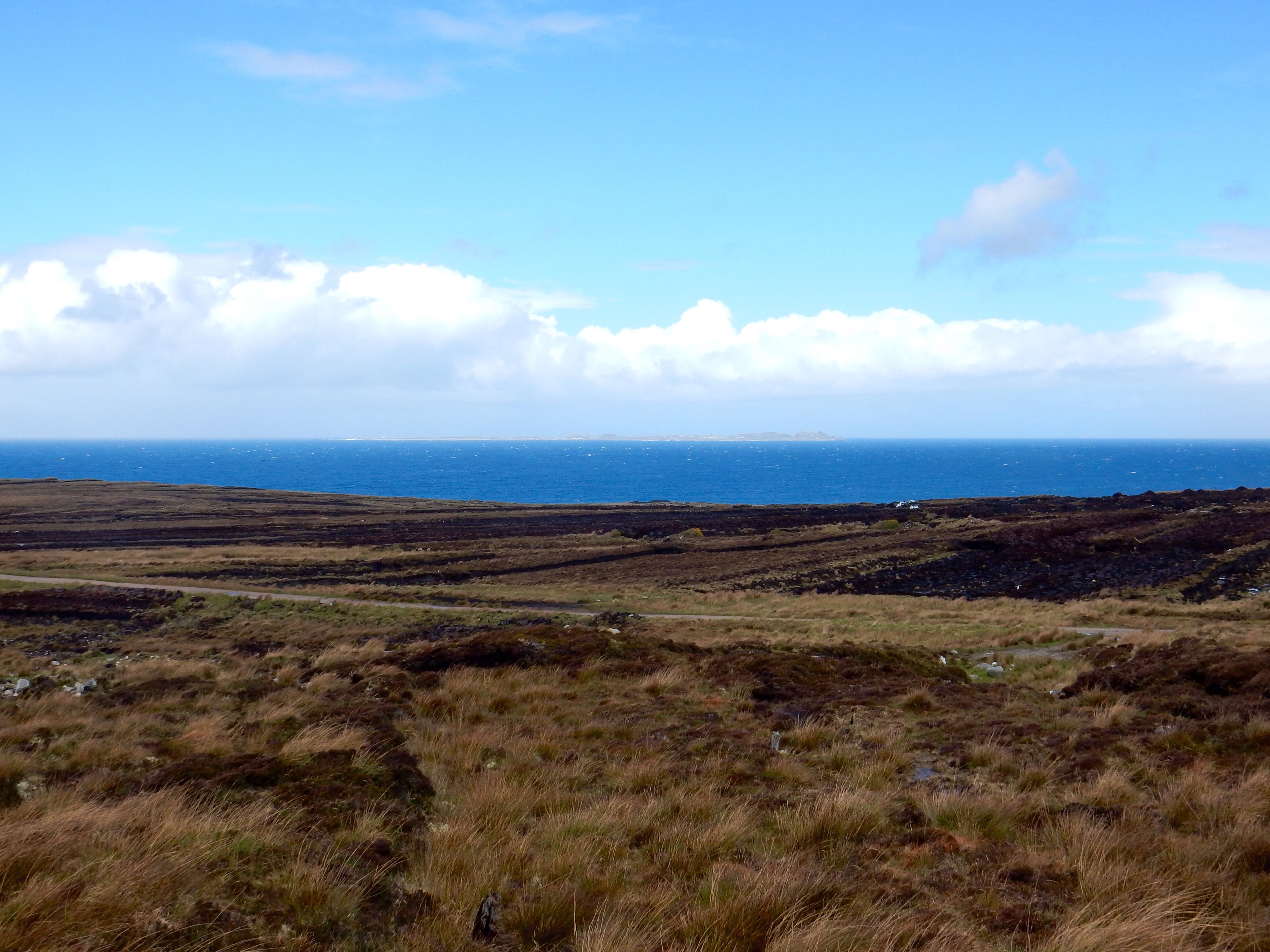
Five months has been a long time to be away from home. Somehow, County Donegal, Ireland, seemed the perfect location for the trip’s coda.
I drove across the invisible border between Northern Ireland and Ireland in the rain. At Letterkenny I turned north onto the Wild Atlantic Way toward Fanad Head at the tip of the peninsula. The Wild Atlantic Way is a fifteen-hundred-mile scenic route on the west coast of Ireland, stretching from County Cork in the south to County Donegal in the north.
The question is impossible to ignore, given the conspicuous reminders of conflict in both Belfast and Derry/Londonderry.
In Belfast, tour companies and cab drivers offer “political tours” or “mural tours” through sectarian neighborhoods, allowing tourists to take photos of posters and memorials. In Derry/Londonderry, where even the city’s name is in dispute, the story of the conflict is told in several museums. The Troubles are still in the headlines.
While I was in Northern Ireland, Prince Charles and Gerry Adams, president of the Sinn Féin political party, made news by shaking hands. Adams’ former comrades say he was on the Irish Republican Army’s (IRA’s) ruling council in 1979 when the prince’s great-uncle, Lord Mountbatten, was murdered. The widely publicized handshake once seemed unthinkable.



 YearTripper