Eccentric Sintra

National Palace, Sintra
National Palace

How did a small village outside of Lisbon became a magnet for whimsy and extravagance?

The town of Sintra, sprawling just below the tops of the mountains of the same name, is studded with outlandish palaces, fairytale castles, even a toy museum, each with an intriguing story.

Perhaps the area’s ancient occultism influenced the designers of its many elaborate residences.

Stone Age settlers were first attracted to the valley because of its lushness. It receives more rainfall than the surrounding area and is often shrouded in mist. The landscape was called the Mountains of the Moon by the Romans. Byron called the area “a glorious Eden.”

Continue reading
Lisbon: Discovering the discoverers

Monument to the Discoveries, Lisbon

In elementary school we studied the great European explorers of the 1400s and 1500s. Christopher Columbus, for one. This period is called the Age of Discovery, a time when European royalty sought profitable new trade routes.

The Portuguese, due to several navigational advancements and their strategic location between the Atlantic and the Mediterranean, led the way.

Bartolomeu Dias was the first European to sail around Africa’s sourthern tip in 1488. Vasco da Gama sailed around Africa to India in 1497. Pedro Álvares Cabral “discovered” Brazil in 1500. And Ferdinand Magellan was the first European to sail across the Pacific Ocean in 1520. His expedition was also the first to circumnavigate the world.

By the mid-1500s, Portugal dominated world trade.

Continue reading

My Top Tens in Scotland

PitlochryI’ve been fortunate to travel throughout much of Scotland during my tour. I spent four weeks in Edinburgh, followed by six weeks in the Highlands and islands. I was drawn to explore some of Scotland’s more remote areas and learn about its complicated, turbulent, and often heartbreaking history. I found the story of Scotland made real by the preservation of its architectural remnants, some thousands of years old. At the same time, I was overwhelmed by the majesty of its landscape and the irrepressibility of the Scots themselves. I stayed in twenty-one different B&Bs and hotels, visited thirteen islands and seventeen castles, took eighteen ferry sailings and seven train rides, and rented four cars.

Here are the “best-ofs” from my trip: Continue reading

At large in Argyll

Argyle, the diamond-shaped pattern on your socks, is derived from the tartan of the powerful Campbell clan. They once controlled Argyll, a large chunk of western Scotland, including twenty-five inhabited islands and over three thousand miles of torn and frayed coastline. The towering mountains and seemingly endless moors are dotted with castles, standing stones, ruined stone huts, and distilleries. I set out to explore them, using Oban, the largest city in the Argyll region, as my base.

Oban
Oban

Oban and nearby

As a jumping-off point, Oban is busy. Tourists, trains, ferries, coaches, and fishing boats jam its downtown. Fresh seafood is available at stands on the piers. I tried cockles with vinegar, a paper cupful. Tasted like mussels.

Continue reading

United or untied? How will Scotland vote?

"Yes" and "no"

They fought like warrior poets. They fought like Scotsmen, and won their freedom.

Narrator, Braveheart

Thursday is the big day. Scottish voters will decide whether to remain part of the United Kingdom or become independent. Which way will they go?

When I arrived in Scotland a few weeks ago, the no camp was winning in the polls 60-40. I was in Edinburgh, which seemed distracted with its festivals. Except for the omnipresent yes signs and occasional festival skits, the referendum was rarely mentioned.

All of that changed when the results of a new poll were released last week, indicating the yes position was in the lead 51 percent to 49. Suddenly, the referendum was the hot topic. The yes csampaign cautiously rejoiced. Media coverage was intense. Politicians in London panicked and sent their party leaders on a road trip to Scotland to beg for no votes. This tactic was met with derision by many Scots. The joke was that David Cameron, the prime minister, needed directions to get here.

Continue reading

Island hopping through the Hebrides

Harris, Hebrides

Compared to the Vikings, I had it easy.

All I needed to hop through the Hebrides was a rental car and a pocket full of ferry tickets. Ferries have provided a lifeline to the remote islands near Scotland’s west coast since the early 1800s.

Today, cars are “rolled on and off” in minutes, providing tourists the freedom to explore on their own schedule. Just make sure to keep the tank “topped up.” Petrol stations are few and far between.

My port of departure was the coastal village of Ullapool (OWL ah pool), a town of picturesque white-washed cottages. The small museum in Ullapool features exhibits on crofting, digging peat, sailing, fishing, and the Highland Clearances. A poster in the hotel lobby promoted a concert—not of traditional Celtic music, but John Coltrane-style free jazz.

Continue reading

Back to the Stone Age in Orkney

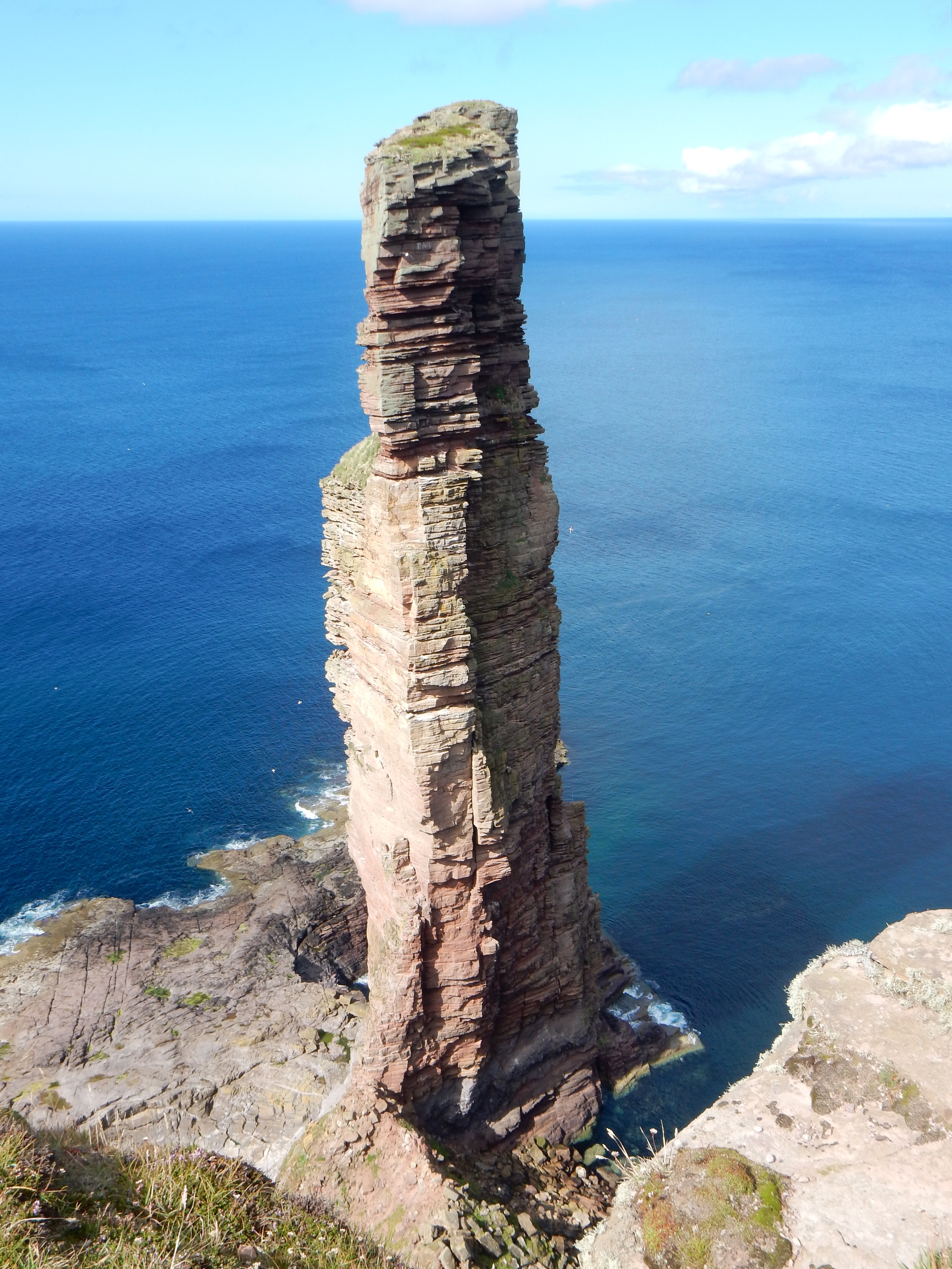
Old Man of Hoy
Old Man of Hoy
The tall stone, if it cares, has care
Beyond the span of our caring.

George Mackay Brown

Hundreds of years before the construction of Stonehenge, the pyramids, and the Great Wall, Stone Age farmers were building towers and homes on the Orkney Islands of Scotland. And millions of years earlier, nature constructed some stone monuments of its own.

Orkney’s Nordic connection is similiar to Shetland’s, although it is less obvious, possibly because Orkney is much closer to mainland Scotland. Orkney is comprised of seventy islands, twenty of which are inhabited. While Shetland’s leading industries are oil and fishing, Orkney focuses on farming, as it’s geography is low-lying and fertile. Sheep rule Shetland’s landscape; cattle dominate in Orkney. Its human population numbers twenty thousand.

Continue reading