
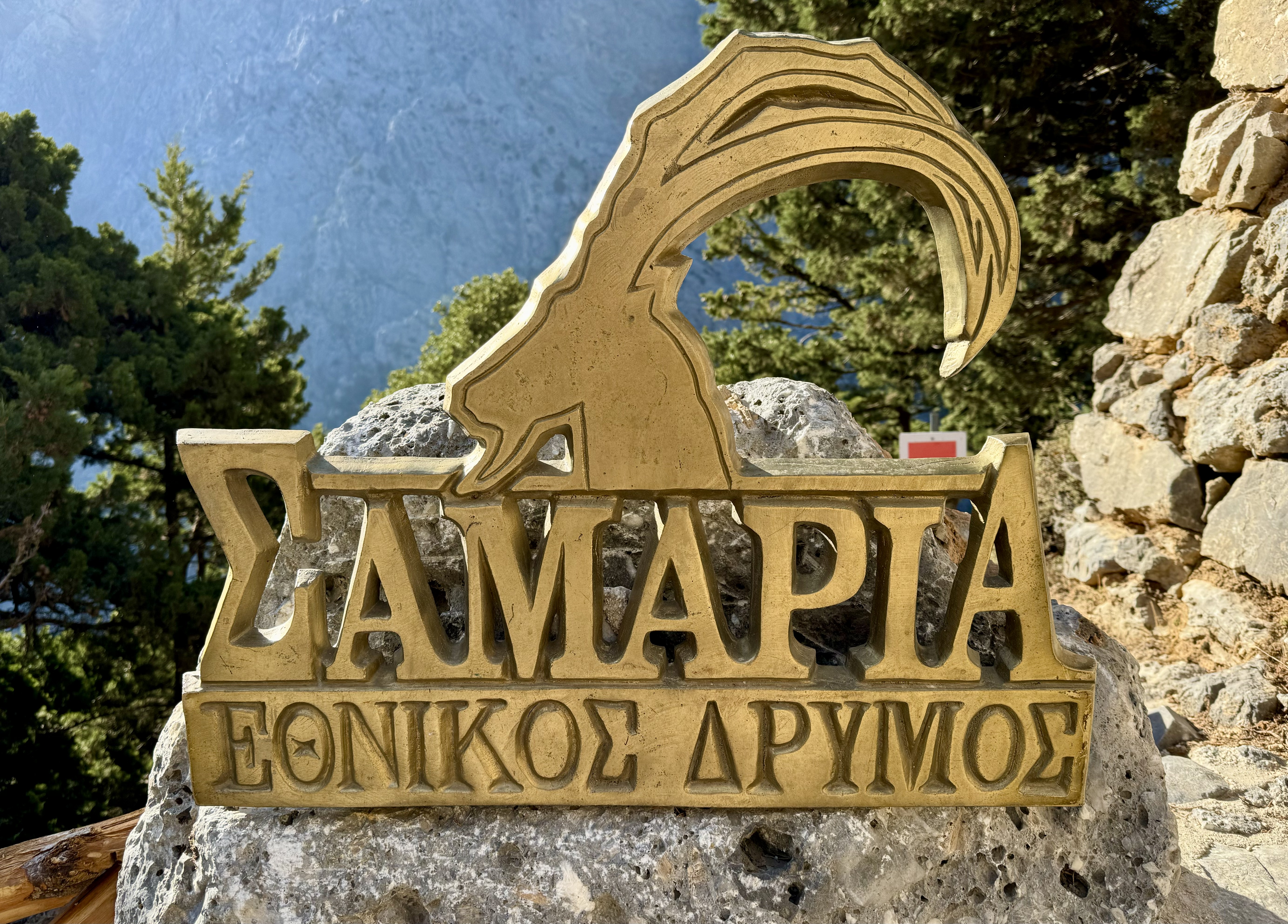
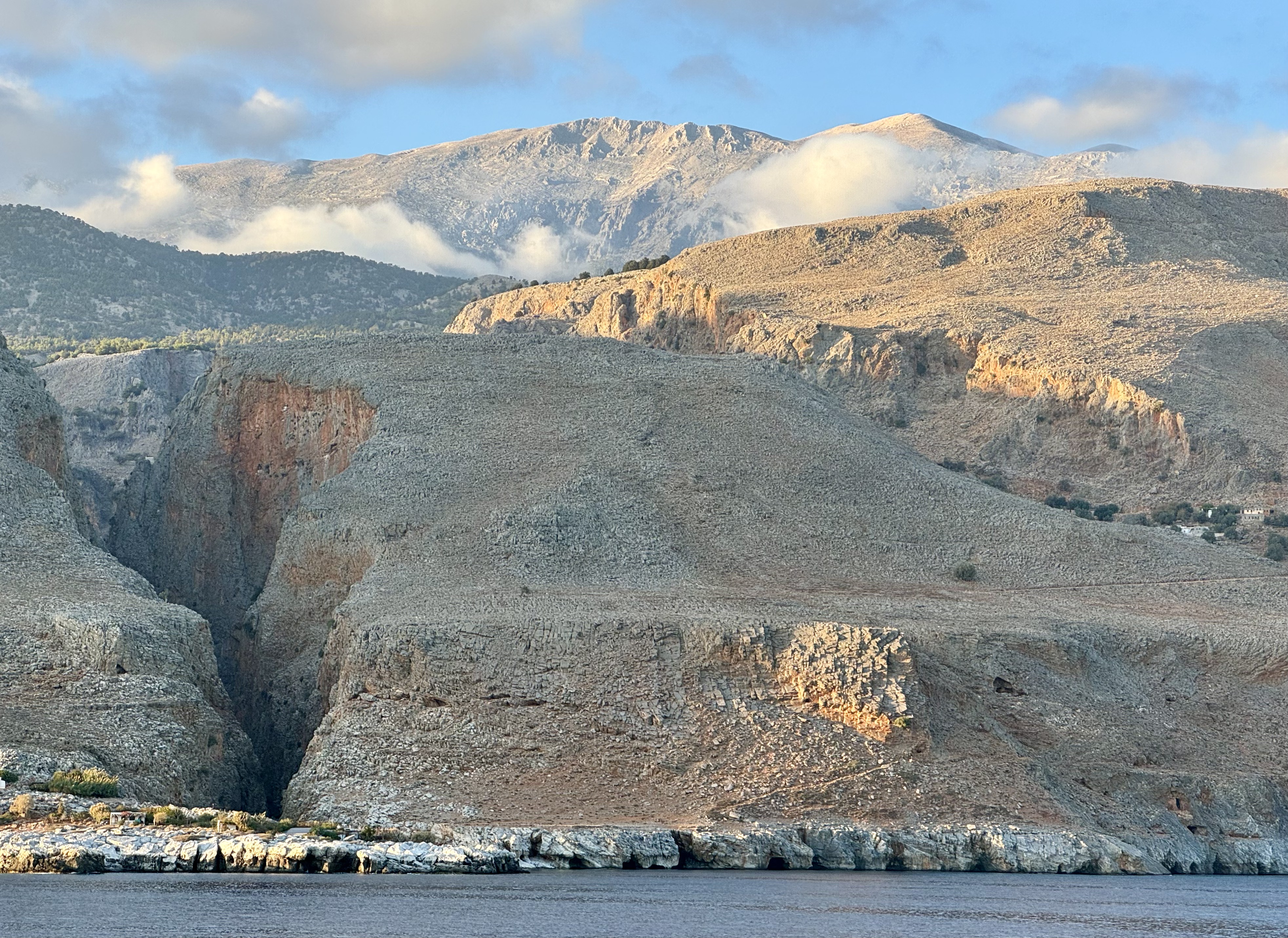
The White Mountains on the island of Crete are bare of vegetation; thus the name. They are a moonscape of limestone.
The range has more than thirty summits over sixty-five hundred feet.
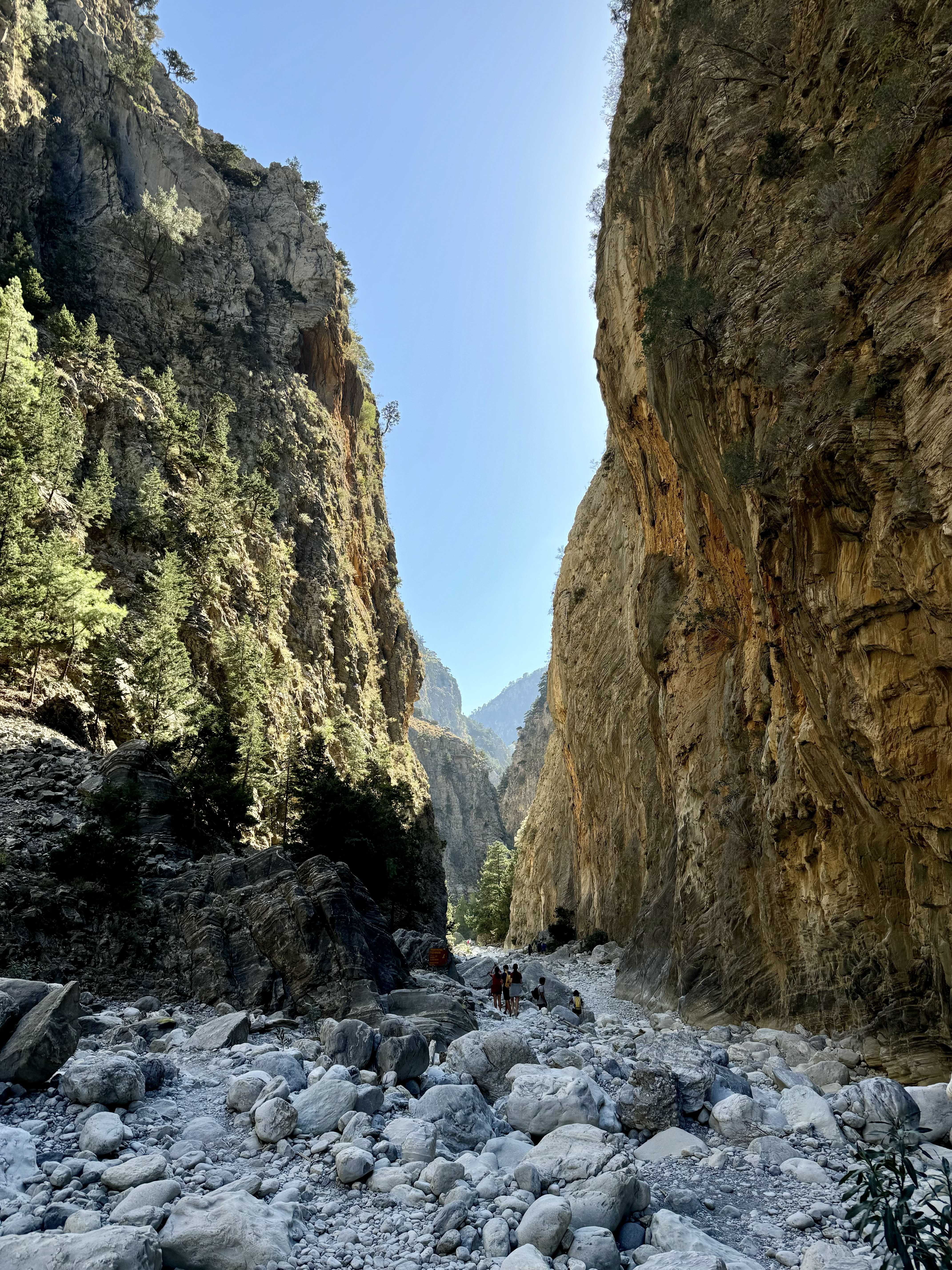
Concealed among the mountains are over fifty gorges, the most famous being the Samaria Gorge. At nearly ten miles, Samaria is the longest canyon in Europe. Since ancient times, people have hidden in the gorge from invaders or holed up between rebel skirmishes.
Today, it is the hideout of the rare kri-kri, the Cretan goat. The kri-kri was the only meat available to mountain guerrillas during the Nazi occupation of World War II. The goats were once common throughout Greece, but now one of their last preserves are the almost vertical three-thousand-foot cliffs within Samaria National Park.

At 7:45 a.m. Leslie and I boarded a bus and left Chania for the northern entrance of the gorge. Outside of town, the bus began climbing through farmland and forests. The peaks of the mountains were obscured by clouds. Once above the tree line, sheep and goats huddled in the road. Each time, the bus stopped and honked until the herds moved.
The bus labored up the narrow road, switchback after switchback. An hour later we were at Xyloskalo, where we were required to present passes to enter the trail.
A cold wind howled at the start, but once we climbed below the rim the canyon walls served as a shield. The gorge trail is all downhill, starting from an altitude of four thousand feet and ending at the village of Agia Roumeli on the Libyan Sea. Over nine miles in length.
Easy, right? Except that the descent is steep and the footing strewn with treacherous scree.
Gorged
Below the rim, an awning of chicken wire arches over the trail to protect hikers from falling rocks. The threat is real—the top of the awning is covered with fragments.
In less than three miles we descended two thousand feet. I’ve read that when hiking downhill the leading knee absorbs up to seven times the body’s weight. My old knees felt every pound of it.
Over the next two miles, the terrain rolled along the river. Signs along the way said the water is safe to drink right from the stream. As a UNESCO Biosphere Reserve, Samaria National Park is a protected ecosystem.
Another hiker claimed to have seen kri-kri. I saw none, although, for all I know, I was wading through a herd of them. My eyes were locked on every footstep, as I tried to avoid slipping on the rocks. Especially the shiny black marble ones. Despite my focus, I fell, bloodying my left knee and hand. I stopped to apply bandages.
We descended another thousand feet and at Mile Five reached the abandoned village of Samariá. The last inhabitants left in 1962. Among the ruined stone buildings and church are picnic tables, restrooms, and a ranger station. Upon noticing my bandages, a ranger handed me a wooden walking stick.

Leslie and I made some calculations. We realized that, unless we picked up our pace, we would miss the 5:30 p.m. ferry at Agia Roumeli—which was the only way to get back to our hotel in Chania and tomorrow morning’s taxi to the airport. Faster hikers cover the gorge top to bottom in four hours. I am not one of them. Now, we had a deadline.
To save time. we skipped lunch and ate energy bars while walking. As we dropped elevation, the canyon walls loomed over our heads. The route follows the rocky riverbed. Often, the trail was vague among the boulders and scree. Several times we crossed the stream on stepping stones and rickety bridges made from small logs.
A ranger led a horse past us, heading in the opposite direction. Apparently, an injured hiker behind us needed medical evacuation out of the gorge.
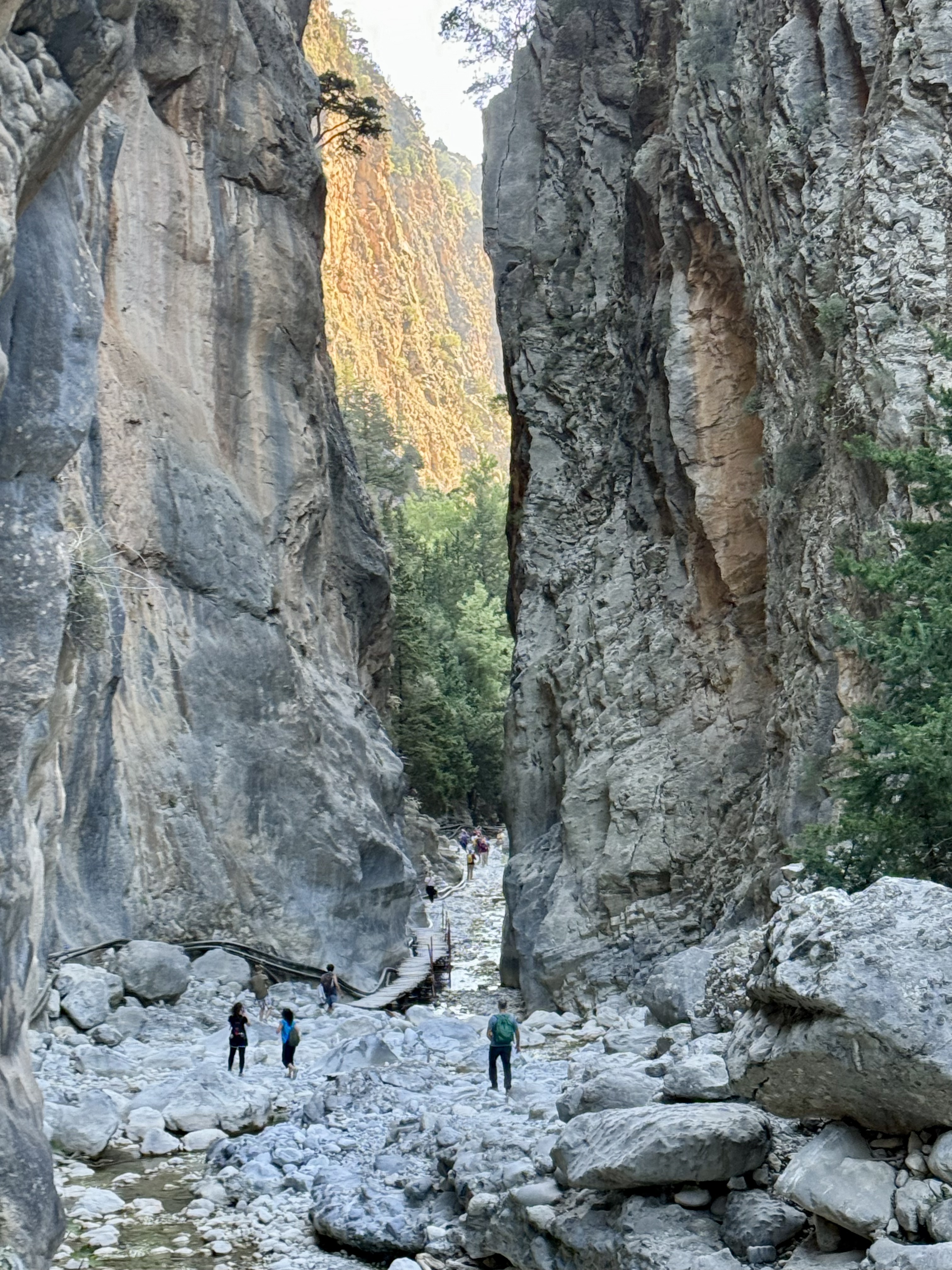
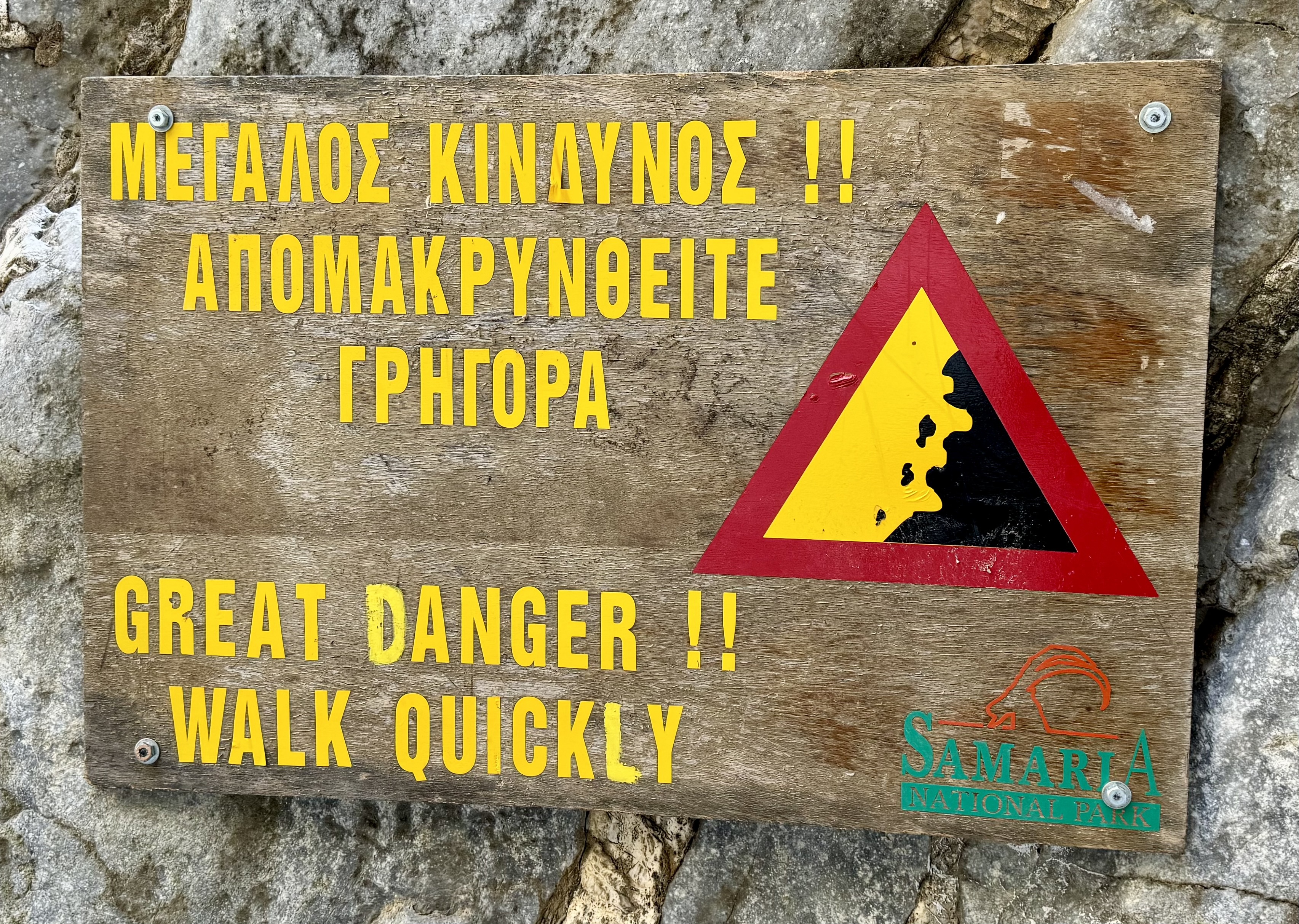
The most famous part of the gorge is at Mile Seven, the stretch known as the Iron Gates, where the thousand-foot canyon walls close to within thirteen feet. A slot canyon. Signs on the trail warned of falling rocks: Great Danger! Walk Quickly!
So we did. The hike took six hours, including our brief stops.
After passing through the park exit, we stopped at a taverna on the harbor in Agia Roumeli. The village is built on the ruins of a Roman settlement, Tara. It is accessible by boat only. No roads.
We celebrated the hike with beers and watched swimmers on the rocky beach. And we made the ferry on time.

Cradle of Europe
Neither Leslie nor I had ever been to Greece, and with only twelve days available to travel together we had to prioritize our stops. We started on Crete, the largest of Greece’s roughly two hundred inhabited islands.
Crete was the birthplace of the Minoan culture, which is considered Europe’s first advanced civilization. The Minoans flourished between 2700 to 1450 BCE. They traded with other cultures throughout the Mediterranean, including Greece, Egypt, Cyprus, Syria, and what is now Turkey, Iraq, and Spain.

Over the centuries, the island was conquered over and over, including by the mainland Greeks, Romans, Arabs, and Turks. Crete became part of Greece in 1913.
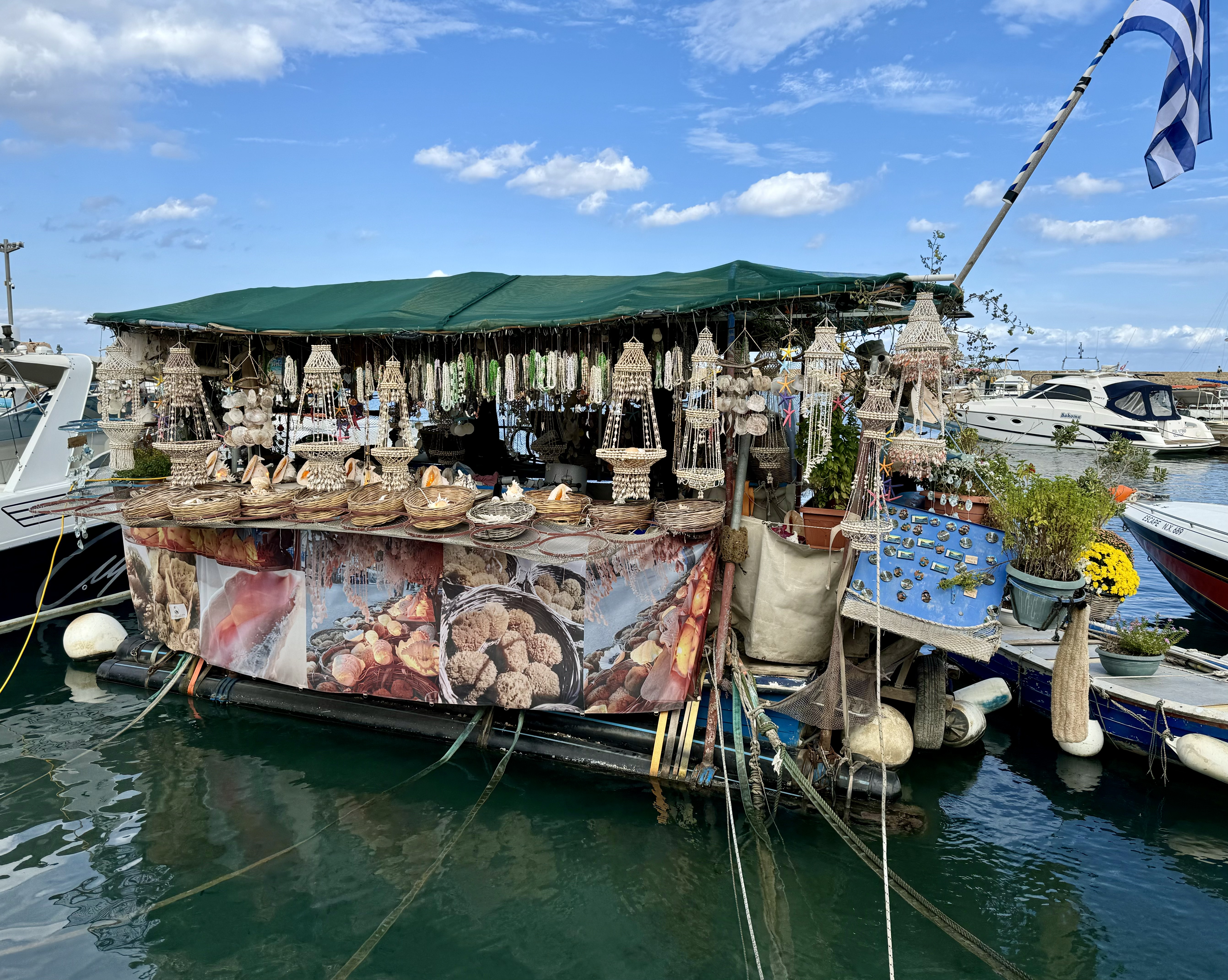
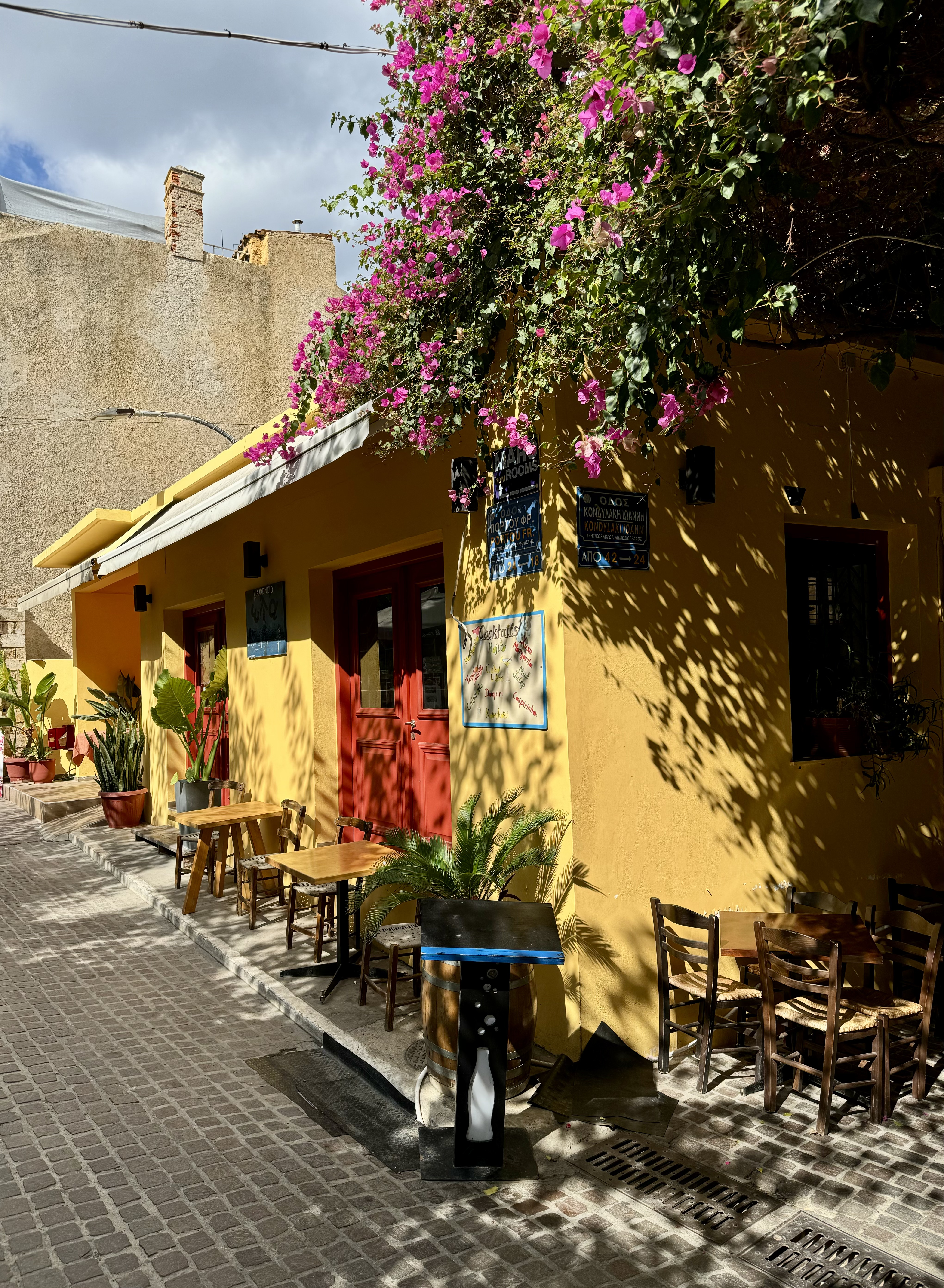
For our base, we selected Chania, Crete’s second largest city and former capital. The Minoans called the city Kydonia, which was mentioned in Homer’s Odyssey and Virgil’s Aeneid. After checking into a hotel down an alley cluttered with restaurant tables, potted plants, and stray cats, we explored the Venetian harbor.
During the 1500s, the Venetians dominated the Mediterranean and established their largest naval base in Chania. As many as forty Venetian galleys were anchored in the harbor. To protect against Ottoman Turks and pirates, the Venetians invested heavily in fortifications.

They constructed a fort, walls and gates, bastions, a seawall, and a lighthouse. The harbor could be closed by stretching a chain from the fort to the lighthouse.
By 1599, eighteen shipyards were built. Each resembled a large stone Quonset hut, positioned at water’s edge.
Eight of them remain. The best known is the Great Arsenali, which nows hosts the Center of Mediterranean Architecture.
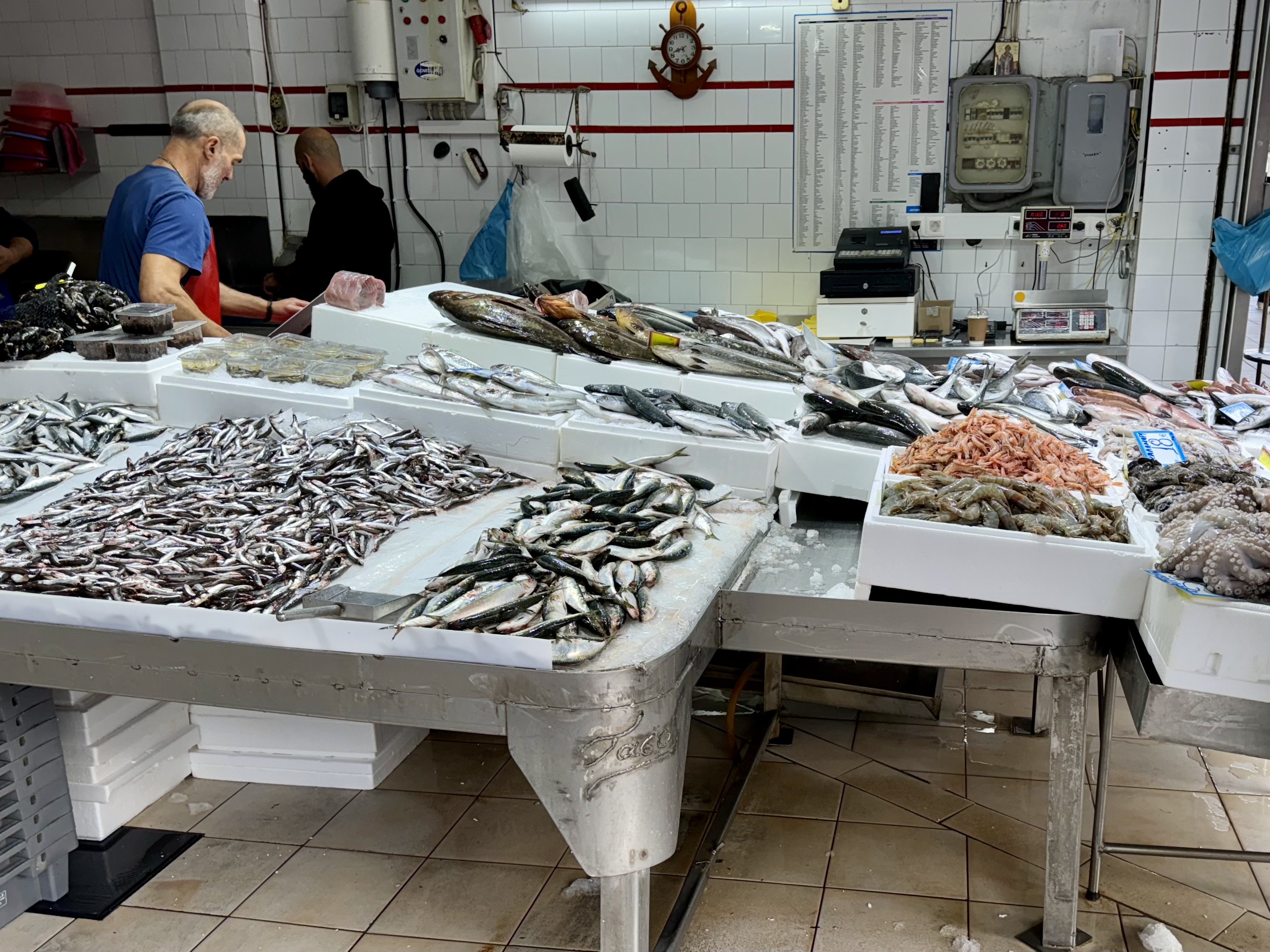
At a hotel-recommended restaurant, we selected two red snappers from several in an ice chest. The waitress was excited to show them to us. “Caught today!” she said. They were charcoal-grilled and served whole, googly-eyed and all, with grilled veggies. A few of the neighborhood cats stopped by our table.

Βull session
The Minoan capital on Crete was Knossos. Now in ruins, it is considered `the oldest city in Europe. Knossos is also the setting for an ancient Greek myth.
The story goes like this: The wife of the king of Knossos had an affair with a bull and gave birth to a creature that was half man and half bull. The half-breed was called the Minotaur. To hide the beast, King Minos ordered the building of a labyrinth, a structure of such confusing design the Minotaur would not be able to find its way out. Nor would anyone else.
Meanwhile, Minos’s son was murdered during the Panathenaic Games by jealous Athenian competitors. Minos declared war against Athens. When the Athenians surrendered, they agreed to his conditions, including that each year seven young men and seven young women would be sent into the labyrinth and fed to the flesh-eating Minotaur.
An Athenian hero, Theseus, volunteered to confront the monster and end the sacrifices. Upon Theseus’s arrival in Crete, Ariadne, the king’s daughter, fell in love with him. She gave him a ball of string with which he could keep track of his course within the labyrinth.

Theseus entered the maze and found the Minotaur sleeping in its center. After a ferocious battle, he succeeded in killing the beast, and escaped Crete with Ariadne. (They broke up later on the island of Naxos.)
Some archaeologists and historians believe this myth may have a basis in reality. The sprawling Palace of Knossos had an underground complex of corridors and chambers that may have seemed like a labyrinth.
The story of the clash with the bullish Minotaur may have been inspired by the religious ritual of bull-leaping, a non-violent form of bull-fighting. Minoans originated the practice, which involves acrobatic jumping over charging bulls. Bull-leaping survives as a sport today in Spain, France, and India.
General mayhem
The Butcher of Crete was the original target of the Cretan underground. During Nazi Germany’s occupation of the island, General Friedrich-Wilhelm Müller oversaw the en masse torture and execution of hundreds of Greek civilians. His command was savage. The Butcher had to be eliminated.
In 1943, a couple of British majors, Patrick Leigh Fermor and William Stanley Moss, devised a plan to kidnap Müller and extract him to British-controlled Egypt.
Both of them were trained commandos. Both were warrior-poets. Prior to his military career, Paddy Fermor, was a scholar, multi-linguist, and travel writer. After the war, Billy Moss became an author, journalist, and adventurer.
Their scheme was approved by their superiors; however, in the meantime, Müller was reassigned. His replacement in Crete was General Heinrich Kreipe. With an approved plan in place, the two Brits made Kreipe the mission’s new target.
In Crete’s mountainous back country, Fermor and Moss joined a band of Cretan resistance fighters that lived in caves. Fermor, disguised as a shepherd, entered the capital Heraklion and studied Kreipe’s routine. Based on Fermor’s reconnaissance, the team decided to ambush Kreipe’s staff car while he was en route between his residence and his headquarters.
The team lay in wait for days, watching for an opportunity. Finally, word came: Kreipe was on the move. At a point where his car slowed for a turn, Fermor and Moss, wearing stolen German uniforms, blocked the road and shouted “Halt!”
Fermor jammed a gun into Kreipe’s ribs. The driver was knocked unconscious. The rest of the team emerged from the shadows. Kreipe, under guard, was forced into the back seat. Fermor impersonated him and Moss impersonated his driver as they daringly bluffed their way through twenty-two German checkpoints within Heraklion.

Outside of the city, the car was abandoned and the general was marched into the mountains. The party continued on foot as tens of thousands of Nazi soldiers searched for them. For seventeen days, they crept through the mountains at night, hid in caves, played cat-and-mouse with patrols, and radioed for an evacuation.
Finally, a boat arrived that transported the prisoner to Egypt. After being interrogated, Kreipe was transferred to a POW camp in Canada.
After the war Müller was convicted of war crimes and executed. Kreipe met his kidnappers again in 1972 on a Greek television show, which can be viewed on YouTube.
Moss described the Kreipe kidnapping in his best-selling book Ill Met by Moonlight.

Point of view
Like the general, we also evacuated Crete.
We flew to the island of Santorini, one of the most touristy stops in the Aegean Sea.
We thought perhaps we should avoid it; however, Leslie’s Greek friend recommended it.
“There’s a reason so many people go to Santorini,” she said. The reason is the view of the caldera, especially at sunset.

Once Santorini was a small circular island with a volcano in its center. Twenty-one thousand years ago, it erupted, collapsing the middle of the island.
The violence left behind a crater filled with water and ringed by a wall of cliffs. The flooded crater is today’s caldera.
Then, around thirty-six hundred years ago, the volcano exploded again in one of the largest eruptions in recorded history. Archaeologists think the destruction caused by the eruption and the tsunami that followed may have ended the Minoan civilization on Crete, just seventy miles away.

Much of the rocky ring around the caldera collapsed, leaving only the crescent-shaped islands of Santorini and Thirassia.
The village of Fira on Santorini is stacked on the cliff face, one building on top of another, overlooking the caldera. Many of the homes front “caves” carved into the volcanic rock. Most of the hotels can’t be reached by cars. Instead, porters stand by to carry bags up and down stone steps and through narrow corridors.
During our stay, five cruise ships anchored each day in the caldera. Tender after tender shuttled passengers ashore. The center of Fira sits thirteen hundred feet above the Old Port dock. To reach it, arriving passengers must choose between riding donkeys, climbing aboard crowded cable cars, or trudging up 588 zigzagging steps in the hot sun.
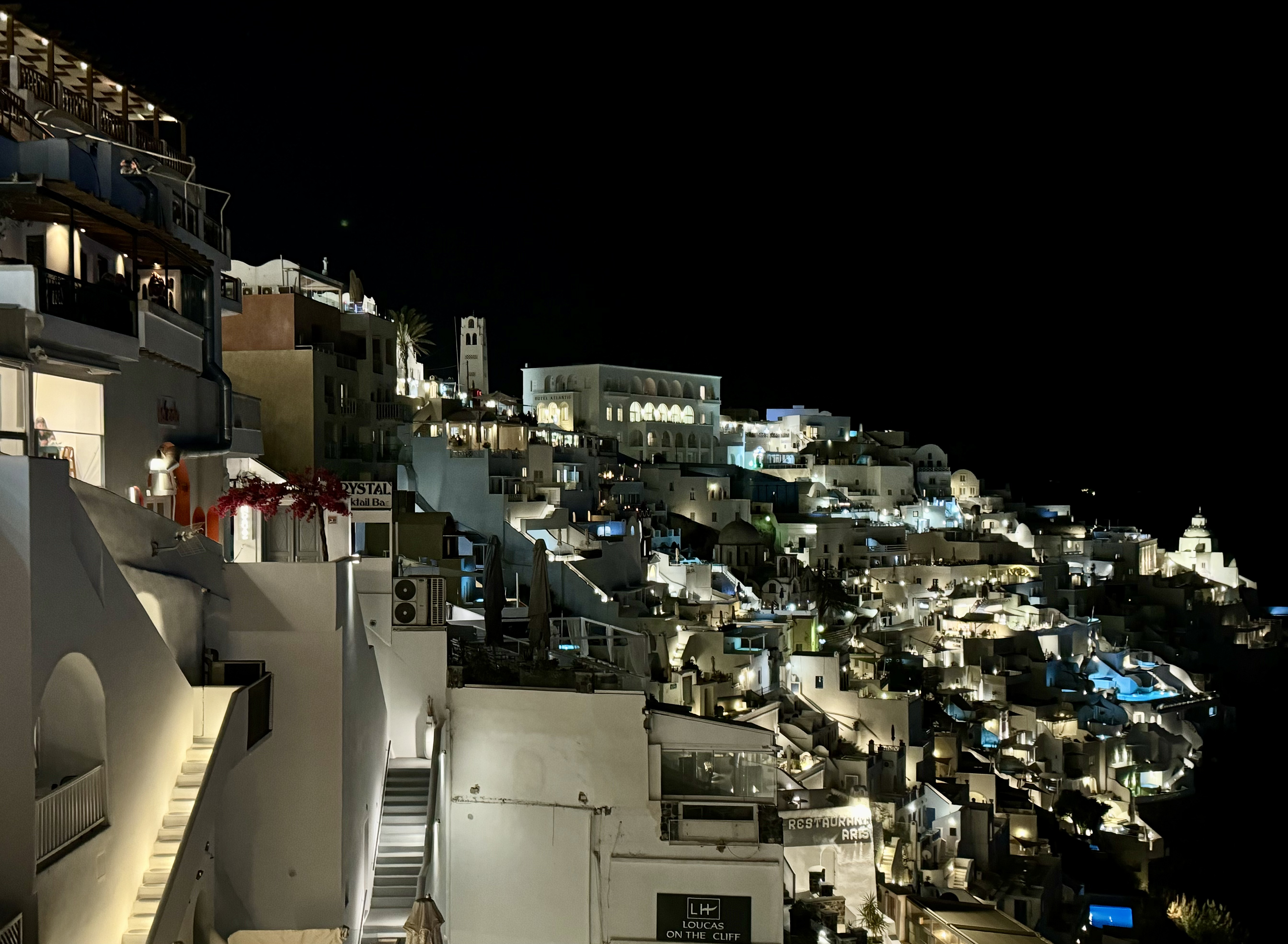
Millions from around the world visit each year. They clog the tight passageways, buy T-shirts with images of donkeys, and get fish pedicures. At sunset the day-trippers shuttle back to their buffet dinners, and leave the alleyways nearly empty.
The daily show is sensational. The view across the azure water of the caldera to the reddish-brown islands spackled with whitewashed cliff dwellings is breathtaking. Sunset daubs the horizon with pinks, peaches, and purples. The spectacle draws huge, appreciative crowds.

Dear Passengers
The next morning, we packed pastries from a local bakery, stepped carefully over the donkey droppings outside of our hotel, and headed uphill.
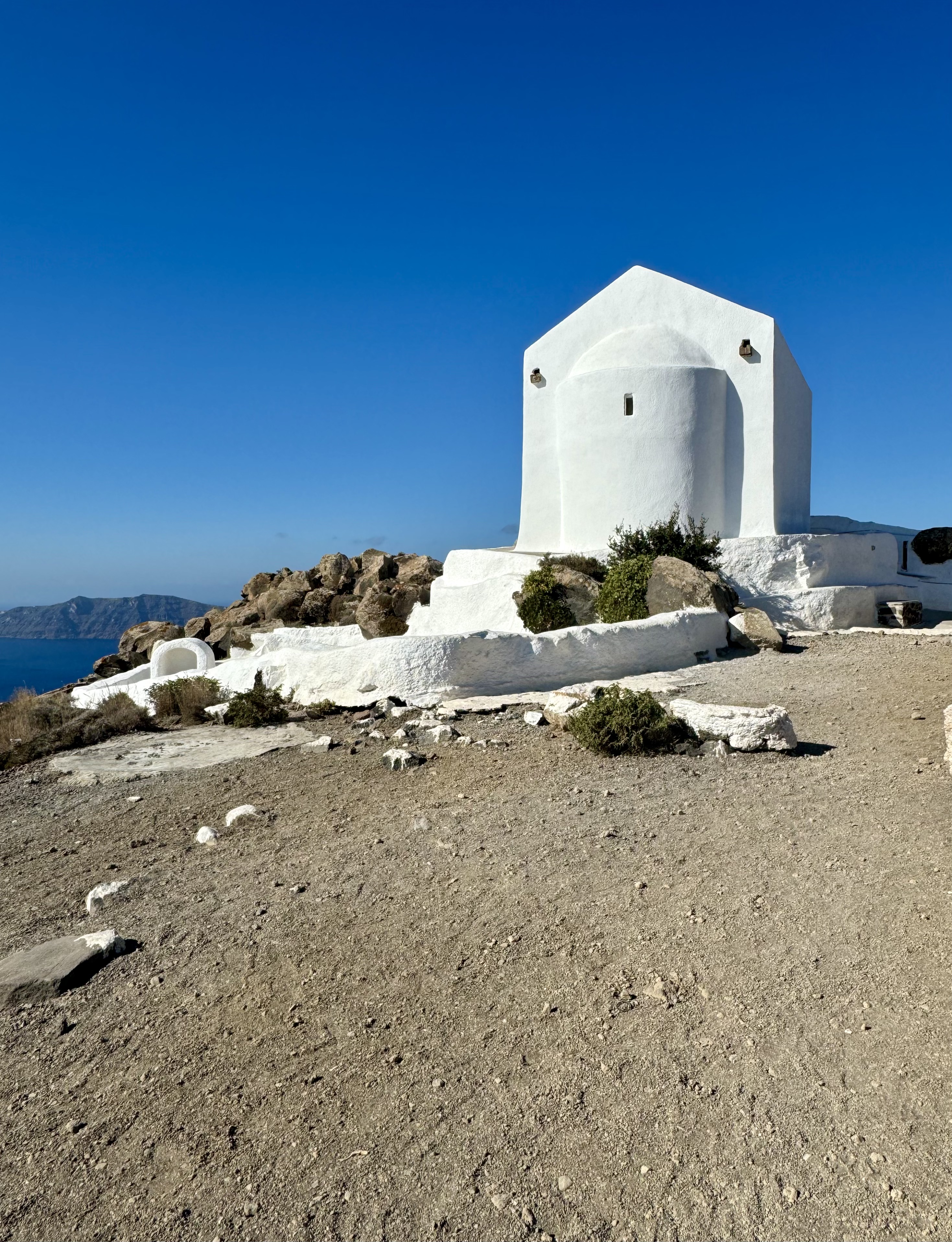
The village of Oia (pronounced EE ahh) is six miles from Fira. From that distance Oia resembles a snowcap. Its gleaming white buildings meld into a single mass on the mountain. The hiking trail to Oia follows the stony spine of the island, offering sea views on both sides.
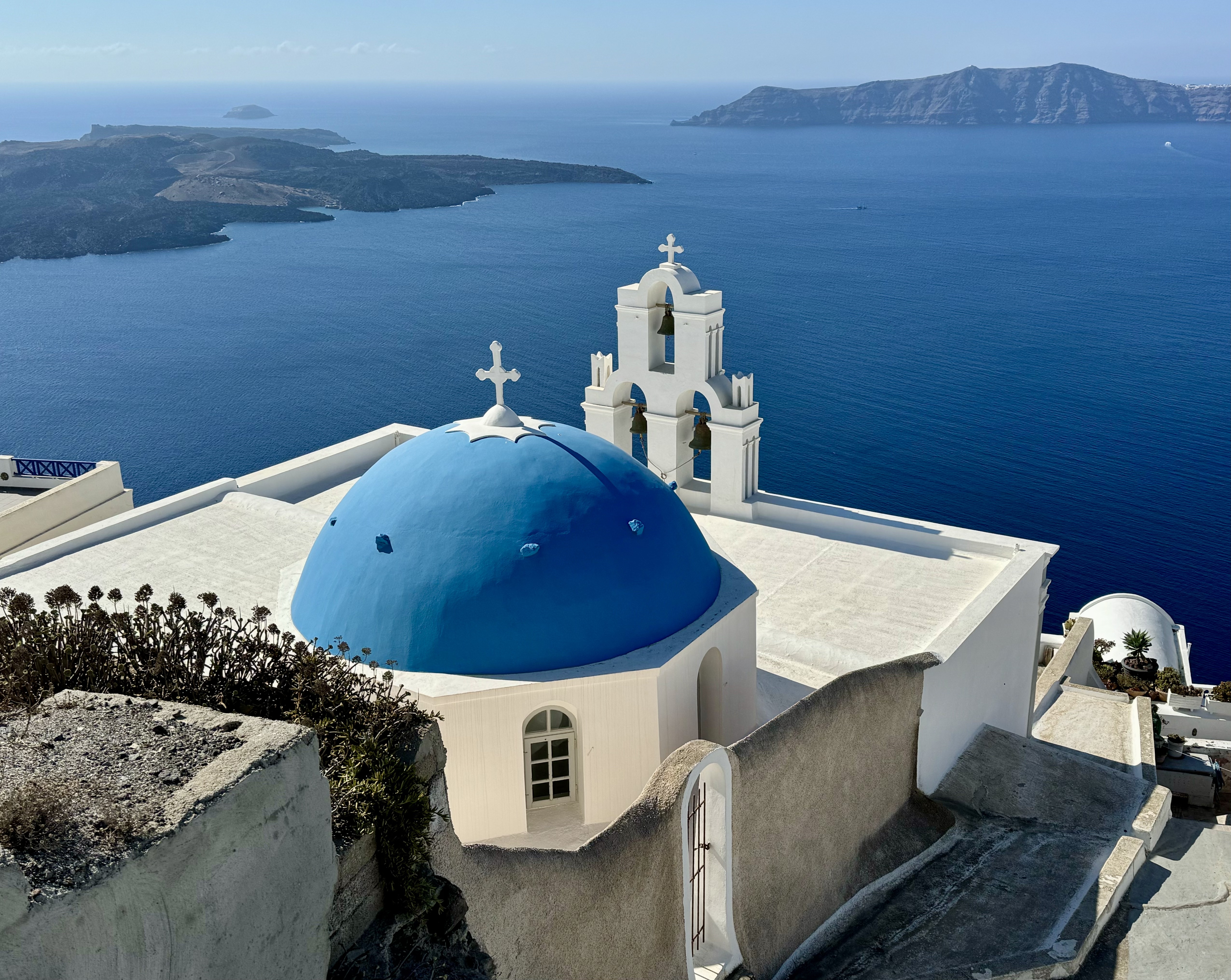
On the ridge, we passed numerous upscale spa-hotels with infinity pools, all of which were empty in the early morning.
The tiny villages of Firostephan and Imerivigli were sleeping in. Only cats and housekeepers were stirring.
Three hours later we strolled down the pedestrian-only street in Oia. The whitewashed buildings contrast perfectly with the village’s iconic cobalt-blue church domes. Oia’s windmills no longer grind flour. Built in the 1600s and 1700s, most of them have been refurbished as hotels.

Oia, like Fira, is a maze of narrow corridors that swell with tourists over the course of the day.
The village was once a bustling port, trading dessert wine with Russia for timber, grain, and fuel.
As in Fira, donkeys lugged cargo uphill from the harbor. The street is flagged with marble from Italy that was used as ballast on the Russian ships.
In the late afternoon I received a text from the ferry service we booked for the next day.
Dear Passengers, Kindly be informed that due to Hellenic Seamen’s Association strike your itinerary on 24/10 with the vessel Champion Jet 2 has been cancelled. Kind regards, SeaJets.
The sailors were on strike. It was not exactly a seafaring disaster of Odysseus proportions. If one must be marooned on an island, Santorini is not a bad option.

Still, I felt obligated to honor our hotel reservation on the island of Naxos.
I imagined every stranded tourist in Greece was scrambling to make alternative arrangements. We ran to the SeaJets office in town for advice, but they could do nothing but refund our tickets.
Somehow, Leslie managed to book an early morning flight from Santorini on Sky Express, an airline based on Crete. Wikipedia says Sky Express has twenty-seven planes. We needed only one.
Find us if you can
The airport terminal in Naxos is tiny with one ticket counter, one conveyor belt for baggage, and a waiting room the size of a bus stop. Like the airport, the island is laid-back.
At one-seventh the size of Rhode Island, Naxos is the largest and most agricultural of the Cyclades group. The rest of the archipelago depend upon it for fruit, vegetables, cheese, and honey.
Naxos was calm and uncrowded—a welcome break from Santorini.
Chora, the capital, has seven thousand inhabitants. Another twelve thousand are scattered around the island in small villages.
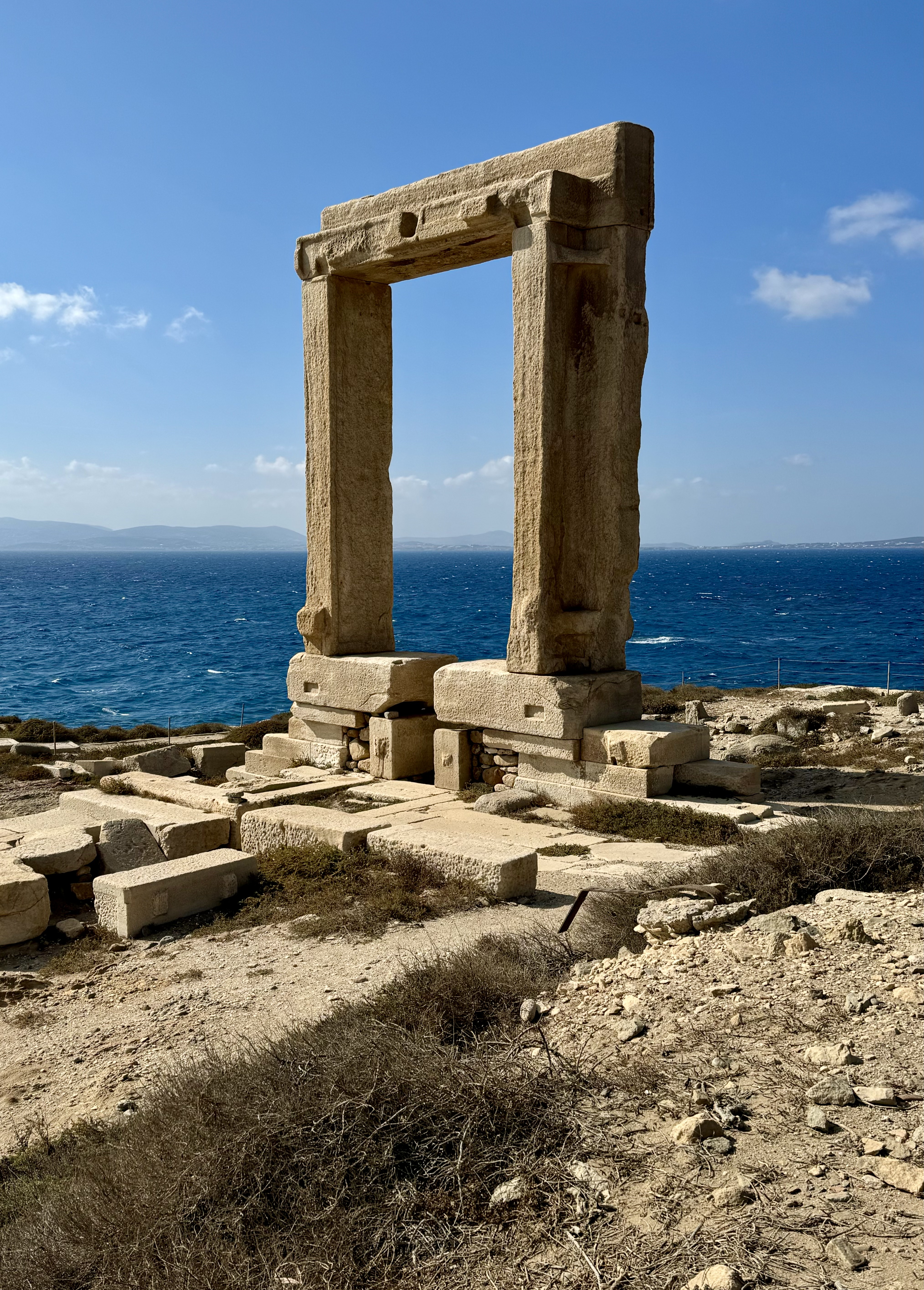
The Temple of Apollo sits on its own islet connected to Chora’s harbor via a causeway. Construction of the temple was started by the tyrant Lygdamis in 530 BCE. The work was interrupted by war and never resumed. Just two columns and a lintel remain—a giant picture frame on the horizon.
According to mythology, the site of the unfinished temple is where Ariadne, the Minoan princess, was abandoned by her lover Theseus after he killed the Minotaur on Crete. Apparently he was only interested in her ball of string.
In Chora the remnants of a Venetian castle loom above the waterfront. This was the seat of power for Marco Sanudo, who founded the town in the 1200s and declared it the capital of his realm. Inside the castle walls were a palace, the mansions of the nobles, and a cathedral.

While the Venetians lived safely inside the walls, the Greeks built their houses outside within a tangle of steep footpaths leading to the harbor.
Today the maze hides homes, shops, art galleries, courtyards, restaurants, and the neighborhood cats.
We enjoyed dinner at the aptly named Labyrinth, cloistered within the passageways. Their directional sign issues a challenge: Find us if you can.

Anniversary of no
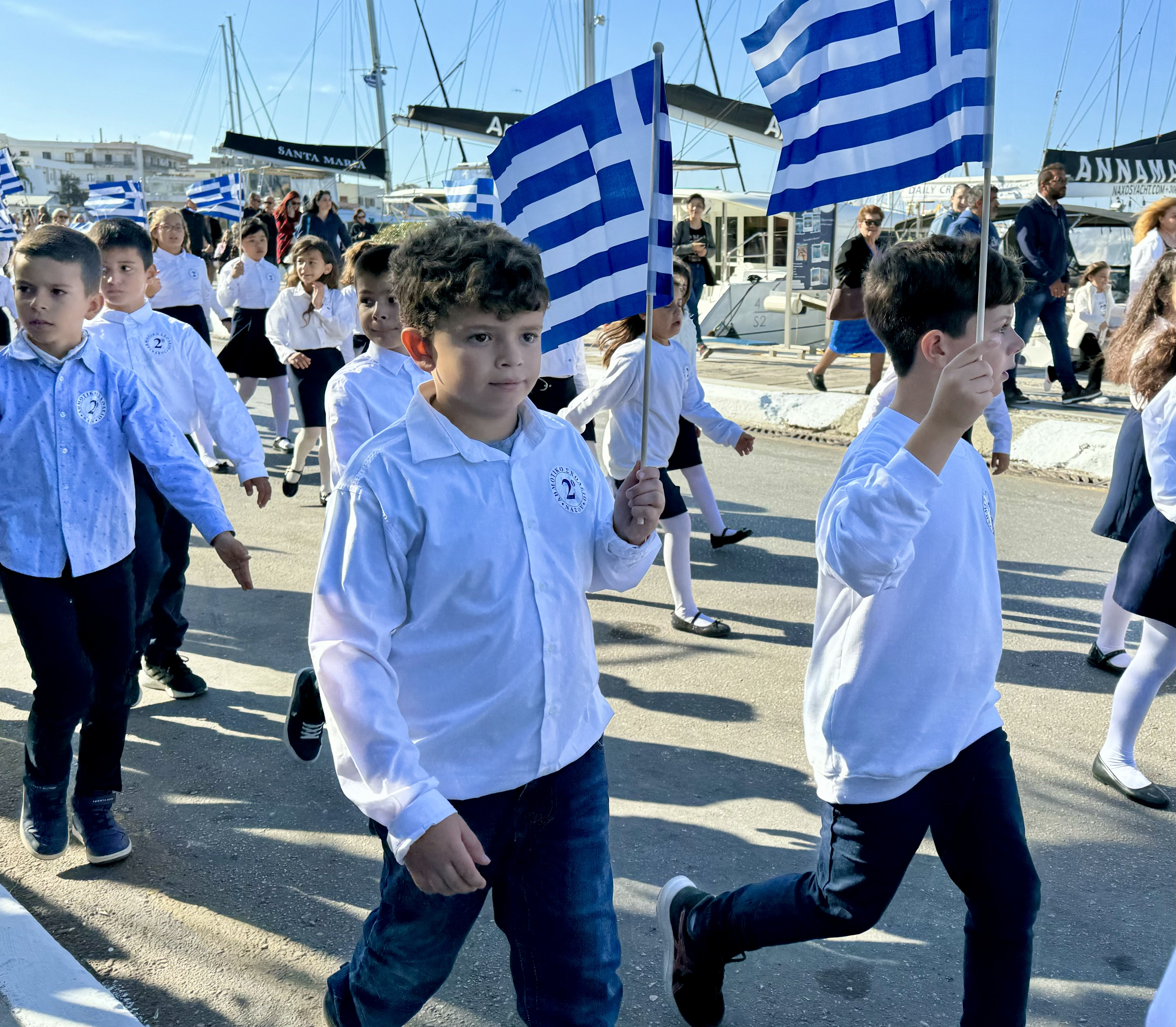
Down near the harbor the streets were closed. Buildings and lampposts were festooned in blue and white. We bought coffee and watched the parade.
Uniformed children marched past us, school by school, swinging their arms to the rhythm of drum corps and waving Greek flags.
Each October 28, Greeks celebrate the saying of the word ohi.
The tradition began in 1940 when an ultimatum from Italian dictator Benito Mussolini was delivered to Greek prime minister Ioannis Metaxas.
Mussolini demanded that Greece allow the Italian army to enter its country and occupy strategic ports and facilities.
As Europe edged toward World War II, nations were being forced to choose sides. Greece had hoped to remain neutral.
Italy’s ambassador delivered the written ultimatum to Metaxas at his home in the middle of the night. Metaxas’s response was pointed: “Then, it is war.” Newspapers paraphrased his statement in one word: ohi (no).
Within two hours of the rejection, Italian forces entered Greece through its border with Albania. The Greeks were caught off guard, but promptly rallied and pushed the Italians back across the border.

Mussolini was embarrassed. Hitler reluctantly sent German reinforcements. Although Greece provided the Allied forces with their first victory, the country was eventually overrun. Hitler blamed Mussolini’s “idiotic campaign in Greece” for his own failed campaign in Russia.
Ohi Day is also called the Anniversary of the No.
One-legged giant
We rented a Skoda and headed into the mountains to explore. The winding rural roads were little more than single-lane, making for some tight squeezes past oncoming traffic.

Our first stop was the village of Chalki, where the shops were just opening for the day. Clerks swept sidewalks while cats lounged in the morning sun. We enjoyed coffee and galaktoboureko, a custard pie made with layers of golden phyllo.
At one of the shops Leslie bought some homegrown lemon thyme and oregano packaged loosely in plastic bags that I doubted would pass customs. They did. We walked through a grove of ancient olive trees with massive trunks to find one of the town’s Byzantine churches, Saint Georgios Diasorites, built in the 1000s.

We visited the Vallindras Distillery, producer of Kitron, a liqueur made from citron leaves. Citron fruit looks like a huge, leathery lemon with a thick rind. However, the liqueur is made using the lemon-scented leaves.
The distillery was established in 1896 by the Vallindras family and is run by the fifth generation today.
On the way to Filoti, we passed Mount Zas (Zeus), the highest peak in the Cyclades. Both Crete and Naxos factor into the ancient god Zeus’s origin story. The Cretans claim he was born on Mount Ida. The Naxiots claim he was raised in a cave on Mount Zas. The cave is still accessible from the trail to the summit.
We parked in a weedy area off of the main road near the village of Melanes. There, behind a rock wall, we found the Kouros of Flerio, a giant statue lying unfinished on the ground.

A kouros is a sculpture of a boy. Some kouroi were created to be offered to the gods. Some were trophies; some tombstones.
The Kouros of Flerio is fifteen feet long and weighs over five tons. It dates to 570 BCE. The statue was roughed out with chisels in a nearby quarry. Apparently one of its legs broke while it was being moved.
The huge sculpture lies abandoned on the side of the mountain, as if waiting for medical evacuation.
This tour of Greece continues in the next post Golden Aging in Athens.
 YearTripper
As I recall, you were on Crete before this most recent. Was this most recent to see parts you had missed before? Where to next? Wasn’t Leslie with you on the Olympic peninsula in the U.S.? I now nominate you for the International Marco Polo award.
Finally, have you decided in what place you ultimately wish to spend your life, assuming you don’t intend to travel until you drop?
Bruce Hyslop
bruce@hysloplaw.com
Nice to hear from you, Bruce. Actually, this was my first time on Crete and first visit to Greece as well. Of course, with a couple of weeks there, I only scratched the surface, so I may have to return. Leslie and I visited Olympic National Park in 2021. See https://yeartripper.com/2021/06/16/olympic-proportions/ And I do intend to travel until I drop (or can’t).
Hi Kirk! Several years ago we went to Santorini and Naxos with our 3 daughters. Loved both but would probably only go back to Naxos. Did you go to the archeological excavation on Santorini? Second favorite memory of the island – after the view of the caldera. Favorite foods on Naxos were the fresh anchovies and the octopus. Along with the true Greek salads on both islands.
Hi, Scott, We didn’t make it to Akrotiri. Ran out of time, as we were island-hopping. If I would go to Santorini again, I would rent a car or taxi and visit the areas beyond Fira and Oia. And, yes, I enjoyed the fresh seafood throughout Greece.